










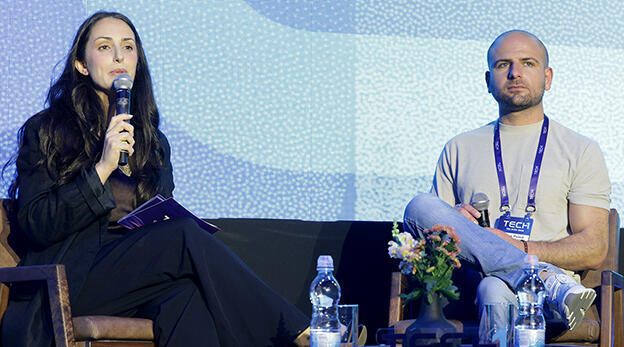
Guardio CEO: "We told employees it was time to learn new AI tools. Otherwise, we wouldn't survive."
Amos Peled recounted how an encounter with a young entrepreneur prompted him to halt the company’s existing plans and chart a new course: "We realized that without understanding AI and developing an instinct for how to use it, we had no chance."
“Those who are working today the same way they were a few months ago need to rethink their approach. It doesn't matter what your role is, whether you're an analyst, developer or designer. Everyone's role has changed. You need to build the tools and systems that will do the work you were used to doing,” said Amos Peled, founder and CEO of Guardio, at the TECH1 conference held today.
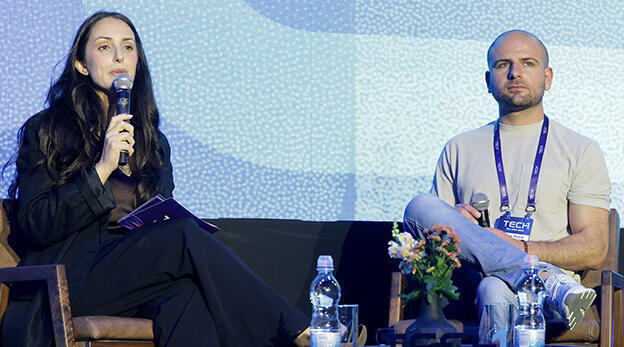
Peled spoke with Anna Pelkin, who leads TikTok Israel's business activities, about how AI is changing the way companies operate and what it takes to remain competitive.
He began by discussing the history of Guardio and his long-standing partnership with co-founders Michael Weinstein and Daniel Sirota.
“We've been working together since 2010,” he said. “We met during our military service in the cybersecurity unit at the Prime Minister's Office. Six years ago, we founded Guardio, bringing together our shared passion for cybersecurity and access management. We've been working together for almost 16 years and are very close friends. The personal and professional sides of our lives are intertwined. All three of us became fathers within two months of one another. We're lucky, and it's an amazing partnership.”
Peled then described a conversation in December 2025 that changed his understanding of how quickly AI was transforming the workplace.
“From time to time, I meet with other founders. In December 2025, I met an entrepreneur whose company was only a year old. Fifteen minutes into the conversation, I realized I didn't understand what he was talking about. He explained how his team was using AI models and applications such as Claude Code to accomplish tasks much faster with a much smaller workforce. I realized that we had become the old guard, struggling to understand what was happening.”
The encounter prompted an immediate response. “After the conversation, we canceled all our plans for the next two weeks. We had already built up momentum in our existing way of working, but we stopped everything and spent three weeks working with the technology, learning how to use it and developing an understanding of its capabilities. We realized that without understanding AI and developing an instinct for how to use it, we had no chance.”
A week after that intensive learning period, Peled said, the company took another decisive step.
“We halted the company's existing momentum and told employees it was time to learn these new tools. Otherwise, we wouldn't survive. It was a powerful moment.”
Today, he argued, the responsibilities of individual employees are changing fundamentally. Analysts can no longer limit themselves to producing insights, developers to writing code, or designers to presenting designs. Instead, employees must learn how to connect AI capabilities to the company's specific needs, building the systems and processes that allow the technology to deliver practical results.
Peled also stressed that technological innovation alone is not enough to build a successful company. Business development and the ability to reach customers must advance alongside the product.
“If we want to build a large, significant company, go-to-market strategies and growth engines are just as important as the technology itself,” he said. “The relationship between them is multiplicative. You have to excel at both. They are critical to the company's success, and one must play a significant role in both areas.”
In an AI-first world, where competitive advantages based solely on technology are becoming harder to sustain, distribution and go-to-market strategy are increasingly important, Peled added. He argued that Israel has a competitive advantage in this area because of its highly technical teams.



