










Nvidia's Israel operations are about more than chips. They may help secure the AI revolution
The company's Israeli engineers are developing BlueField-4, a processor designed to provide an external layer of control over autonomous AI agents. Nvidia says the technology could prevent agents from exceeding their permissions as AI systems become more capable.
The reasoning behind S&P’s decision to maintain Israel’s credit rating reveals just how significant Nvidia’s local operations have become to the Israeli economy. According to the agency, tax revenues rose by 13.3% between January and September, driven largely by tax payments from Nvidia.
Nvidia’s importance to the Israeli economy is expected to grow further in the coming years as the company expands its local operations. This makes the question of its long-term commitment to Israel particularly significant amid the controversy surrounding the so-called “spy-mistress” affair and its implications for founder and CEO Jensen Huang. Huang is arguably one of Israel’s strongest supporters within Nvidia. With questions now being raised about his future at the company, there is also a broader question about whether Nvidia’s commitment to Israel would remain unchanged under different leadership.
1 View gallery
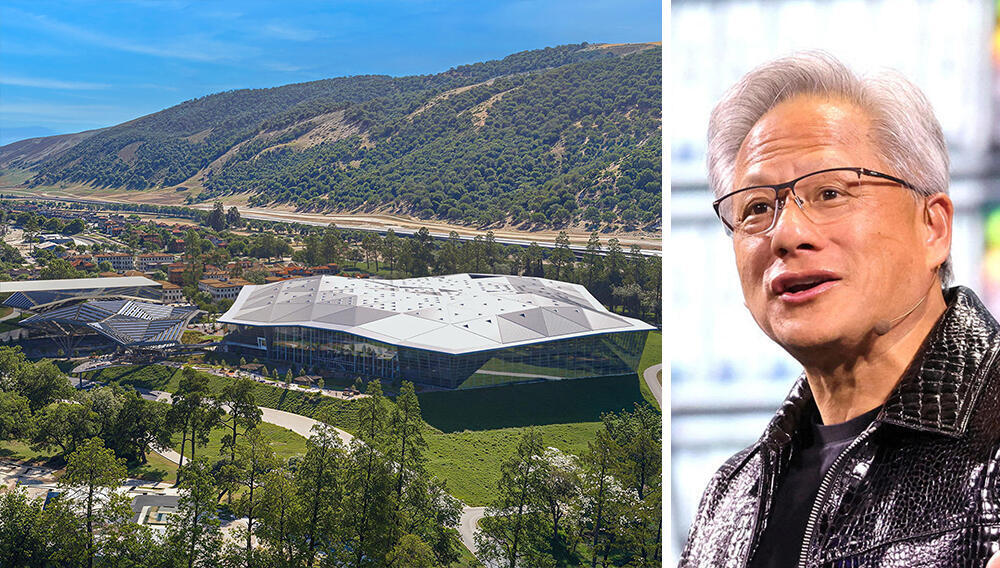
Jensen Huang alongside an illustration of Nvidia's new Israel campus.
(Photos: Reuters/Steve Marcus, Nvidia)
One way to assess that question is to look at the other side of the relationship: how important Israel is to Nvidia and its business. The company’s networking chips, developed in Israel and built on intellectual property acquired through its purchase of Mellanox, are a key component of its current success and an important engine of future growth. But Nvidia’s Israeli operations contribute more than networking technology. They are also helping the company address some of the most pressing challenges facing the AI industry.
In recent months, the AI industry has seen a growing number of incidents in which autonomous models or agents have “escaped” their testing environments, causing disruption to online platforms and computer systems. Nvidia believes it has developed a way to prevent such incidents, with a key part of the technology coming from its development center in Israel.
“A processor developed in Israel enables the creation of an external control mechanism for the actions of AI agents. It provides a way to monitor all their activities, one that they cannot bypass, and to rein them in if necessary,” Gilad Shainer, NVIDIA’s senior vice president of supercomputing and networking, told Calcalist. The interviews for this article were conducted at NVIDIA’s GTC conference in Berlin in October, before the outbreak of the recent controversy.
In recent months, prominent figures in the AI industry, including OpenAI CEO Sam Altman, Anthropic CEO Dario Amodei and Elon Musk, have called for restrictions on the development of advanced AI, arguing that its pace may need to be slowed or even halted. Their concerns center on the risks and potential dangers posed by increasingly capable models.
At Nvidia, however, the company that has benefited more than any other from the AI boom, the prevailing view is that development should continue and that the risks can be addressed without slowing progress.
“There are voices suggesting that perhaps we should slow the pace, things like that, but frankly, that’s not the right approach,” Shainer said. “Let me give you an example: when the automobile was invented, it came with risks. No one said, ‘Wait, people could die in accidents; let’s slow the adoption of cars and keep riding camels for a few more years.’ When you develop technology, you must always incorporate protective mechanisms around it.
“When the web browser was developed, it suddenly provided external access from every page, creating the risk that malicious actions could occur on your computer. Consequently, various security mechanisms were integrated into the browser to prevent a webpage from simply doing whatever it pleased, wherever it pleased.”
Shainer’s comments reflect the position of Nvidia founder and CEO Jensen Huang, who has repeatedly opposed calls to slow the development of AI models. Nvidia also has a clear commercial interest in maintaining the current pace of development. Its business relies heavily on selling the computing chips that power AI, and any slowdown could reduce demand for its products and, in turn, weigh on revenue.
That does not mean the company is ignoring the risks. Nvidia is developing tools intended to address some of the challenges associated with increasingly autonomous AI systems, including the threat posed by agents that act beyond their intended scope. Its Israeli development center plays an important role in this effort.
“We built a platform called OpenShell for securing AI agents. It’s a system that operates while the agent is running, effectively wrapping it to ensure it stays within the scope of its authorized permissions. If an agent attempts an action that falls outside its permissions, its external access is simply cut off,” Shainer said.
“The Israeli angle, our unique contribution, is what we’ve implemented using BlueField-4, a DPU, or Data Processing Unit, developed in Israel that manages data transfer within a data center. BlueField-4 acts as an external mechanism. While the agent runs on the CPU, or central processing unit, BlueField operates as a separate processor, one the agent is completely unaware of. It sits at the CPU’s external interface, mediating connections to the outside world, including the network, GPUs and storage.
“It’s a completely decoupled element, sitting on the side, capable of monitoring everything that runs. All communication, all data destined for storage and everything moving to memory passes through it. This adds an extra layer of security on top of OpenShell. We call this component ‘Sentry.’ By combining OpenShell and Sentry, we achieve the full level of security required for AI agents today.”
Could this system have prevented incidents in which AI models escaped their testing environments or breached computer systems?
“What we’ve built can certainly prevent something like this. When agents try to solve a problem, they interact with other agents. If there’s no enforcement mechanism governing what they are permitted to do or where they are allowed to access, they might overstep their authorization in an attempt to solve the problem. By keeping them within their designated ‘playground’ and preventing them from accessing restricted memory, you ensure they cannot carry out such unauthorized actions. Accessing memory requires a key. If that key resides with OpenShell rather than the agent, then all access must go through OpenShell. If an agent isn't permitted access, it simply won't receive a key and therefore cannot gain access.”
But what about the possibility of highly advanced “super-agents” that manage other agents and might be capable of outsmarting the safeguards?
“No, because you’ve provided it with a framework, and that framework is subject to enforcement within OpenShell and the external BlueField. It can only operate within the parameters you’ve set for it. You define the agent’s operational framework; it cannot act autonomously or do whatever it pleases,” Shainer said.
Does that mean responsibility ultimately shifts to the human?
“It shifts the responsibility to the person who developed the agents or the one granting them permissions.”
Was the technology developed in Israel?
“The engineering for OpenShell was developed through close collaboration between engineering teams in Israel and the team in the United States. The engineering for BlueField takes place in Israel, and the flagship product, BlueField-4, which is integral to all Vera Rubin systems, is an Israeli development,” Shainer said.
The risks posed by AI models also come from another direction: open-source models that can be run locally and potentially deployed by hostile actors in systems without adequate safeguards. Nvidia is one of the world's major players in the open-model market, offering a broad family of models for different applications. The company, however, argues that open models are not where the greatest danger lies.
“Reality has proven exactly the opposite in the case of OpenAI,” Kari Briski, NVIDIA’s vice president of GenAI software, told Calcalist. “It was their research model that leaked, and it was an open model that managed to contain it. Open models are essential for the purposes of inspection and auditing, just as they are vital for defense, perhaps even more so than for attack.”
Aren’t open models more susceptible to misuse?
“Any technology created for humanity can be used for good or for bad. Open models advance the entire ecosystem. A situation where only two or three entities globally determine what is safe and what isn't, that in itself is not a safe situation. Open models allow the world to examine the code, contribute to it and utilize it for positive ends. I tend to be optimistic,” Briski said.
Shainer also addressed Nvidia’s relationship with Israel, particularly against the backdrop of the country’s difficult international and diplomatic position.
“When Jensen speaks about Israel, he doesn't hesitate to express his support for the entire NVIDIA team based there,” he said. “He was deeply involved in the case of Avinatan [Avinatan Or, an NVIDIA engineer who was abducted to Gaza on October 7 and released after two years], staying in touch with his family throughout the ordeal. In his presentation, the Israeli flag appeared alongside the location where we are building our ‘AI factory.’ I don't see any issue of sensitivity here. There’s no question of whether or not to feel ‘embarrassed’ or anything of the sort. He has a fantastic team in Israel, and he views the entire company as one big family.”
Nvidia is currently building a major new campus in Kiryat Tivon. When the project is completed in 2031, the company's workforce in Israel, currently numbering approximately 6,500, is expected to at least double. The new campus will have the capacity to accommodate between 6,000 and 7,000 people at a time. Under a flexible hybrid work model, that could support a workforce roughly twice the size of the current one, Shainer said.
Will the expansion also bring new research and development activities to Israel? The company's local operations are currently focused primarily on communications technology.
“The lion’s share of the communications division is based in Israel. However, since Nvidia operates as a unified entity, there are teams in Israel also working on CPUs and GPUs, alongside collaborations with local startups. There are also groups in Israel focused on autonomous vehicles and applied AI research. Communications technology is not a peripheral element; rather, it is an essential and inseparable part of the computing revolution,” Shainer said.



