









The question marks behind Mobileye’s $900 million bet on Mentee
Why the acquisition of its founder’s robotics startup raises strategic and governance concerns.
The surprising deal to sell Mentee Robotics to Mobileye for $900 million further cements Amnon Shashua’s status as one of the richest professors in the world, with an estimated fortune of around $2 billion. He made most of his wealth through the IPO and subsequent sale of Mobileye to Intel for $15 billion, but also through companies he founded, including AI21 and OrCam. The major stakeholder deal announced on Tuesday night at the annual CES show in Las Vegas may not dramatically alter his standing, but it still adds another billion shekels to his fortune.
Shashua, founder, CEO, president and director of Mobileye, is also the founder, chairman and largest shareholder of Mentee. Holding 37.8% of the robotics company, his stake alone is worth $341 million in the transaction. Not all of it will be paid in cash, but the majority, $612 million of the $900 million consideration, will come in cash from Mobileye’s coffers, with the remainder paid in shares. Mobileye’s stock jumped sharply following the announcement, though much of the gain was later erased.
1 View gallery
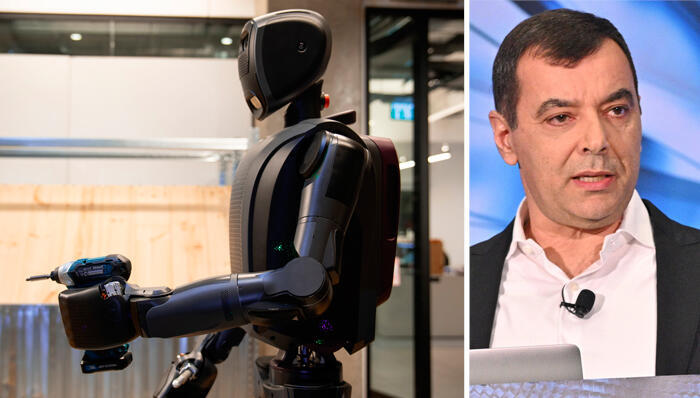
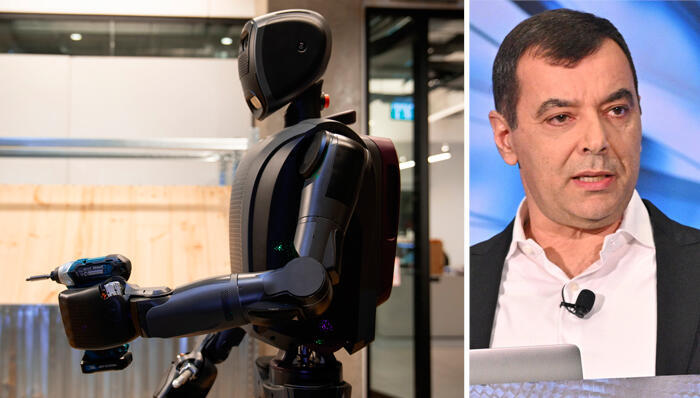
Amnon Shashua (right) and Mentee robot.
(Photos: Walden Kirsch/Intel Corporation and Mentee)
At the same time, Shashua’s holding in Mobileye itself will increase from about 1% to roughly 2% through the receipt of restricted shares, some of which will be locked up for five years, a mechanism designed to retain him and other senior Mentee executives. Based on Mobileye’s current market valuation of roughly $10 billion, that additional stake is worth close to another billion shekels.
Had Mobileye been traded in Tel Aviv rather than New York, the deal would likely never have gone through. In Israel, such a transaction, clearly involving a controlling interested party, would almost certainly have been blocked by institutional investors. Here, Shashua stands on both sides of the deal, selling a revenue-free company just four years after its founding and after its most recent funding round valued it at slightly over $100 million.
On Wall Street, however, sensitivity to such conflicts is far lower, as reflected in the market’s initial enthusiasm for the deal. Much of the AI revolution is built on circular transactions: Microsoft invests in OpenAI, which in turn buys Microsoft’s cloud services; Nvidia invests in OpenAI or Anthropic, which then purchase its chips. The Mobileye-Mentee transaction fits neatly into that pattern.
Moreover, Shashua is clearly inspired by Elon Musk, who, alongside Nvidia CEO Jensen Huang, is promoting the vision of “physical AI”: robots powered by artificial intelligence. Musk has explicitly tied this vision to Tesla’s future valuation. When he recently sought approval for an extraordinary compensation package potentially worth hundreds of billions of dollars, he argued that most of Tesla’s future value, projected at $25 trillion, would come from robots rather than cars, referring specifically to Optimus, Tesla’s humanoid robot. If Musk’s logic holds, then Mobileye shareholders may have secured a rare bargain by paying “only” $900 million.
Mobileye’s move, and Shashua’s role in it, should be examined from several angles. From a procedural standpoint, everything was done by the book. In the U.S., post-Enron and WorldCom regulation has created a rigid framework designed to manage conflicts of interest. Although Mobileye is a public company, 85% of its shares are owned by Intel, which acquired it in 2016 and re-listed it in New York in 2022. Mobileye’s board, where Intel has significant representation, established a strategy committee to examine multiple robotics companies and determine an appropriate acquisition target and valuation. McKinsey was also brought in as an external adviser. Shashua formally recused himself from all discussions and decisions related to the deal. Nonetheless, the preferred candidate turned out to be his own startup.
1. Does Mobileye Need a Robotics Bet?
The first question is why Mobileye, whose core business is autonomous driving, feels an urgent need to acquire a robotics company, an exciting but still immature field. At present, no company is selling humanoid robots at scale. Even the most prominent players, including Tesla’s Optimus and Figure AI, which recently raised $1 billion at a $39 billion valuation, are still at the demonstration and pilot stage.
Shashua argues that Mobileye needs a new growth engine, and the data support that view. Founded in 1999, Mobileye helped define the vision of autonomous driving, but full autonomy has been repeatedly delayed. Today, the company remains heavily dependent on driver-assistance systems (ADAS), which generate roughly $2 billion in annual revenue and positive cash flow. That cash has built a war chest of around $1.7 billion, enabling the Mentee acquisition. But competition in ADAS is intensifying, pricing pressure is growing, and margins are eroding.
Mobileye disclosed on Wednesday that it has an order backlog of $24.5 billion over the next eight years, but the bulk of it still comes from ADAS rather than fully autonomous systems. This year is expected to mark the first commercial deployment of autonomous taxis based on Mobileye’s technology, yet the company has already been overtaken by Waymo in that market. Shashua appears to have convinced the board that incremental progress is no longer enough.
The acquisition of Mentee is meant to reposition Mobileye as a “physical AI” company, a term coined by Huang, spanning autonomous vehicles, humanoid robots, and non-humanoid robotic systems. While the connection between cars and robots may not seem obvious, an autonomous vehicle is, in effect, a robot on wheels.
Advances in AI are rapidly collapsing the distinction. Tesla, for example, uses similar chips and algorithms in both its vehicles and Optimus. Path-planning algorithms that prevent a car from crashing are closely related to those that allow a robot to place its foot without falling. The key difference is environmental structure: roads are standardized, while homes and workplaces are not. Industrial environments, however, sit somewhere in between.
Mobileye estimates that it could begin selling humanoid robots as early as 2028. The strategy is not just technological, integrating chips and software, but also commercial. Mobileye already sells to car manufacturers and suppliers, many of whom face acute labor shortages in factories and logistics centers, creating a natural customer base for industrial robots.
2. Why Not Build In-House?
Mentee currently employs fewer than 100 people, including Shashua’s son and son-in-law, neither of whom holds a senior role. Employees will share $50 million in retention bonuses and receive additional stock options worth tens of millions of dollars. Given that Mentee has raised only about $38 million across two funding rounds, the return for shareholders is extraordinary.
If robotics is truly strategic, why didn’t Mobileye simply build an internal division? Even accounting for the high cost of talent, assembling a team would likely have cost far less than $900 million. Moreover, Mentee’s co-founder Shai Shalev-Shwartz is already Mobileye’s chief technology officer.
Just a month ago, Mobileye laid off 200 employees as part of a streamlining effort. Some of that talent could presumably have been redirected. The fine print of the acquisition also notes that Mentee will continue to operate as a separate unit and that the deal will slightly reduce Mobileye’s operating margin.
3. Is Mentee Worth $900 Million?
Whether Mentee justifies its near-billion-dollar price tag remains an open question, even for Mobileye’s board and Goldman Sachs, which advised on the deal. According to Shalev-Shwartz, commercial sales could begin in 2028, through either direct purchases or leasing models with service contracts. For now, pricing and market size remain speculative.
The valuation is also not final in economic terms. Mentee shareholders, including Shalev-Shwartz (13%, worth $118 million), Israel’s 10D fund, Cisco’s investments arm, and U.S.-based Ahren, will receive 26 million Mobileye shares. Many investors believe Mobileye itself is undervalued, trading at a sales multiple of around four, partly due to Intel’s 85% ownership stake, which limits liquidity. Any future reduction of Intel’s holding could send Mobileye’s stock sharply higher, retroactively inflating the value paid for Mentee.
Shashua dismisses the criticism. “The only question that needs to be asked is whether acquiring Mentee is good for Mobileye,” he told Calcalist. “The fact that I make money along the way is not what’s important, someone has to make a profit in these deals. For Mobileye, entering humanoid robotics is a natural step. There is deep technological and operational synergy. The overlap in AI infrastructure, production capabilities and customers is substantial. In the future, there will be millions of robots doing industrial jobs.”



