










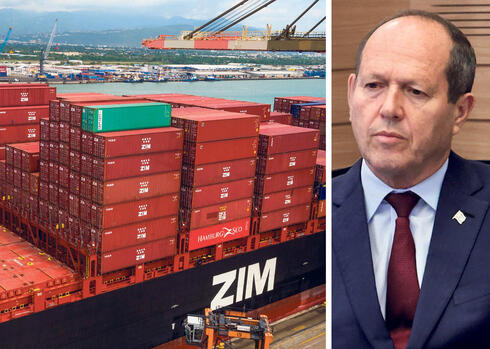
Barkat opens the door to approval of $4.2 billion Zim sale
The Economy Ministry had objected to the deal, but the minister has instructed officials to hold a new meeting with Hapag-Lloyd and FIMI.
There has been a shift in the government’s position on the proposed sale of Zim. Economy Minister Nir Barkat has become convinced, contrary to the position previously formulated by the professional staff at the Ministry of Economy, that the deal can be approved and that its execution would benefit the state.
Calcalist has learned that Barkat’s position took shape following a meeting he held with FIMI CEO Ishay Davidi at Davidi’s request, against the backdrop of changes made to the deal’s structure by Hapag-Lloyd and FIMI last Thursday. The German shipping company and FIMI signed an agreement last February to acquire Zim for $4.2 billion.
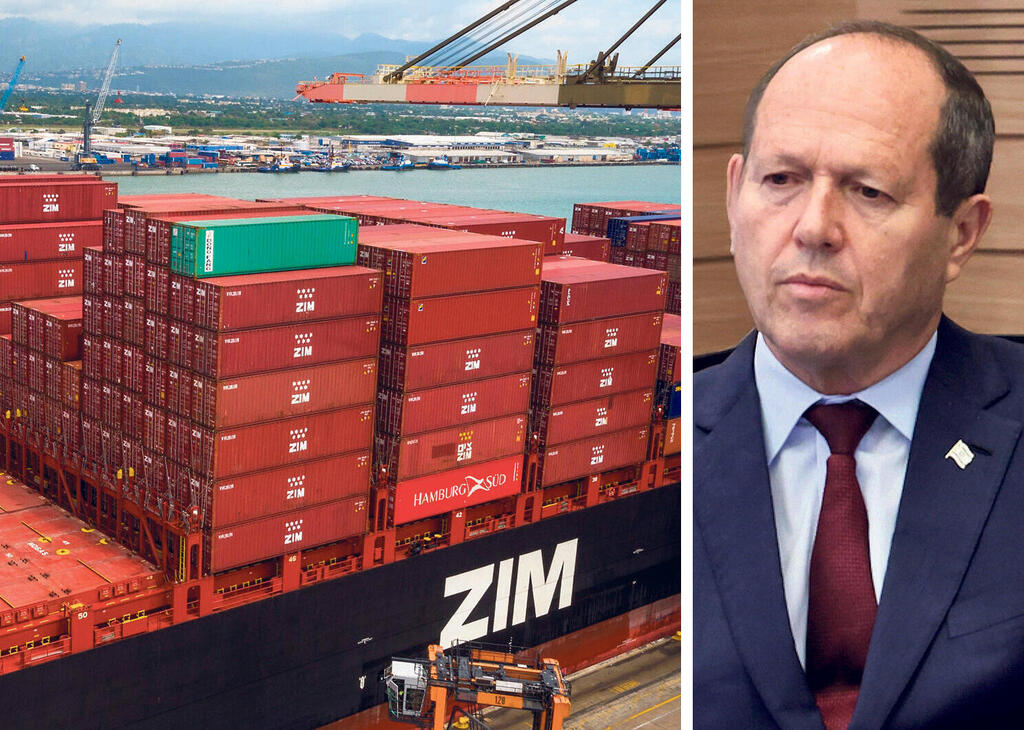
The state’s “golden share” in Zim mandates Israeli ownership and imposes additional conditions on the company. FIMI is expected to assume these obligations by establishing a new entity, Zim Israel. The new company would be significantly smaller than the current Zim, owning 12 vessels and chartering four, compared with the 99 vessels Zim currently operates.
Barkat has instructed the Ministry of Economy’s professional staff to hold a follow-up meeting with representatives of Hapag-Lloyd and FIMI. The meeting is scheduled to take place after the Sukkot holiday, when the German company and FIMI will present their arguments in favor of the deal. If the professional staff is persuaded, it could pave the way for the Ministry to adopt an official position that differs significantly from its initial stance.
In May, the Ministry of Economy objected to the deal, joining objections previously raised by the Ministries of Agriculture and Transportation. The professional body handling the matter within the Economy Ministry is the Foreign Trade Administration, headed by Roey Fisher.
In an opinion issued in May, Fisher wrote that “the emerging sale structure poses a direct risk to maritime traffic and to Israel’s economic and strategic interests. The bulk of Zim’s operations is being transferred to a German shipping giant partially owned by nations that do not maintain diplomatic relations with Israel (Qatar and Saudi Arabia), while local operations are being isolated within a new entity (Zim Israel). Although this new entity remains under Israeli ownership, it lacks the profitable asset base required for economic survival beyond a few years. This is a corporate maneuver that effectively hollows out the State’s 'golden share,' jeopardizing the national interests it was designed to protect. Splitting Zim into two companies raises concerns that the proposed structure creates a crippled entity, incapable of sustaining itself commercially or operationally.”
Barkat himself adopted the professional echelon’s position at the time, primarily because of his opposition to any ties between Israel and Qatar, a position he has consistently voiced within the government.
Davidi, who is conducting an intensive campaign to secure approval for the deal, argues that Zim is currently far more exposed to Qatari and Saudi involvement because it has no controlling shareholder. Under the current structure, he argues, investors from countries that do not have diplomatic relations with Israel could freely purchase up to 24% of Zim’s shares on the stock exchange before being required to disclose their holdings. Under the Hapag-Lloyd deal, Davidi says, Zim would be less exposed to such a scenario.
Barkat, however, received only partial answers on several other issues during the meeting.
One concerns employee layoffs. Approximately 200 Zim employees are expected to leave as part of the acquisition. Davidi told Barkat that the severance terms offered to the employees would be generous and pledged that the issue would be resolved. Barkat accepted the argument and, according to people familiar with the matter, the layoffs are not expected to be grounds for his opposition to the deal.
Another issue concerns security. Following a meeting with relevant professionals, primarily officials at the Director of Security of the Defense Establishment (Malmab), Barkat became convinced that the sale to Hapag-Lloyd and FIMI would not pose a security risk and that the new Zim would meet Israel’s security needs.
A separate concern is the relatively small size of the new company. The Zim acquisition is taking place amid a broader consolidation trend in the shipping industry, in which large companies acquire mid-sized operators, which in turn acquire smaller ones. Davidi argues that Zim’s smaller size could actually be an advantage, although Barkat remains unconvinced and has requested additional data on the issue.
Another point concerns Hapag-Lloyd’s commitment under the agreement to provide financial backing to Zim for 10 years. The current agreement does not include guarantees beyond the 10-year period, and FIMI and Hapag-Lloyd will also be required to provide assurances regarding the company’s longer-term financial stability.
Barkat also spoke with Zim’s workers’ union, which strongly opposes the deal, as well as with the Shipping Authority. He formed the impression that much of the opposition stems from the fact that a major Israeli company is being sold and from expectations of layoffs.
In response, Barkat argued that there is no inherent impediment to selling a large Israeli company as a business transaction, provided that the country’s security needs are protected. If employees are offered favorable terms, and some are reportedly interested in accepting them, he does not believe that this should prevent the deal from going ahead.
“As long as security interests are not compromised, and are even enhanced, and conditions are dramatically improved alongside fair treatment of employees, there is no impediment to selling an Israeli company,” Barkat told Calcalist in response.
Davidi also sought to reassure Barkat by pointing to his record as an owner of companies employing a total of 60,000 people in Israel. He said he had never encountered problems with employees or security agencies regarding the defense companies he owns. He also assured Barkat that Zim had met security requirements during recent wars and would continue to do so.
Barkat’s position is likely to generate controversy, given that other ministers and government ministries controlled by Likud have opposed, and continue to oppose, the deal.
Eight government bodies are scheduled to submit their positions to the Government Companies Authority by the end of the month, after which the authority is expected to make a decision. If the various government bodies fail to reach agreement, as currently appears likely, the matter will be brought before the cabinet, which will make the final decision.
It is possible that the process will not be completed until after the elections, potentially under a transitional government.



