










Nvidia in advanced talks to acquire AI21 in $2-3 billion deal focused on talent
EXCLUSIVE: The move would mark Nvidia’s fourth major Israeli purchase and signal the limits of Israel’s LLM ambitions.
Chip giant Nvidia is in advanced talks to acquire AI21 Labs, one of the few Israeli startups developing a large-scale language model for artificial intelligence, Calcalist has learned. According to estimates, the deal could be valued at $2-3 billion, up from AI21’s last known valuation of $1.4 billion, set during a fundraising round completed in 2023.
According to reports, AI21 completed a $300 million fundraising round earlier this year led by Nvidia and Google. The company never officially confirmed the round, however, and its valuation was not disclosed. Estimates at the time suggested that the valuation had not risen significantly compared with the 2023 round.
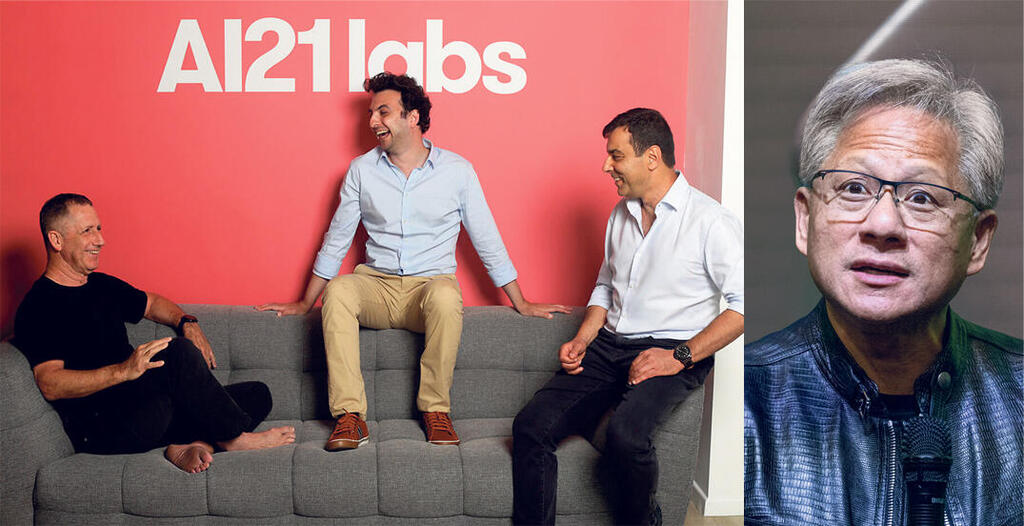
AI21 has long been considered “on the shelf,” with Google also previously exploring a potential acquisition. In recent weeks, however, talks with Nvidia have advanced significantly and have reached the most senior levels. Nvidia’s primary interest in AI21 appears to be its workforce of roughly 200 employees, most of whom hold advanced academic degrees and possess rare expertise in artificial intelligence development.
Such a transaction would effectively provide Nvidia with a fast-track expansion of its AI talent base in Israel, at an implied cost of roughly $10-15 million per employee. While this reflects strong international demand for Israeli AI talent, it also underscores a retreat from AI21’s original ambition to compete directly with leading AI model developers such as OpenAI or Anthropic.
If completed, the deal would resemble an acquihire, focused primarily on talent rather than technology. For Nvidia, this would mark its fourth significant acquisition in Israel and its second-largest after the $7 billion purchase of Mellanox. In 2023, Nvidia also acquired Deci and Run:ai for a combined $1 billion.
AI21 was founded in 2017 by Professor Amnon Shashua, Professor Yoav Shoham, and Ori Goshen, and was initially seen as a flagship effort to place Israel at the forefront of artificial intelligence, years before the generative AI boom that began in 2022. Shoham, a leading AI researcher at Stanford University, and Goshen serve as co-CEOs, while Shashua is chairman. Nvidia and Google first invested in AI21 in the company’s 2023 fundraising round, which was completed and later expanded during the war in Israel.
Over the past two years, however, AI21 has struggled to keep pace with the rapid advances of the industry’s leading players. In April, the company halted development of Wordtune, its long-running consumer-facing product for AI-assisted writing and reading. Today, AI21 focuses primarily on specialized language models aimed at enterprise customers, where accuracy and reliability are critical and the tolerance for error is far lower than in consumer applications.
The company’s flagship enterprise product, Maestro, is designed to improve language-model accuracy by up to 50%. In recent months, AI21 has also introduced a new reasoning model that it says is faster and more efficient than competing systems, reducing memory consumption. Despite these efforts, estimates suggest the company’s annual revenue remains modest, at around $50 million, far below the multibillion-dollar revenues generated by leading AI competitors.
Nvidia, meanwhile, is facing growing competitive pressure following advances in Google’s TPU chips, which are increasingly positioned as alternatives to Nvidia’s GPUs for AI workloads. Last weekend, Nvidia reportedly made a far larger move by acquiring the founder and staff of chip startup Groq for $20 billion, gaining access to technology developed by engineers who previously led Google’s TPU efforts.
An acquisition of AI21, relatively small by Nvidia’s standards, given its roughly $60 billion cash position, would further extend CEO Jensen Huang’s expansion strategy in Israel. Earlier this month, Nvidia announced plans to build a massive campus in Kiryat Tivon, expected to house up to 10,000 employees by 2031. Nvidia currently employs about 5,000 people in Israel, including roughly 3,000 in Yokneam, the former headquarters of Mellanox. The company also maintains large offices in Tel Aviv and plans to significantly expand its presence in Be’er Sheva.
For Shashua, a sale of AI21 would mark a more muted outcome compared with the $15 billion sale of Mobileye to Intel in 2016. At the same time, he is already deeply engaged in a new AI venture, AAI. The startup recently raised hundreds of millions of dollars in a funding round led by Lightspeed, achieving unicorn status less than two years after its founding.
AAI focuses on what Shashua describes as the most forward-looking area of artificial intelligence: reasoning and “thinking” models, rather than conventional training and inference systems. The company was founded by Shashua together with Professor Shai Shalev-Shwartz, who also serves as Mobileye’s chief technology officer, along with several former doctoral students and researchers from fields including computer science, mathematics, physics, and biology.
As Shashua has written, the company’s goal is “to bring about a new era of discovery by developing the code for superintelligence.”
AI21 declined to comment. Nvidia had not responded by the time of publication.



