











Intel to acquire Israeli quantum startup Classiq for $2.3 billion
The deal marks a record acquisition in the quantum computing industry and a major exit for Israel’s tech sector, with Classiq’s founders, employees and early investors poised for substantial returns.
The first major exit for Israel’s quantum industry: Classiq, a developer of operating systems for quantum computers, is being acquired by Intel for $2.3 billion in a combination of cash and stock. The deal would make Classiq the most expensive quantum company acquisition to date, by a significant margin. The previous record was set last year, when IonQ acquired Oxford Ionics for $1 billion.
The transaction also marks a major acquisition for Intel, which paid approximately $1 billion for Israeli mobility company Moovit six years ago and $2 billion for Habana Labs a year earlier. Intel has made other acquisitions since then, including the Israeli company Granulate, but those deals were valued in the hundreds of millions of dollars. Intel has not acquired another Israeli company since the Granulate deal in 2022.
1 View gallery
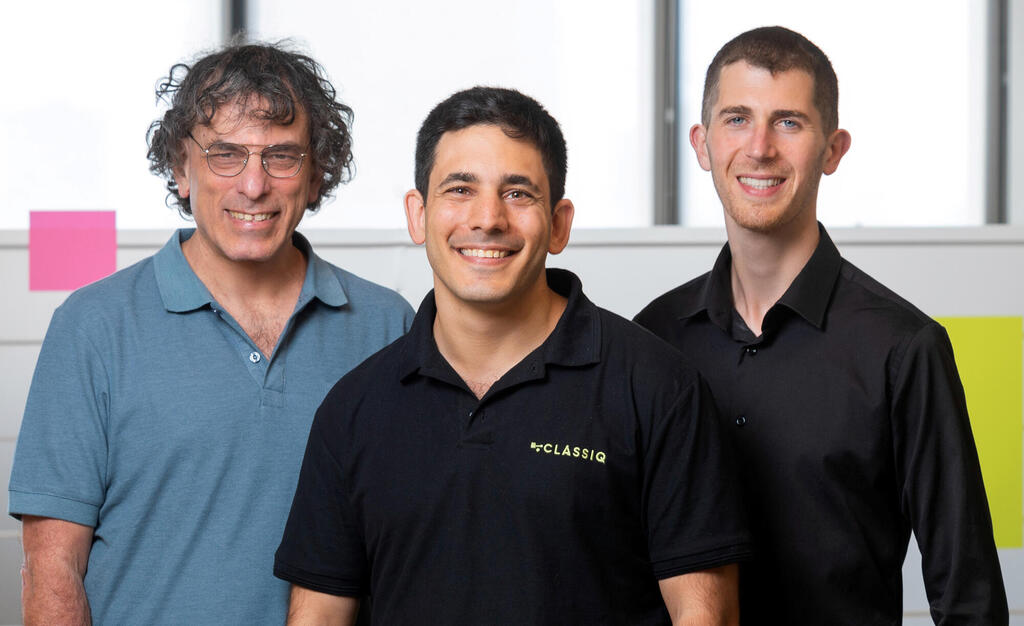
Classiq founders Nir Minerbi, Amir Naveh and his father, Prof. Yehuda Naveh.
(Photo: Eyal Toueg)
For Israelis accustomed to multibillion-dollar exits in cybersecurity, $2.3 billion might not seem particularly large. In quantum computing, however, it represents a landmark deal. Despite the excitement surrounding the field, quantum computers have yet to achieve widespread practical commercial use. There are currently only 117 quantum computers worldwide, and they remain prohibitively expensive and largely inaccessible.
Quantum computing has shown promise for decades, and the field has recorded several significant breakthroughs over the past two years. Yet it has not experienced its own “ChatGPT moment,” a breakthrough that would bring the technology into widespread use.
Despite its small size, Israel is considered one of the world’s five leading countries in quantum computing, both in the number of companies operating in the field and in the volume of private investment. Intel’s acquisition of Classiq for more than $2 billion could draw greater investor attention to Israel and provide another catalyst for the development of its quantum industry.
The deal recalls Intel’s acquisition of Mobileye, the autonomous-driving company founded by Amnon Shashua, a decade ago. That transaction helped trigger a wave of investment in Israeli companies in the sector. The hope is that Classiq’s exit will have a similar effect, with even better long-term results for the industry.
For Classiq’s founders, employees and investors, the acquisition represents an impressive exit for a company founded just six years ago. Classiq currently employs around 150 people. Employees collectively hold 10% of the company’s shares, equivalent to $230 million at the acquisition price, although the proceeds will vary among individuals. Intel has also allocated more than $100 million in retention grants to encourage employees to remain with the company.
Classiq was founded by Nir Minerbi, Amir Naveh and his father, Prof. Yehuda Naveh. Minerbi is the CEO, Amir Naveh is the CPO, and Yehuda Naveh is the CTO. Minerbi and the younger Naveh are graduates of the Israel Defense Forces’ Talpiot program, as are many of the company’s employees. Yehuda Naveh previously held a senior position at IBM’s Israeli development center. Each of the three founders is expected to receive between $80 million and $100 million from the deal.
Classiq generates revenue, but its annual revenue remains in the tens of millions of dollars, well below an annual run rate of $100 million. The acquisition price therefore represents a substantial valuation multiple for a relatively young company.
Classiq occupies a distinctive position in the quantum computing industry. It develops software that serves as an operating system for quantum computers, bridging the gap between complex hardware and the people and organizations seeking to use it. The company’s ambition is to become the “Windows” of quantum computing.
IBM, a pioneer in quantum computing, is its main competitor. Estimates suggest that Classiq has already surpassed IBM in market share, although the companies’ positions depend on how that market is measured. Classiq’s software is hardware-agnostic, meaning it is designed to work across different quantum computing platforms rather than being tied to a single manufacturer.
Its customers span several industries, including banking, automotive and pharmaceuticals. They include BMW, Rolls-Royce, HSBC, Deloitte, Toshiba and Citi.
Classiq has raised approximately $200 million to date, making the acquisition a profitable outcome for its investors as well. Its most recent funding round, a $110 million raise in 2025, valued the company at an estimated $600 million to $700 million, far below the acquisition price.
Entrée Capital, which led Classiq’s pre-seed round and is its largest shareholder, stands to gain the most. The fund is expected to receive more than $300 million on an investment of just a few million dollars. Team8 Capital, the company’s second-largest shareholder, holds a 9% stake.
The deal is also expected to benefit Israeli savers through The Phoenix, which holds a 7.5% stake in Classiq. Unlike many recent Israeli technology exits, most of which have involved cybersecurity companies, Classiq is incorporated in Israel. The state is therefore expected to collect tax revenue from the transaction beyond the taxes paid by founders and employees who sell their shares.
However, because a significant portion of the consideration is in Intel stock, not all the proceeds will be realized immediately in cash.
One of Classiq’s private investors is Lip-Bu Tan, Intel’s current CEO, who has led the chipmaker’s turnaround over the past year and a half. Tan invested in Classiq personally before becoming CEO of the company now acquiring the startup. According to sources close to Classiq, he recused himself from discussions concerning the acquisition.
Other notable investors include NightDragon, a fund led by Dave DeWalt, who previously headed cybersecurity company McAfee.
Until recently, Classiq had been exploring a potential IPO on Wall Street, where several quantum computing companies have gone public over the past year. Most entered the public markets through mergers with special-purpose acquisition companies, or SPACs, and their subsequent share-price performance has been weak in recent months.
The only company to go public through a traditional IPO was Quantinuum, which debuted at a peak valuation of $15 billion. It has since lost 35% of its value and is currently valued at approximately $9.5 billion. IonQ, which went public through a SPAC merger in 2021, is now the most highly valued publicly traded quantum company, with a market capitalization of around $13 billion.
At $2.3 billion, the Classiq acquisition would place the Israeli company among the five most highly valued businesses in the global quantum computing sector. The valuation also illustrates the premium Intel is willing to pay for a company operating in a field that has yet to reach broad commercial adoption.
Like many founders, Minerbi and Naveh had spoken of global expansion and building an independent company. But with Intel offering $2.3 billion for a business that had raised approximately $200 million and was valued at $600 million to $700 million in its latest funding round, the acquisition represents a substantial outcome for its shareholders and a major milestone for Israel’s quantum industry.



