










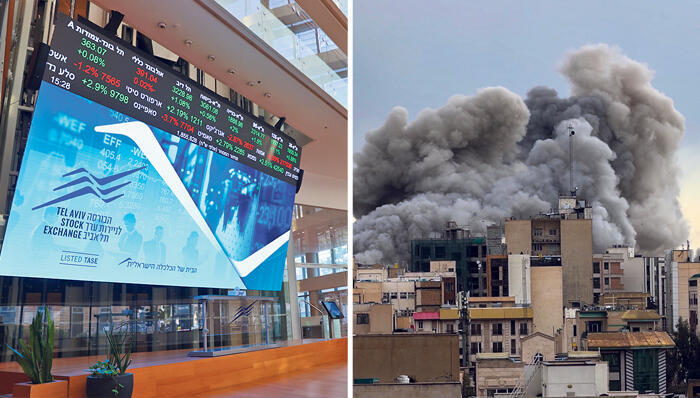
Israeli stocks defy war fears, post broad gains in first week of Iran conflict
Economists say markets are pricing in a short conflict and limited disruption.
The first trading week in the shadow of the direct military campaign against Iran closed on the Tel Aviv Stock Exchange with notable price increases, contrary to early expectations of negative volatility. In a weekly summary, the TA-35 index rose by 5.5%, while the TA-125 index added 6.3%. An even stronger trend was recorded among second-tier stocks, with the TA-90 index ending the week with an 8.7% jump.
The gains were broad-based across most sectors on the exchange. The rally was led by the TA Oil & Gas index, which jumped 15.2% over the week amid an 8%-9% rise in global oil prices to around $85 per barrel. The Tel Aviv Insurance Index followed with a 15% increase, while construction and defense stocks each climbed 12.3%.
1 View gallery
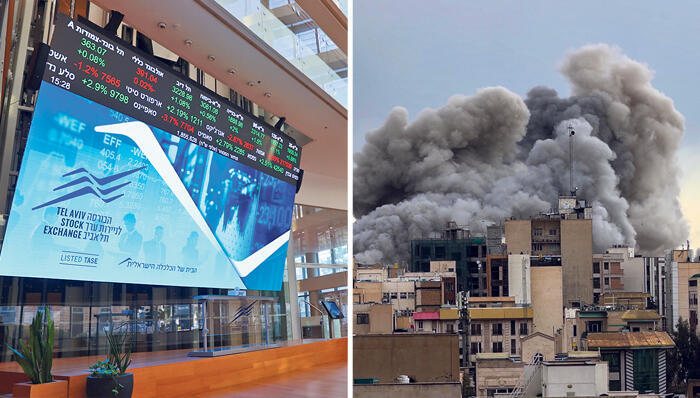
Bombing in Tehran alongside the Tel Aviv Stock Exchange.
(Photos: Bloomberg, AP/ Mohsen Ganji)
According to Ori Greenfeld, chief economist & strategist Agam Leaderim, the optimism reflected in the Israeli capital market stems from a growing consensus that the fighting is likely to be short and will not lead to a broad paralysis of the economy. One sign of this expectation, he noted, is the assumption that Ben Gurion Airport will reopen relatively quickly for both incoming and outgoing flights.
Speaking on Calcalist’s “Money Engines” podcast, Greenfeld said that since the economic damage is expected to be limited to only a few days, it does not materially affect companies’ long-term profit expectations. He also noted that certain sectors, particularly defense industries, are benefiting from increased investor optimism following the global demonstration of the effectiveness of Israeli interception systems such as Iron Dome.
The Tel Aviv Defense Index climbed sharply, rising 12.3% by the end of the week. Elbit Systems stood out in particular, with its shares jumping 16.2% over the week and extending a streak of six consecutive days of gains. The rally pushed the stock to a cumulative increase of more than 50% since the beginning of the year.
According to Greenfeld, the surge reflects strong investor confidence following the real-time demonstration of Israeli interception technologies such as the Arrow and Iron Dome, which have once again proven their effectiveness during the conflict.
Addressing the surge in energy prices that boosted oil and gas stocks, Greenfeld explained that while concerns about supply disruptions exist, the market has not yet entered a state of panic. As long as there is no direct damage to production infrastructure, the broader economic impact remains limited, he said, since alternative routes exist for transporting oil even if traffic through the Strait of Hormuz were disrupted.
Greenfeld added that while oil prices have risen by single digits, natural gas prices in Europe have jumped by tens of percent, largely because of Europe’s dependence on maritime energy shipments. By contrast, Israel and the United States enjoy greater energy independence.
Alongside these economic factors, Greenfeld and podcast host Shai Salinas pointed to another driver of the rally: a psychological expectation of a “total victory.” According to Greenfeld, the intelligence and military achievements in the early days of the war have led some investors to speculate about the possible collapse of the Iranian regime. In such a scenario, the market is pricing in the weakening of Iran’s regional proxies and a dramatic improvement in Israel’s security environment for years to come.
However, Greenfeld cautioned that this optimistic pricing may ultimately prove misleading. He expressed skepticism about the likelihood of a rapid regime collapse in Iran and warned that if the regime survives, and if threats from other fronts, particularly Hezbollah in Lebanon, persist, Israel could face a prolonged period of reserve mobilization and continued economic strain in the northern regions.
In such a scenario, both economic and security risks would remain significant. Greenfeld warned that the market may eventually need to reprice those risks, which he believes are not currently fully reflected in stock valuations.
He also noted that if the fighting continues for an extended period, the Bank of Israel may be forced to suspend its planned interest-rate cuts. Ongoing pressure on the labor market and potential supply disruptions would likely require a comprehensive revision of the country’s economic forecasts.



