










Israel’s AI ambitions could require four or more new gas-fired power plants
Approved and expected data center capacity could require roughly four and a half 670-megawatt power plants, while further allocations could increase demand. The government is still grappling with how to balance technology investment against the environmental and economic costs.
How many polluting power plants will Israel need to build to supply the data centers planned across the country? How much additional air pollution will they generate? And do the economic benefits justify the potential health and environmental costs of their enormous energy consumption? These questions have fueled a dispute between government ministries and the Electricity Authority, which released rules for connecting data centers to the power grid after suspending approvals for three months.
One of the rules caps each new data center at 200 megawatts of electricity consumption. That is a substantial limit, but even a facility of that size would consume electricity on a scale comparable to that of an average Israeli city such as Ashdod. Supplying such facilities will require additional power generation capacity and reliable sources of natural gas.
1 View gallery
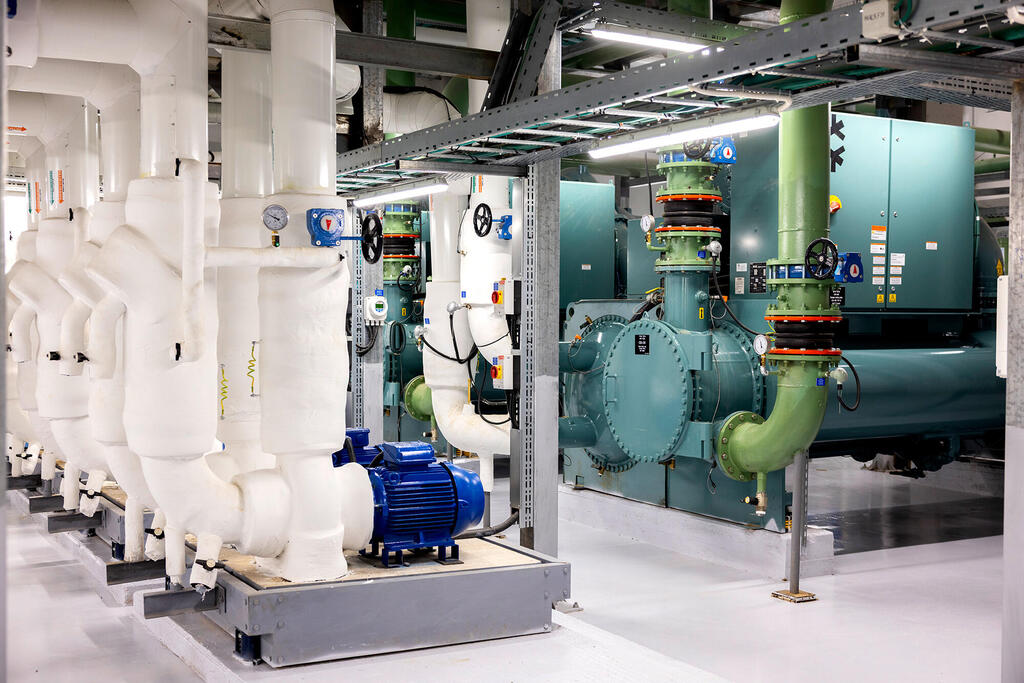
A cooling room at a data center in Kfar Saba. Many communities around the world are demanding that the polluting facilities be kept away from them.
(Photo: Eli Desa)
The scale of demand is striking. Developers have submitted requests to connect data centers with a combined capacity of 27,000 megawatts, equivalent to the output of approximately 40 gas-fired power plants rated at 670 megawatts each. Not all these projects will be built. In the near term, however, the Electricity Authority is expected to allocate another 1,000 megawatts to data centers, on top of approximately 2,000 megawatts in connections already approved. Together, that would amount to 3,000 megawatts of capacity, comparable in scale to the electricity consumption of roughly 1.5 million households.
The Finance Ministry has yet to publish a cost-benefit analysis that could establish criteria for approving data centers and assess their broader economic implications. As a result, the Electricity Authority is preparing to set policy without the government-wide economic guidelines that could help balance the sector’s potential benefits against the costs borne by the public, including environmental and health damage.
Around the world, proposed data centers are facing growing opposition over concerns ranging from air pollution and noise to rising electricity bills. In Israel, the immediate implications are already becoming clearer. The approximately 2,000 megawatts in approved connections could require three power plants, each with a capacity of about 670 megawatts. The additional 1,000 megawatts expected to be allocated would increase the potential requirement to roughly four and a half plants. Further allocations could push the figure higher, while the country still lacks a clear picture of how the facilities will be supplied or how their costs will be distributed. Estimates suggest data centers could consume between 15% and 17% of Israel’s electricity by 2030.
Artificial intelligence has sharply increased demand for data centers worldwide, and Israel is experiencing the same rush to build infrastructure. Domestic technology companies are seeking capacity, while international firms are also interested in establishing facilities in the country, where electricity is considered relatively cheap.
The environmental costs could be substantial. An Allianz Trade study estimated that data centers generated 286 million tons of carbon dioxide in 2025, 57% more than the International Energy Agency had estimated. Without cleaner electricity generation, emissions could more than double by 2030, while annual climate-related damage could rise from $68 billion to $154 billion. Company figures cited in the report show that Google’s and Microsoft’s emissions each increased by 25% over the previous year, while Amazon’s rose by 16%.
Data centers can contribute to air pollution in three main ways: through diesel generators used as backup power, gas turbines installed on-site to generate electricity, and emissions from the power plants supplying the grid. These sources release pollutants associated with a range of health risks.
A study by researchers at the University of California, Riverside, and Caltech estimated that pollution from generating electricity for AI data centers in the United States could contribute to around 600,000 cases of asthma symptoms and 1,300 premature deaths annually by 2030. These are projected effects, not current annual totals, and the estimates concern the United States rather than Israel. They nevertheless illustrate the potential health consequences of the additional electricity generation required to power the AI boom.
The National Economic Council wants to avoid limiting the data center market
Building data centers in a small, densely populated country such as Israel presents particular challenges. Expanding the sector will require additional power plants, while facilities may also operate polluting generators within their own compounds. Even a standard 50-megawatt data center consumes electricity on a scale comparable to that of a residential neighborhood of approximately 10,000 homes.
The government must now decide how much additional data center capacity to permit without undermining the reliability of the electricity system or imposing excessive costs on the public. The proposed additional allocation of 1,000 megawatts would bring the total approved and planned capacity to approximately 3,000 megawatts. Depending on the pace of further approvals and the assumptions used, data centers could account for around 17% of electricity supplied to the economy in 2030, a substantial share that could place additional pressure on the grid and increase local pollution.
The National Economic Council wants to avoid unnecessarily restricting the sector’s growth. But approving projects without a comprehensive framework for assessing their costs and benefits could leave Israel committed to energy-intensive infrastructure without sufficient oversight. Government ministries have raised concerns about the pace of expansion, while the role of the Environmental Protection Ministry has been notably less visible.
The ministry did not respond to Calcalist’s questions or provide policy guidelines for the sector. Other government ministries have also acknowledged that the environmental regulator, headed by Minister Idit Silman, has had a limited role in the debate. This contrasts with developments in other countries, where environmental and energy requirements are increasingly being incorporated into data center policies.
The stakes extend beyond local air pollution. According to estimates from BDO, greenhouse gas emissions associated with data centers could account for 9% of emissions from Israel’s electricity sector in 2030. The country must also consider the cost of meeting the sector’s growing demand, the implications for electricity prices paid by households and businesses, and the effect on its natural gas reserves and energy security.
In February, the Finance Ministry’s chief economist began preparing a cost-benefit analysis of data center construction. The report is not expected to be published in the coming months, despite its importance to the policy debate. In the meantime, the Electricity Authority is preparing to release additional capacity without the benefit of a completed assessment of the wider economic and environmental implications.
The report is intended to examine the contribution data centers could make to economic growth, productivity and state revenues; whether projects should be prioritized according to their expected economic benefits; and how rising electricity demand could affect prices paid by Israeli consumers. It is also expected to assess broader costs, including pressure on land resources, air pollution, the depletion of natural gas reserves and the implications for Israel’s energy security.
Other countries are imposing conditions on data center growth
In the United States, data centers have become a prominent local and political issue ahead of the November midterm elections. Residents in many communities are opposing projects over concerns about pollution, noise and electricity costs. Between January and July, local authorities adopted 294 moratoriums and bans, while more than 50 projects were canceled this year. The number of active opposition groups rose from 396 at the end of 2025 to 833 in March 2026.
Other countries are considering tighter conditions for new facilities. Greece’s Ministry of Environment and Energy has proposed legislation requiring investors to deposit guarantees of €200,000 per megawatt for three years. Under the proposal, once a project is ready, its operator would be offered a grid connection for a three-year period. Another central provision would require at least 60% of the electricity consumed by data centers to come from renewable sources.
Ireland requires 80% renewable electricity as a condition for grid connection, while similar legislation is advancing in Spain. In Singapore, some new data center tenders require at least 50% green energy.
These approaches reflect an effort to make data center expansion conditional on the availability of power and the management of its environmental impact. Israel faces a similar question: whether to prioritize rapid growth in a strategically important technology sector or first establish a framework that accounts for its effects on electricity supply, public health and household costs.
The Environmental Protection Ministry did not respond to Calcalist’s request for comment.



