










Israel, Cyprus and the EU join forces to tame the “Wild West” of AI
Following a recent joint initiative in Tel Aviv, the Delegation of the European Union, the Embassy of Cyprus, Microsoft Israel, and Generative AI for Good are driving a critical regional exchange. Their joint vision centers on harnessing the AI revolution to propel regional prosperity, while establishing the ethics that will ensure its responsible use into the future.
There is no doubt that the AI revolution presents an unprecedented frontier of opportunity, one of the most tangible engines propelling the global tech industry today. At the same time, it remains a Wild West that risks outpacing the ethical guardrails required to keep it in check. Developing AI as an ethical infrastructure while fully capitalizing on its innovative potential is a balancing act that not only proves too complex for any one nation to tackle in isolation, but paves the way for new models of regional collaboration.
For Israel and the European Union, this dialogue has already begun, with Cyprus emerging as a vital intermediary given its geographic positioning and regulatory alignment with the EU. During a recent visit to Tel Aviv, the Ambassador of Cyprus to Israel, H.E. Mr. Kornelios Korneliou, told Calcalist: “Interconnectivity, both in infrastructure and in regulatory frameworks, is becoming increasingly important.”
2 View gallery
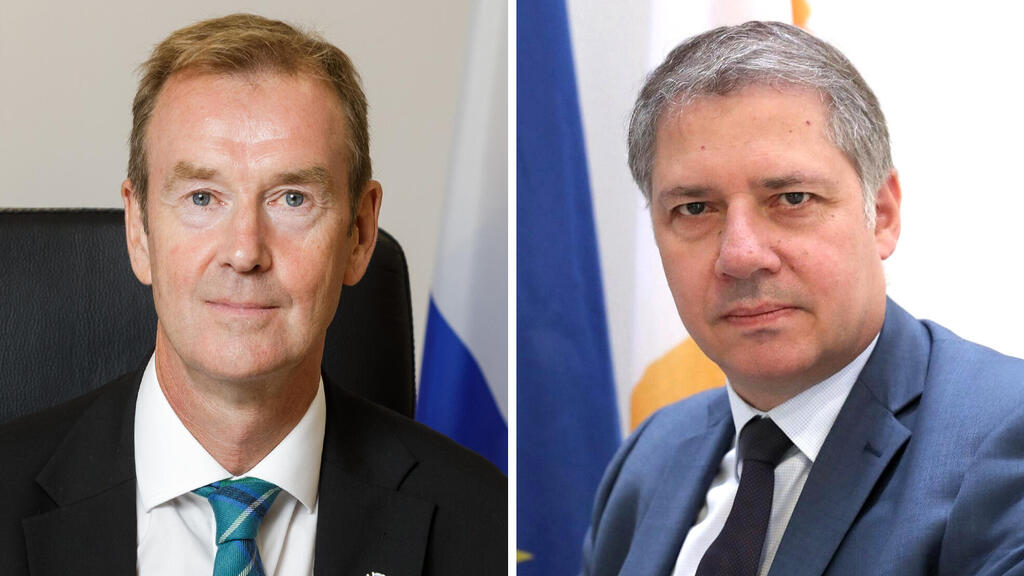
H.E. Michael Mann, H.E. Kornelios Korneliou.
(Photo: EU Delegation to Israel, Embassy of the Republic of Cyprus)
“The requirements across the AI value chain are immense. No single country or region can address them alone," he continued. "This is why partnerships are becoming essential; not only to develop and deploy AI solutions, but also to ensure that the benefits are shared as widely as possible. For Israel, Cyprus, and the wider EU, this creates a strong opportunity.”
The shared realization of this opportunity most recently prompted a gathering in Tel Aviv to promote how Israel, Cyprus, and the EU could act as regional allies, to build an innovative and ethical future off the back of the AI revolution. The event, titled AI for Responsible Innovation and Shared Prosperity: The Regional Innovation Bridge, took place in late June, and was co-hosted by the Delegation of the European Union to the State of Israel, the Embassy of the Republic of Cyprus in Israel, Microsoft Israel, and Israeli startup Generative AI for Good.
“To me, responsible innovation means thinking about accountability, transparency, safety, and human oversight from the start, rather than treating them as an afterthought,” said Hila Hubsch, Head of Corporate, External and Legal Affairs at Microsoft Israel. “No single company, government, or country can solve these challenges alone. The future of AI will be shaped by collaboration.”
H.E. Michael Mann, Head of the Delegation of the European Union to the State of Israel, further stressed that working together “is no longer a discussion about some distant future, it is about how we shape a technology that is already transforming our economies and societies.”
AI, said Mann, “is creating new opportunities in health, cybersecurity, science, manufacturing and public services, but it also raises shared questions around safety, trust and accountability. That means regional cooperation can no longer be only about funding or trade; it also has to be about standards, governance and practical deployment.”
The triad of Israel, Cyprus, and the EU presents a largely latent opportunity as an axis that can rise to this occasion of shared innovation and responsibility. Shiran Mlamdovsky Somech is the founder and CEO of Generative AI for Good, an Israeli startup that uses ethical AI to amplify silenced voices, who spearheaded the event. She explained: “Europe is a global leader on responsible AI, and the EU AI Act is one of the most serious attempts anywhere to define what trustworthy technology actually looks like in practice.”
“Cyprus has a fascinating and growing role as a gateway between the Middle East and Europe, especially now as it holds the EU Council Presidency," she continued. "That combination of geographic position and regulatory alignment creates real opportunities for the kind of cross-border collaboration we need in this space.”
Completing the equation, Israel provides “the founders, the builders, the investors who are actually making decisions about how AI develops.”
Mlamdovsky Somech used healthcare as one of the most urgent examples of why this union is necessary: “AI is already being used in life-critical decisions, in diagnostics, in triage, in mental health support,” she said. “These are areas where the stakes are as high as they get, and where responsible AI design isn't a nice-to-have, it's essential."
But what does this collaboration look like in practice?
According to Sofronis Papageorgiou, Commercial Councilor at the Embassy of Cyprus, who was also in attendance at the event, such synergies can be created “by bringing together Cypriot research excellence and one of the fastest-growing technology ecosystems in Europe, Israeli innovation leadership, and joint access to EU funding through programs such as Horizon Europe, as well as to global capital.”
Ambassador Korneliou further mentioned that “AI can also support broader connectivity initiatives such as IMEC (India-Middle East-Europe Economic Corridor), where future regional networks will rely not only on ports, roads, and energy links, but also on secure digital infrastructure, smart systems and trusted data flows.”
Beyond shared economic interests, there is an equally mutual incentive to “accelerate solutions with real societal impact," as Ambassador Korneliou noted. These include AI deployments that address regional vulnerabilities and concerns like food security, water management, and climate resilience.
What's more is these ideations are not a far-off reality. In fact, Mann shared a recent win for this burgeoning chapter: the new European Pandemics AI Observatory. “Working together with the World Health Organization, the AI Observatory will provide scientists, public health responders and policymakers with access to a powerful AI-driven analysis, forecasting and actionable recommendation toolset, trained on novel globally sourced data,” he explained.
“This is truly an international endeavor, with participants from the UK, Spain, Bangladesh, Luxembourg, Denmark and two entities from Israel: Clalit Health Services and Arteevo Technologies, which together receive nearly two million Euros in EU contributions for this exciting project.”
However, even with the momentum and fervor propelling this regional ambition forward, the actual execution as it scales inevitably brings with it a host of practical and bureaucratic blockades. "Ensuring the right balance between innovation and accountability remains a complex task for both national and international regulators," explained Korneliou.
Papageorgiou echoed this concern. "A key challenge moving forward is regulatory alignment and interfacing across jurisdictions," he said. "As cross-border cooperation deepens, the question is how to ensure that technology can scale and benefit people across borders without being slowed down by fragmented regulatory requirements."
According to Mann, the biggest barrier to regional relationships is “often a false one: the idea that regulation and innovation are somehow in conflict.”
“We do not see it that way,” he stated. “Clear, predictable rules can create trust, and trust helps technologies scale up."
As Hubsch summarized, “the biggest challenge is often bringing together different perspectives, priorities, and approaches,” adding that “that's also the greatest opportunity.” She believes that “when people from different sectors and countries work together, they tend to build stronger, more resilient solutions that can have a much broader impact.”
The optimism is just as well, given, as Mann expressed, “AI is making cooperation more strategic and more urgent.”
For Korneliou, it heralds the time to “adopt a ‘strength in unity’ approach.”
Indeed, ideally, the dual pursuit of innovation and gold standards in AI stands to lift everyone involved, proving the whole is greater than the sum of its parts. "AI sovereignty across the entire AI value chain is an ambition that smaller countries cannot achieve independently,” said Papageorgiou.
As Hubsch noted, "I think our region has a real opportunity to show that innovation and responsibility can go hand in hand."
One thing is for certain, as Mlamdovsky Somech pressed, with AI's remarkable trajectory, initiatives uniting the region in a joint endeavor for a responsible and prosperous future are initiatives that cannot afford to wane. “The conversation about responsible AI isn't something happening in the future,” she affirmed. “It's happening now, in the products being built today, in the decisions being made in rooms like the one we were in.”



