










1,097 AI posts and counting: How Israeli politicians are using AI to win votes
A new Open University project tracking political content found that 12.7% of posts published since July 28 used AI, often in ways that are difficult for voters to recognize.
In the current election campaign, political parties and politicians have published 1,097 pieces of content created, at least in part, using AI, 12.7% of all the content they uploaded to social media platforms, according to data from a new monitoring project led by the Open University. The leading party is Likud, whose politicians are responsible for 70% of the AI-generated content identified so far.
The project, called “This is AI,” was established to make the use of AI during the election campaign more transparent to the public. It scans the Facebook, TikTok, Instagram and X accounts of politicians and political parties and analyzes the content they publish, including photos, videos, posts and audio clips, to determine whether AI was used to create or edit them.
1 View gallery
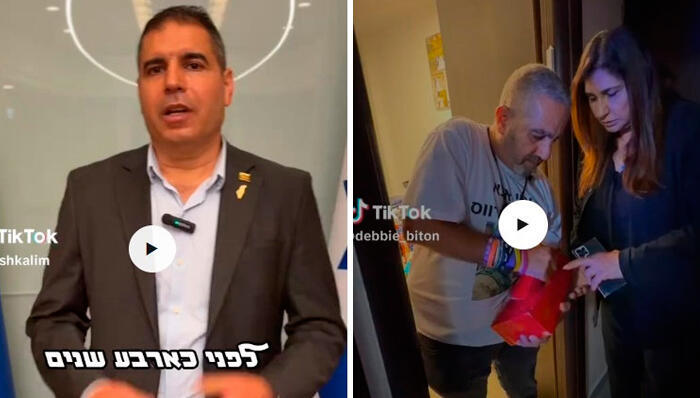
Videos that used AI by Osher Shekalim (left) and Debbie Bitton from Beyachad-Yesh Atid
(Screenshot from the website zebeai.info)
“We want to create public transparency tools to help the public deal with the entry of AI into the electoral system, and also to help maintain the integrity of the elections,” Prof. Anat Ben-David of the Open University, who leads the project, told Calcalist. “This is the first election in Israel in which artificial intelligence has been used in this way. Voters are still not familiar with all the ways candidates use AI. We do not believe that AI is necessarily wrong, but rather want to examine all types of use and answer a question that concerns citizens who are exposed to political propaganda: Is it AI?”
The identification process involves several stages. First, the project checks whether the account operator has published a notice stating that the content was created using AI, as required by the Central Elections Committee for AI-generated election content. It also checks whether the platform itself has labeled the content as AI-generated and whether the content carries a watermark from the system used to create it.
If none of these indicators are present, the content is analyzed by AI-detection systems, whose findings are then reviewed and approved by a human team.
Once content is identified as having an AI component, it is added to the project's database along with information such as the platform on which it was published, the type of content, its publication date and the content itself.
The project does not pass judgment on the material. Instead, it uses descriptive labels, with the goal of creating a database that citizens can use to track the extent of AI use throughout the election campaign, examine how different politicians and parties are using the technology, and identify emerging trends.
The project is funded by the Shamgar Center for Digital Law and Innovation and the Safra Center for Ethics at Tel Aviv University. It is supported by Israeli data company Bright Data, whose tools are being used to collect content from the various platforms.
According to Ben-David, the uses of AI in political campaigns can vary widely.
“At one end, there is a poster or jingle in a propaganda video. At the other end, there can be uses that mislead voters, for example, deepfake videos depicting something that never happened and potentially causing a political storm that could influence voters before the election,” she said. “These are the areas where such a tool, alongside promoting AI literacy, can help maintain the integrity of the elections. At the same time, it can help strengthen public trust in the system: if the Elections Committee decides to remove certain content, we will be able to see whether it was created using AI.”
“The upcoming elections will be different from anything we have known to date because of the central role AI now occupies in our lives, unlike the 2022 elections,” said Dana Mazia, director of Bright Data’s Bright Initiatives project. “In an era like this, it is more important than ever to develop critical thinking about everything we see online, while at the same time building tools that allow us to examine content in depth.”
According to the project, as of Sunday morning, political parties and politicians had published 8,611 posts since July 28. Of those, 1,097, or 12.7%, were identified as having been created, at least in part, using AI.
AI use has been increasing both in absolute terms and as a share of all political content. The peak so far was recorded last Friday, when 138 pieces of AI-related content were published, accounting for 19.8% of all posts that day. By comparison, on July 28, only nine AI-related pieces of content were published, representing 3.4% of all posts.
Facebook was the leading platform for AI content, accounting for 32% of the identified material, followed by Instagram with 30%, X with 20% and TikTok with 18%. Videos accounted for 76% of the AI-related content, with the remainder consisting of images.
Likud leads the party rankings by a wide margin, with 773 pieces of AI-related content, or 70% of the total. It was followed by the Democrats with 56 pieces (5%), Yisrael Beiteinu with 55 (5%), Yashar with 38 (3%), Beyachad-Yesh Atid with 30 (3%) and Otzma Yehudit with 30 (3%).
The four politicians who have used AI most extensively are all from Likud, and each has published more AI-related content than any other individual politician from another party.
Ariel Kallner leads the list with 179 AI-related posts, accounting for 16% of all the AI content identified by the project. He is followed by Hanoch Milwidsky with 79, Dudi Amsalem with 66 and Avihai Boaron with 61.
The large volume of AI content produced by Likud politicians is partly attributed to the party's upcoming primaries, as candidates seek to promote themselves while operating under budget constraints.
The use of AI is often subtle and not necessarily easy for the average user to recognize.
Prime Minister Benjamin Netanyahu, for example, has published 20 AI-related items since July 28, representing 16% of all his publications during the period. These included an AI-generated photo posted on Instagram to mark six years of the Abraham Accords, a post on X promoting a podcast interview with a photo of Netanyahu and the interviewer edited using AI, and an Instagram video containing excerpts from an interview with a Gazan that was broadcast by pro-government Channel 14.
In the latter case, the interview excerpts themselves were authentic, while some of the threatening graphics accompanying them were created using AI.
This content, and many similar examples, illustrates how deeply AI has penetrated political communication, not only as a tool for creating content from scratch, but also for editing, enhancing and repackaging existing material.
That distinction is becoming increasingly important for voters. AI-generated election content does not necessarily mean that an entire video, image or recording is artificial. In many cases, authentic material is combined with AI-generated images, graphics, voices or other elements.
The simplicity and speed of AI-based editing tools are likely to accelerate this trend in the weeks remaining before the election.
Hybrid content, such as the video featuring the Gazan interview, creates an especially difficult challenge. Even when content is labeled as having been created using AI, either by the politician who published it or by an external monitoring project such as “This is AI,” it may not be immediately clear which part of the material was generated or altered using the technology.
Is an image of Netanyahu shaking hands with a podcast host entirely AI-generated, or was AI used only to add a caption or alter the background? Is the Gazan interviewee itself a creation of AI, or is the person real and the statements authentic, with AI used only for editing and graphics?
“This complexity reflects the reality of content production,” Ben-David said. “Most of it is produced as hybrid media rather than as fully AI-generated videos. AI components are often embedded within videos that also contain completely authentic material.
“We mark anything that contains an AI component, unlike the Elections Committee, which requires labeling only content that meets its definition of deepfake content. This is important from a transparency perspective. We are not selective about what we upload. We look at everyone.”



