










Nearly half of Israeli students fail to reach basic math level in PISA collapse
Israel’s mathematics, reading and science scores all fell to their lowest levels ever in the 2025 PISA exam. The deterioration was particularly stark among weaker students, while the share of top performers declined sharply across all three subjects.
Israel suffered a dramatic collapse in the 2025 PISA exam, which assesses the performance of 15-year-old students in mathematics, reading and science. In all three subjects, Israel recorded its lowest-ever scores, with results significantly below those in the previous exam, held in 2022. Israel's scores in all three areas were also well below the OECD average, placing the country among the bottom-performing group of developed countries.
Israel's average score across the three subjects fell by 29 points, the second-sharpest decline among the 75 countries and economies tested, after Latvia.
Israel's mathematics score fell to 433 points, down 25 points from 458 in 2022 and the second-sharpest decline worldwide, after Malta. Israel's previous low in mathematics was 442 points, recorded in 2006, while the current score is 37 points below the country's peak of 470, recorded in 2015.
1 View gallery
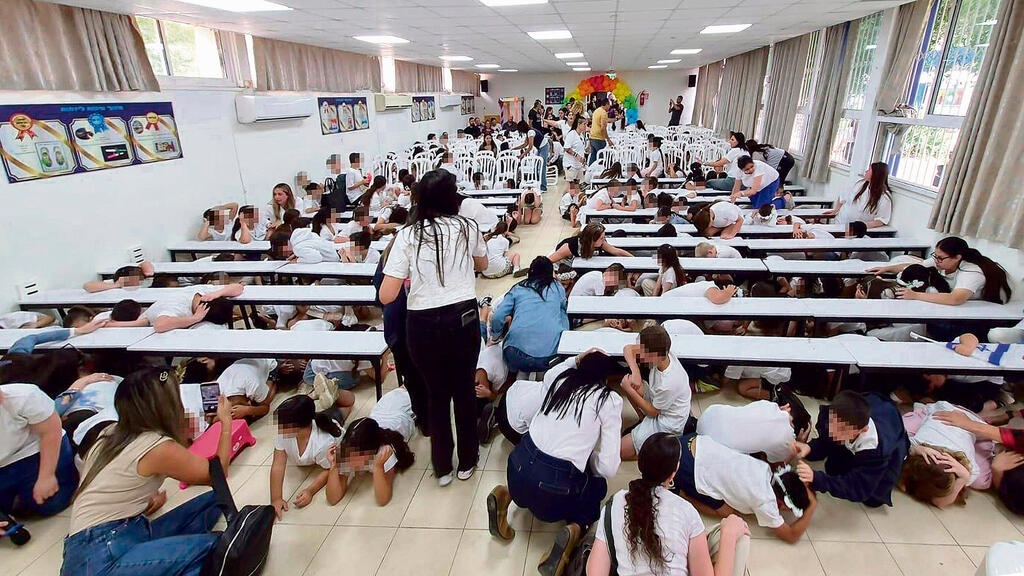
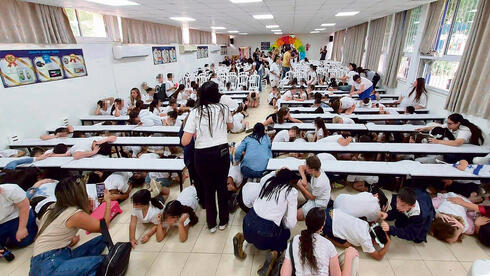
Students in Kiryat Shmona take cover during a missile alarm.
(Used in accordance with Section 27A of the Copyright Law)
Israel's score is also 30 points below the OECD average of 463. As a result, Israel fell from 38th to 43rd place among the countries and economies tested, and from 31st to 33rd among OECD countries (out of 38).
Israel's science score fell to 442 points, down 23 points from 465 in 2022 and the third-sharpest decline worldwide. The result is even lower than Israel's previous low of 454 points, recorded in 2006, and 28 points below its peak of 470 in 2012.
Israel's science score is 40 points below the OECD average of 482. The country fell from 37th to 43rd place among the countries and economies tested and from 30th to 32nd among OECD countries.
The steepest decline was in reading. Israel's score fell to 436 points, down 38 points from 474 in 2022 and the second-sharpest decline worldwide, after Latvia. Israel's previous low in reading was 439 points, recorded in 2006, while the current score is 50 points below its peak of 486 in 2012.
Israel fell from 30th to 37th place among the countries and economies tested and from 23rd to 31st among OECD countries.
The deterioration is also evident in the distribution of students across performance levels. In all three subjects, Israel has a higher share of low-performing students and a lower share of top-performing students than the OECD average. While this was also the case in most areas in 2022, the gap has widened dramatically. Across all three subjects, Israel ranks 31st out of 35 countries in the share of top-performing students.
The share of low-performing students in mathematics, those performing below Level 2, jumped 9 percentage points, from 37% in 2022 to 46% in 2025, meaning nearly half of Israeli students failed to reach the baseline proficiency level. The OECD average is 34%.
At the same time, the share of top-performing students in mathematics, those at Levels 5 and 6, fell from 8% to 5%, compared with an OECD average of 8%. In the leading-performing countries and economies, including regions of China, the shares were far higher: urban China at 54%, Singapore at 37%, Taiwan at 32%, Macao at 29%, South Korea at 23%, Japan at 22% and Hong Kong at 21%.
The share of low-performing students in science jumped 8 percentage points, from 32% in 2022 to 40% in 2025. The OECD average is 25%, leaving Israel 15 percentage points above the average.
In the leading-performing countries and economies, including Macao, urban China, Singapore, Estonia, Japan, Taiwan and South Korea, the share of low-performing students is below 15%. The share of top-performing students in Israel fell from 6% to 4%, compared with an OECD average of 7%.
The share of low-performing students in reading jumped 11 percentage points, from 30% in 2022 to 41% in 2025. The OECD average is 31%.
The share of top-performing students fell by more than half, from 11% to 5%, dropping below the OECD average of 6%.
Education Minister Yoav Kisch attributed the results to the disruption caused by the war.
"After nearly a year and a half of war, the evacuation of communities and deep disruptions to the continuity of learning, in my view these results are evidence of the extraordinary resilience of Israel's education system," Kisch said. "Israel maintained its ranking in reading and science compared with 2018, and in math it dropped just one place."
The Education Ministry said that "PISA 2025 is, first and foremost, a snapshot of learning during wartime, during which communities were evacuated, students moved between frameworks, and educational institutions closed and reopened."
"Work to improve achievement began even before the results were received," the ministry added.



