









Israel wants to lead in AI education. Its teachers aren’t ready yet
Education Minister Yoav Kisch is pushing AI-powered personalized learning across Israeli schools, but a new study finds that most teachers still use AI mainly to prepare lessons rather than teach with it.
Education Minister Yoav Kisch likes to present Israel as an emerging powerhouse in AI-powered education. But behind his statements about personalized learning and an AI revolution lies a far less impressive reality: Teachers primarily use artificial intelligence to prepare lessons rather than in the classroom, the Ministry of Education is perceived as disconnected from needs on the ground, and many educators do not feel equipped to lead students into the new world of AI.
A comprehensive study by Prof. Gila Kurtz, dean of the Faculty of Instructional Technologies at Holon Institute of Technology, found that teachers frequently use artificial intelligence as a tool for lesson preparation but rarely incorporate it into classroom activities. “Everyone looks at it as something good to have, but they don’t use it for collaborative work or for products other than presentations,” Kurtz says.
Teachers were asked to rate their use of artificial intelligence on a scale of 1, meaning not at all, to 5, meaning to a very great extent. Most of the use is concentrated in instructional planning: expanding on content they teach (3.4), getting inspiration for teaching methods (3.3), and preparing lesson plans (3.2).
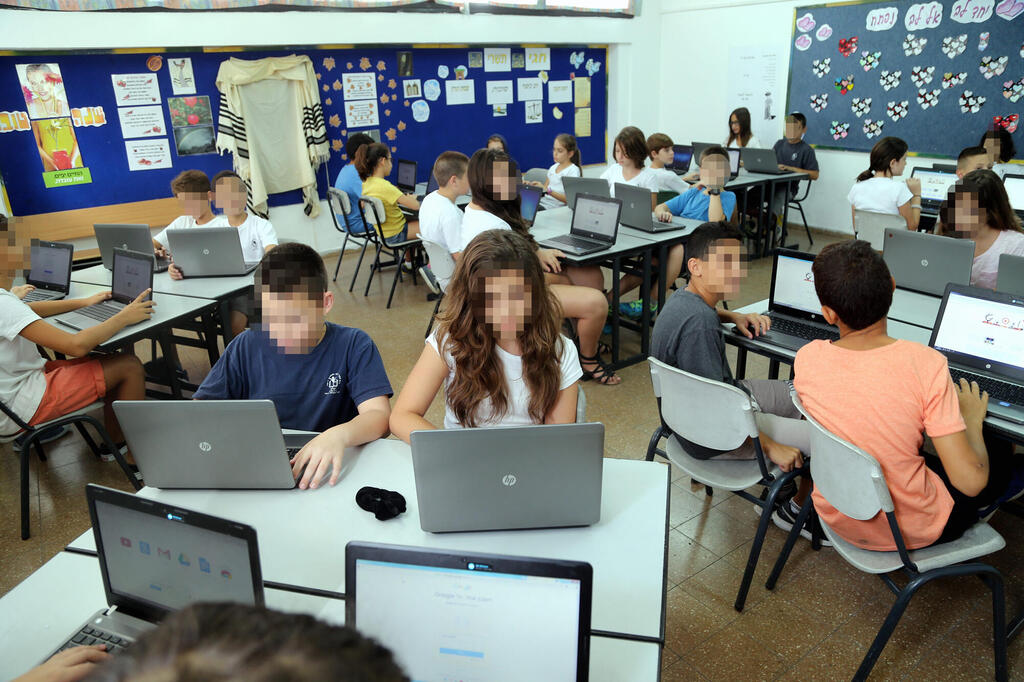
Use during lessons was considerably lower. Independent student learning with the help of AI scored 2.8 out of 5, while creating unique learning products such as games or podcasts scored 2.7, and preparing research projects scored 2.6. Although many of the measures, both inside and outside the classroom, showed slight improvement compared with 2025, classroom use of AI remained relatively low and the gap between using AI to prepare lessons and using it to teach students persisted.
The Ministry of Education is perceived as disconnected from teachers’ needs when it comes to integrating AI, receiving a score of just 2.4. Only about half of teachers are familiar with the ministry’s policy on technology integration. Teachers also report limited pedagogical knowledge about incorporating artificial intelligence into teaching (2.7), as well as limited systemic encouragement to bring the technology into the classroom (2.7).
Some 76% of teachers said they have limited pedagogical knowledge of AI integration or no knowledge at all. Another 66% said they do not incorporate independent student learning through AI, or do so only to a limited extent.
The principals interviewed painted a similar picture. Some 90% pointed to a gap between the education system’s recognition of the importance of generative AI and its actual implementation. They described implementation as slow and uneven, guidelines as not always clear, and progress as highly dependent on individual schools taking the initiative.
Against this backdrop, Kisch used a traditional opening-of-the-school-year session of the Knesset Education Committee on Thursday to present a more optimistic picture. He said Prof. Andreas Schleicher, head of the OECD’s education department, had described Israel as one of the world’s leading countries in integrating personalized learning into education.
But when did Schleicher say this?
An attempt, with the help of AI, to establish the source of the statement found only a report on Channel 14. According to the report, Schleicher sent Kisch a letter noting that in 2024 Israel ranked in the middle compared with other countries. The report said Schleicher predicted that expanding the use of AI in teaching English and math in middle schools could eventually place Israel among the leading countries in personalized learning.
In other words, Schleicher was apparently discussing where Israel could go, rather than where it currently stands. The letter itself was not published, making it impossible to independently assess the context of his comments. Kisch’s office said Schleicher’s remarks appeared in a letter sent to the minister but did not provide the letter.
The initiative Kisch was discussing calls for all middle schools to begin teaching English through AI-guided personalized learning, while 150 schools will begin using personalized learning in math. Kisch said at the committee session that he would rather move forward and make mistakes than fall behind. Given the pace of change in AI, that is a position worth taking seriously.
But former Education Minister Shai Piron, now president of the Pnima Israel organization, is skeptical of the ministry’s approach, primarily because he sees it as a top-down reform.
“AI integration depends on grassroots initiative. The whole idea is matching needs. There’s no such thing as a ministry building bots,” Piron says.
“Change won’t come from a minister imposing a reform from above,” says Dr. Rony Ramot, head of strategic planning and academic development at Seminar HaKibbutzim College. She notes that according to a 2025 survey by the Teachers Union, close to 70% of Israeli teachers do not feel confident guiding students in the field of artificial intelligence.
A study conducted at the beginning of the year by the National Authority for Measurement in Education (RAMA) found that only 32% of students in the state education system feel that their school teaches them how to use AI tools.
Ramot points to UNESCO, the UN’s education organization, which has called for teachers to receive training before AI is integrated into education systems. “In Israel, the school schedule is built so that teachers have no time for training. Principals also aren’t given the authority, autonomy and time to develop and shape AI policy,” she says.
According to Piron, many of the concepts currently used to organize education may become irrelevant within a few years.
“We’re educating for a world that doesn’t exist,” he says. “In the future there won’t be classrooms. Learning through AI is personal learning. Students learn alone in front of a screen. Every child will have an AI agent that tailors the learning experience and areas of interest to them.”
One consequence, he argues, will be a fundamental change in the teacher’s role.
“The teacher of the future won’t transmit knowledge. Teacher training will need to shift toward conveying values, social skills and emotional intelligence.”
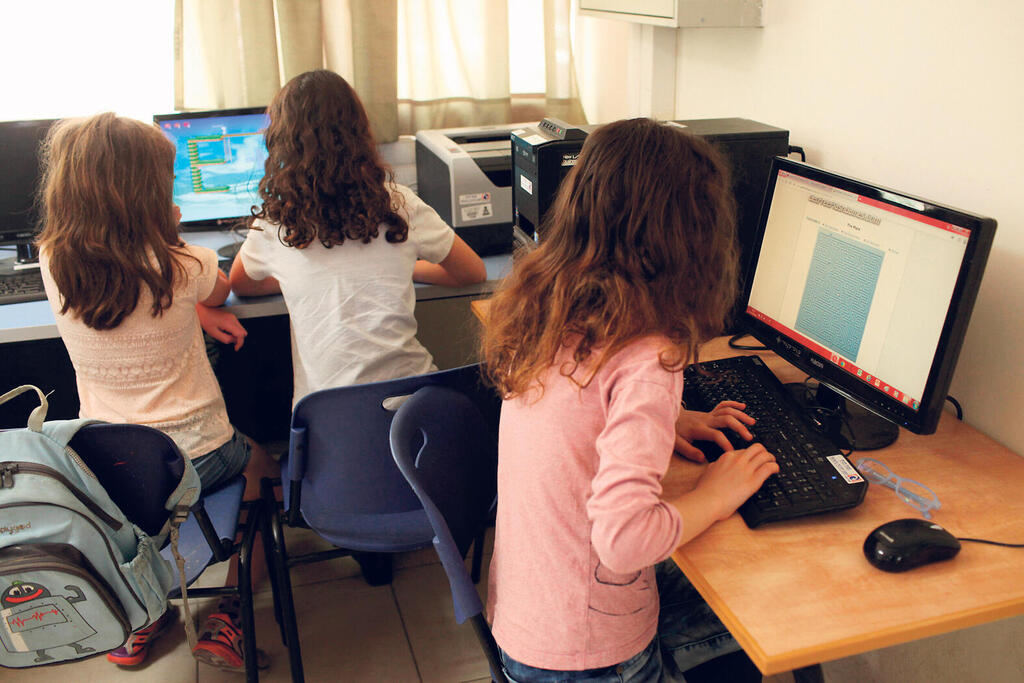
The teacher of the future won’t give lectures
AI researcher Dr. Amir Gefen of the Faculty of Education at Bar-Ilan University shares that view.
“All the processes of education, teaching and learning are being disrupted,” he says. “The situation in which the teacher is the source of knowledge is over. The role of educators will be to prepare students for a world we don’t know what it will look like. Whoever manages to navigate the new world will be whoever is agile and flexible.”
“AI makes it possible to realize a centuries-old fantasy of personalized teaching. There’s something abnormal about a teacher talking to 30 students at once,” says Prof. Yoram Harpaz of Beit Berl College of Education and a partner in the startup PaiDevo, which diagnoses students’ skills, areas of interest, strengths and weaknesses and matches them to a personal curriculum.
If AI makes learning increasingly individualized, Harpaz believes the school’s role could shift toward providing digitally sterile spaces that function almost like gyms for human interaction, empathy and independent thinking.
“AI isolates children a great deal and atrophies their social skills,” he says. “I see the use of group dynamics, debating and lots of social interactions.”
Gefen agrees. “Children will be able to learn everything from home with augmented-reality glasses, but they’ll leave home for school in order to meet other children and significant adults. It will be a lot more similar to a Scouts activity.”
The teacher’s second role, he says, will be to teach students how to work with AI rather than simply rely on it.
“The teacher will no longer give a lecture, but will open the lesson, let students work and move between them. He becomes a facilitator,” Gefen says. “Afterward there will be 20 minutes of summarizing the work with AI. The teacher just organizes the learning.”
“There will no longer be a classroom with rows of Formica desks and students sitting facing the teacher,” predicts Harpaz. “It will be more like the open-space cubicles of a tech company, with teachers moving among the students, guiding them and giving them attention.”
But the transformation could extend beyond the classroom itself. If learning becomes personalized, the traditional system of testing students at the same pace also comes into question.
“If we’re moving toward personalization,” Piron asks, “how do you administer a grade-wide exam? How do you issue report cards? How do you hold matriculation exams?”
He argues that students in AI-oriented classes can progress through material far faster than under the traditional system. “Most students in AI-oriented classes finish a year’s material in a third of a year to half a year. They binge on the material.”
That creates a fundamental problem for an education system still organized around common curricula and standardized assessments.
“Israel’s assessment method is an outdated method based on memorization and summarizing,” says Ramot. “It hasn’t been suitable for many years now. We need to ask ourselves how to adapt assessment methods.
“Children need to know how to do presentations and research projects, and know how to defend their work. They’re heading into a new world in which knowledge itself has no value, only the ability to use it, apply it and articulate it.”
Harpaz estimates that the number of matriculation exams could eventually shrink to core subjects such as English, math, Hebrew and Hebrew culture.
The gaps are expected to grow
One organization already experimenting with AI-based learning is the Amit network. Michal Aflalo, its VP of research and development, says every student entering middle school is offered three learning methods: studying in a group with a teacher, independent learning with AI, or in-depth, research-based study that connects different subjects.
During the first semester of seventh grade, students try all three methods and then choose how they will learn each subject. The rule is that every student must study at least one subject using each method.
Teachers, Aflalo says, are becoming mentors. They set goals and targets and teach skills. She predicts that within a few years, matriculation exams will become easier for students because the skills they acquire will give them a significant advantage.
But she acknowledges that many teachers are not enthusiastic about the transformation they are being asked to make.
“A third of the teachers are completely with us, a third are on the fence, and a third are in opposition,” she says. “Our job is to lead the changes, and there is a great deal of guidance and support for teachers.”
According to Aflalo, one of the biggest advantages for teachers is the amount of time the system can save them. Rather than having information scattered across different software, the program brings together attendance, grades, achievements, discipline, difficulties and extracurricular activities in one place.
She also argues that AI could help narrow educational gaps.
“One of the goals of working with AI is narrowing gaps. When a student in the periphery and a student in the center get exactly the same content with the same videos, and teachers accompany students through the same processes, the results shouldn’t be different,” Aflalo says.
Gefen, however, believes the opposite could happen if the education system does not actively address inequality.
“The gaps will grow and the strong will get stronger, like always,” he says. “I see this with my students at Bar-Ilan. The strong students get even better thanks to AI, and the average students copy-paste into the chat, and that causes them to fail.”
That concern is particularly relevant given Israel’s existing infrastructure gaps.
Remote learning during the Covid pandemic exposed severe disparities in access to computers, and those disparities remain a challenge as the education system moves toward AI. In March, Calcalist published survey data from the “Manhigim” organization of school principals showing that at 29% of schools, more than half of students do not have a computer for remote learning. At another 52% of schools, more than 20% of students lack access to a computer.
Kisch said at the Education Committee session that one reason the system is starting with an independent English-learning program is that language learning is more convenient on a mobile phone, and virtually all middle-school students have one.
But mobile phones also bring interruptions and distractions, while computers are generally easier to isolate for learning purposes.
The experience of remote learning over the past six years has repeatedly highlighted the danger that technological shifts can widen the gap between strong and weak students. The concern now is that Israel could enter the AI era without first resolving the inequalities that made previous technology-driven changes so uneven.
In response, the Education Ministry said: “The matter is being handled by the Administration of Innovation, in coordination with additional parties in the ministry.”



