










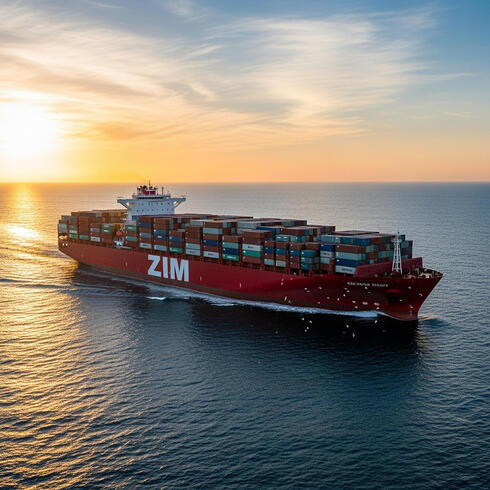
Is the Zim sale unravelling? Regulator questions legal structure
Golden Share obligations may block transfer of control.
General Manager of the Government Companies Authority Roi Kahlon has effectively halted the proposed $4.2 billion sale of Zim to German shipping giant Hapag-Lloyd.
In a position paper drafted on Wednesday by Kahlon and his team, which reached Calcalist, the conclusion is clear: although the company has not yet submitted an official request to review the transaction, media reports indicate that the proposed split between the buyer and the FIMI fund is inconsistent with the terms of the Golden Share. “If what is presented in the publications corresponds to reality,” the paper states, “the state may not be able to approve the deal.”
The position of the Government Companies Authority is critical, as it is the body that operates the Golden Share on behalf of the state. Completion of the transaction is conditional upon its approval.
“The deal reshapes the future of the former national shipping company,” the Authority wrote.
According to the paper, the company’s legal structure would change significantly. The merger is expected to be executed through a reverse triangular merger, after which Zim would become a privately held company fully owned by Hapag-Lloyd.
Simultaneously, the buyer would sign an agreement with the Israeli FIMI fund under which vessels would be transferred to FIMI so that it could assume the obligations derived from the Golden Share. Under the proposed “strategic outline,” global operations would be integrated into Hapag-Lloyd, while FIMI would manage the Israeli activity.
According to previously published reports, most of Zim’s global operations, including 99 chartered vessels, its main trade routes (particularly the Asia-U.S. lines), international customer contracts, and the brand outside Israel, would be absorbed into Hapag-Lloyd. The Israeli entity would retain 16 Zim-owned vessels, national routes to and from Israel, the Haifa headquarters, and the obligations stemming from the Golden Share.
Under the reported terms, Hapag-Lloyd would acquire all shares in cash at $35 per share, reflecting a company valuation of approximately $4.2 billion, a 58% premium over the market price.
The most critical component of the deal concerns the Golden Share, the central regulatory tool that enables the state to protect its vital interests in the company.
All reports, the document notes, explicitly state that completion of the transaction is conditional upon the state’s consent to the change of control, as required by the Golden Share.
The Golden Share grants the state several binding rights under the company’s articles of association. These include preserving Zim’s national character: the company must remain Israeli, with its headquarters and operational center in Israel. Key roles such as chairman and CEO must be Israeli citizens.
The Authority also notes that Hapag-Lloyd has shareholders from Saudi Arabia (10.2%) and Qatar (12.3%) through sovereign investment arms, a factor described as significant in the current geopolitical climate.
In addition, any decision on liquidation, merger, or split requires the prior written consent of the Golden Share holder - the State of Israel. The company must maintain at least 11 seaworthy vessels at all times, which the state may requisition during emergencies. Any transfer of control or acquisition exceeding 35% of shares also requires prior written approval. The state may disqualify purchasers if there is concern over national security or foreign relations.
Furthermore, none of the rights attached to the Golden Share can be amended without the state’s written consent.
The Authority also addresses a 2003 decision by the Ministers of Finance and Transportation, which in principle allowed for a split into “Zim International” and “Zim Israel,” provided four cumulative conditions were met:
- All holdings would be sold as part of privatization.
- The Minister of Defense would confirm that the split does not harm vital security interests
- Zim Israel would remain a viable “going concern.”
- Zim Israel would maintain a sufficient fleet of seaworthy vessels.
Government officials noted that even under those historical conditions, the current deal would not qualify.
Moreover, they argue that circumstances have changed dramatically since 2003. The COVID-19 pandemic demonstrated the fragility and strategic importance of maritime transport, while the ongoing regional war underscored the national security implications of supply chains. Trade wars and geopolitical tensions have further elevated shipping to a core national interest.
Related articles:
According to the Authority, the conditions established in 2003 may no longer be sufficient or relevant in today’s environment.
Treasury sources expressed concern that even if security authorities were to approve the deal, which they view as unlikely, the restructured “Israeli Zim” might struggle to meet its Golden Share obligations independently.
The global shipping market is highly cyclical and volatile. Officials warned that the Israeli entity could become “a small and weakened company in a market dominated by global giants,” creating elevated risk.
The worst-case scenario, according to Authority officials, is that within several years the Israeli entity could fail to meet Golden Share requirements, forcing the state to intervene financially to preserve a vital national asset, including ships and skilled manpower.
“Who would inject the money?” one senior official asked rhetorically. “The state will not inject money. There is no situation in which the state both grants regulatory benefits and then has to pay for them.”
Another concern is irreversibility: once the deal is completed, there would be no practical way to unwind it. Therefore, officials argue, conditions must be defined clearly and rigorously before any approval.
Alternatively, the state could enter prolonged negotiations to ensure that the four original conditions, or even stricter ones, are met, potentially requiring that additional assets remain under Israeli control. Such a scenario could necessitate a fundamentally revised transaction structure.



