










From air taxis to Iron Dome, Farnborough showcases aviation's new era
AI, autonomous drones, electric aircraft and combat-proven missile defenses highlighted how technological innovation and rising geopolitical tensions are reshaping aerospace.
On the first day of last week's Farnborough International Airshow, two very different visions of aviation's future took center stage.
On the main runway, Britain's Vertical Aerospace sent its electric vertical takeoff and landing (eVTOL) aircraft into the air for a public demonstration. Across the exhibition halls, defense companies showcased autonomous drones, laser weapons, AI-powered systems and next-generation missile defenses.
Together, they captured an industry being transformed by two powerful forces: rapid technological advances and the fastest military buildup Europe has seen in decades.
Held every two years, the Farnborough Airshow has long been a showcase for major aircraft orders, breakthrough technologies and the future of aerospace. This year, however, the mood was markedly different. Artificial intelligence, advanced semiconductors, battery technology and new materials dominated conversations, while wars in Ukraine and the Middle East gave many of the innovations an added sense of urgency.
Vertical Aerospace's demonstration highlighted how far electric aviation has progressed. Without major advances in battery density, electric propulsion and lightweight composite materials, its aircraft would never have left the ground, let alone achieve its claimed range of more than 100 miles (160 kilometers).
Like many eVTOL developers, Vertical Aerospace struggled to attract investment after the Covid-19 pandemic. The company says it has since secured British government backing and is exploring military applications for the aircraft, including special operations missions.
Commercial aviation has recovered strongly from its pandemic slowdown, but defense has become the industry's fastest-growing business as governments race to replenish depleted arsenals and prepare for increasingly complex conflicts.
That shift was particularly visible among Israeli defense companies.
Rafael and Elbit Systems arrived at Farnborough betting that years of operational experience would become one of their strongest selling points. As European governments accelerate military spending, the companies are positioning combat-proven technologies, from layered missile defense and precision strike weapons to drones, electronic warfare and laser-based air defense, as answers to rapidly evolving battlefield threats.
"The threshold has shifted," Rafael CEO Yoav Tourgeman said ahead of the show. "Proven performance and reliable delivery are now the baseline requirements, not differentiators."
His comments reflected a broader change in defense procurement. The wars in Ukraine and the Middle East have demonstrated the importance of layered air defense, counter-drone systems, electronic warfare and affordable precision weapons, areas where Israeli companies have accumulated extensive operational experience.
"Defense represented about 30% of our business only a few years ago, and now it's more than 50%," said Matthew Pritchard, vice president of sales and customer engagement at aerospace supplier Ontic.
"But across the industry, we're struggling to keep up with demand. During the pandemic, many skilled workers left the sector and production facilities shut down. We're still recovering from that."
The result is one of the industry's biggest paradoxes. Boeing and Airbus now have commercial aircraft backlogs stretching years into the future for airliners whose designs are decades old. Likewise, legacy military platforms such as the Eurofighter Typhoon and Lockheed Martin's F-16 continue to attract strong demand.
At the same time, entirely new technologies are rapidly entering service.
Dutch company Robin Radar Systems, which began by developing radar systems to detect birds around airports before expanding into counter-drone technology, said it is experiencing rapid growth as governments prioritize air defense.
Overall, Farnborough generated nearly $85 billion in military and civilian deals, alongside a wave of announcements from Lockheed Martin, RTX and MBDA aimed at lowering the cost of air-defense and precision-strike missiles.
The wars in Ukraine and the Middle East have fundamentally changed what military buyers are looking for.
With the United States racing to replenish stocks of Patriot air-defense missiles, Tomahawk cruise missiles and other advanced weapons, manufacturers increasingly emphasized lower-cost strike systems, autonomous drones and reusable unmanned aircraft.
"We are literally learning in real time," said Andrew Hawkes, a former Royal Air Force Typhoon pilot who now leads the European rollout of Shield AI's stealth X-Bat drone.
"The evolving threat environment is driving everything."
Few exhibitors illustrated that trend more clearly than Rafael.
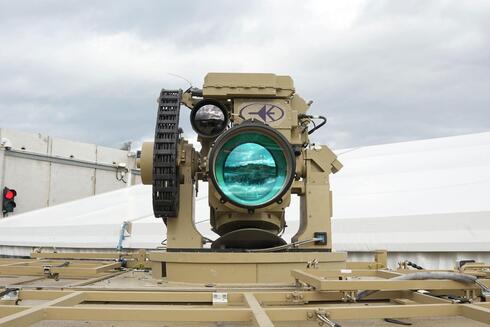
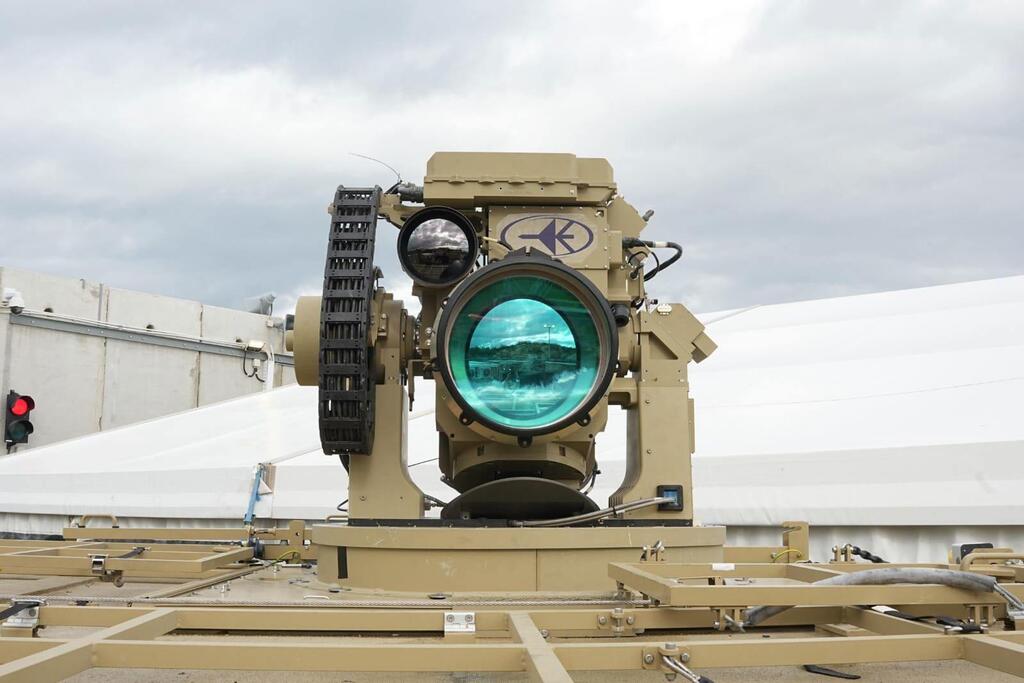
The company showcased Iron Dome, David's Sling, the mobile Spyder air-defense system and Iron Beam, the laser interception system that entered operational service with the Israeli military last year. Rather than focusing primarily on future concepts, Rafael emphasized systems that have already been deployed operationally.
The company also highlighted counter-drone systems including Sky Dart, Hunter Eagle and Ghost Hunter, reflecting the growing importance of defending against inexpensive unmanned aerial threats.
Beyond defense, Rafael presented precision-strike capabilities designed for GPS-denied environments, including the SPICE 250 precision-guided munition, the ROCKS long-range air-to-surface missile and the ICE BREAKER cruise missile, which combines terrain-following navigation, artificial intelligence-based scene matching and human-controlled guidance.
Meanwhile, Shield AI, founded in 2015 by former U.S. Navy SEAL Brandon Tseng, is preparing to fly its stealth X-Bat before the end of the year under the control of an autonomous AI pilot.
The company says the aircraft will eventually be capable of carrying many of the same weapons as the much more expensive F-35 fighter while operating at a fraction of the cost.
Although the X-Bat uses an established engine already deployed in aircraft such as the F-15 Eagle, advances in lightweight composite materials and dramatically smaller onboard computing systems have made the aircraft possible.
Not every next-generation platform is moving at startup speed.
Among Farnborough's largest announcements was continued progress on the Global Combat Air Programme (GCAP), the joint British-Italian-Japanese effort to develop a sixth-generation stealth fighter by 2035.
That timeline represents a significant acceleration compared with the F-35 program, whose development began in the 1990s before entering operational service decades later.
The project has taken on growing strategic importance as European and Indo-Pacific allies seek greater defense autonomy amid uncertainty over America's long-term security commitments. Canada announced during the show that it would join GCAP as an observer.
Meanwhile, the United States has indicated it does not intend to export its own next-generation fighter, Boeing's F-47, which is expected to make its maiden flight in 2028.
The same conflicts are reshaping how defense technologies are designed and manufactured.
Engineers increasingly incorporate battlefield lessons into product development, particularly from Ukraine, where developers are locked in a constant race against evolving Russian electronic warfare capabilities targeting systems such as SpaceX's Starlink network.
Some next-generation aircraft, including Boeing Australia's Ghost Bat, are being developed by established aerospace giants. Others come from rapidly growing defense startups.
At Farnborough, Anduril unveiled Thunder, an autonomous twin-rotor vertical-takeoff drone designed to complement, or in some missions replace, traditional attack helicopters over contested battlefields.
Elbit Systems highlighted another major trend: the localization of defense manufacturing.
Through its UK subsidiary, which supplies the British Army, Royal Navy and Royal Air Force, the company showcased electronic warfare systems, helmet-mounted displays for helicopter pilots, synthetic training environments, laser technologies and unmanned systems.
Following its acquisition of British drone manufacturer U-TacS earlier this year, Elbit plans to expand drone manufacturing in Britain, reflecting a broader European effort to strengthen domestic defense production while reducing dependence on overseas suppliers.
Civil aviation is undergoing its own manufacturing revolution.
Canadian startup Horizon Aircraft, like Vertical Aerospace, is developing an aircraft that uses electric lift rotors embedded in its wings for vertical takeoff. Unlike fully electric aircraft, however, it switches to a conventional aviation-fuel engine during forward flight, significantly extending its range.
The company expects its first full-scale prototype to begin flight testing within the next nine months.
"Manufacturing technology has advanced tremendously, particularly in composite materials, thanks to Formula One and aerospace innovation," said Phil Kelly, Horizon's senior vice president for business development.
"That allows us to build aircraft that are lighter and stronger."
Although few aircraft on display were designed primarily using artificial intelligence, engineers said AI is already transforming aerospace by accelerating computer simulations, engineering design and certification processes.
For now, however, traditional aircraft continue to dominate order books.
According to RBC Capital Markets, Airbus and Boeing together received more than 1,200 commercial aircraft orders during the first half of 2026, well above the average recorded between 2022 and 2025.
Whether that civilian boom can withstand rising energy prices and growing geopolitical uncertainty remains an open question.
One thing is already clear: the aerospace industry is entering one of the most transformative periods in its history. Advances in artificial intelligence, autonomous systems, electric propulsion and advanced manufacturing are arriving just as governments around the world are dramatically increasing defense spending, ensuring that the future of flight will be shaped as much by global security as by technological innovation.



