









"I'm less concerned about the immediate impact of the dollar's weakening on high-tech" - Clal CEO Yoram Naveh
At the National Economic Conference the CEO of Clal Insurance and Finance downplayed the responsibility of institutional investors for the strengthening of the shekel, and expressed optimism about the Israeli economy: "We're growing at a rate five times higher than Europe"
In recent years, Yoram Naveh, CEO of Clal Insurance and Finance, has expressed optimism about the future of the economy. Has his outlook changed? Naveh answered this and other questions at Calcalist, Bank Leumi and Clal's National Economic Conference.
According to him, "I've learned over time that reality is shaped by personal outlook, and I'm optimistic by nature. I'm happy to be part of a generation that chooses to be here, I'm very optimistic about the country's future, and our challenge is to be worthy of those who were forced to sacrifice, to turn things into an opportunity out of hardship."
Naveh added: "We're a desalination superpower. The DNA of the people here is amazing. The challenge for every CEO is the human approach, because our DNA is right."
1 View gallery
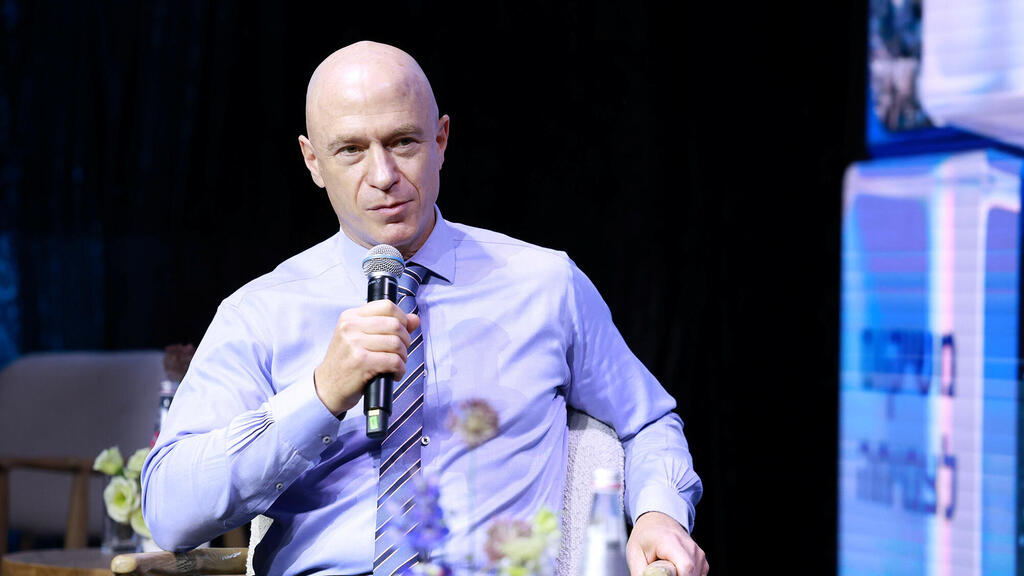
National Economic Conference - Yoram Naveh, CEO of Clal Insurance and Finance.
(Photo: Orel Cohen)
"As for Israel's economy, you have to analyze it based on facts. I often show a slide that tells the story of our economy. It's a surprising slide. Israel's real growth for the current year is 4%. In Germany and France it's about 0.5%-1%, that's four or five times [less]. Average real consumption is also important; in other countries, France for example, it's 2%. There's a slowdown in growth worldwide, the world is in certain trends, and our position has improved because we have real growth five times [higher]. In terms of GDP per capita, we've passed Germany, and that's before the dollar's recent exchange-rate move. We're approaching $70,000 GDP per capita, that's excellent. Our debt-to-GDP ratio reflects figures showing that only Germany does better than us. In France it's over 100%, our numbers are good."
"We have a leading pension system, the retirement age is set at the right point. And as for demographic growth, we're in a good place, 1.5% compared to stagnation in Europe. In Europe, for example, the solution is immigration, and that creates challenges. In other words, the state of our economy is good, better than it was a few years ago. And there are challenges everywhere in the world."
Naveh added further: "I think our economy is strong. There was also talk here about small and medium businesses, and that's a challenge that always exists. We're keeping our finger on the pulse of the credit risk of these businesses, and their condition is good. That stems from adjustments made in business management, meaning flexibility, hybrid employment, and so on."
When Naveh was asked about the claim heard in recent months that the shekel's recent strengthening is the fault of the institutional investors, he said: "There are quite a few factors responsible for this. The institutional investors are the last of them. Israel's economy is strong; it has a current account surplus. We export, and that strengthens the shekel. This is positive for the economy in Israel given moderating inflation. These are good long-term trends. If we look at data from 2021 to today, we'll see that even before the war and before the 2022 crisis, the shekel moved around 3.2 shekels to the dollar, meaning this needs to be addressed at the state level and by the Bank of Israel. A move from 3.2 shekels to the dollar to 3.0 is a trend that needs to be dealt with. I'm less excited about the immediate impact on high-tech, because you can't run long-term policy based on fluctuations. And besides, there was fat there. If wage costs rose because of the dollar, there are ways to deal with that."
Naveh added: "There's a lot of money out there today, and the decision over it belongs to the ordinary citizen. If a citizen buys 100% stocks with no hedging, that's the public's decision. Our discretion, in the end, covers only a small portion of institutional money. The institutions are not a material factor in this area."
On investment in Israel, and in infrastructure in particular, Naveh noted: "The institutional investors benefit from the tax breaks the public receives. The Israeli economy needs money for growth. Anyone managing money in their own country is giving money to that country's prospects. Our fiduciary duty and our obligation in investment management dictate that we'd be glad for that to happen in Israel. The state can create national projects. We're low in infrastructure investment relative to the OECD, and infrastructure projects can be accelerated. Also, even during the war we saw the banking system step in to help carry the load. Long-term investments are a place institutional investors should be, and we'd be glad to do that in Israel; I would, for instance, prefer to invest in a toll road in Israel, given the returns."
Naveh also addressed competition in the credit market, and specifically the acquisition of MAX. According to him, "Going back to 2022, we deserve credit for driving the competition, with special credit going to chairman Haim Samet and the board members. The focus on credit cards wasn't at the heart of the competition. After that we saw a strategic shift among competitors, and today's competition is around airline clubs, and that's mainly about the non-bank element. Both MAX and Clal see this as an area where they can grow; it gives the customer a better value proposition, it raises the conversation about what you get everywhere. If companies don't give enough value, the customer will move on their own."



