











Leumi Chairman: "Populism against the banks is negatively affecting the entire economy"
According to Uri Alon at the National Economic Conference: "Whoever truly seeks to ensure growth and prosperity and create proper competition must also preserve the resilience of the banking system, and not harm it"
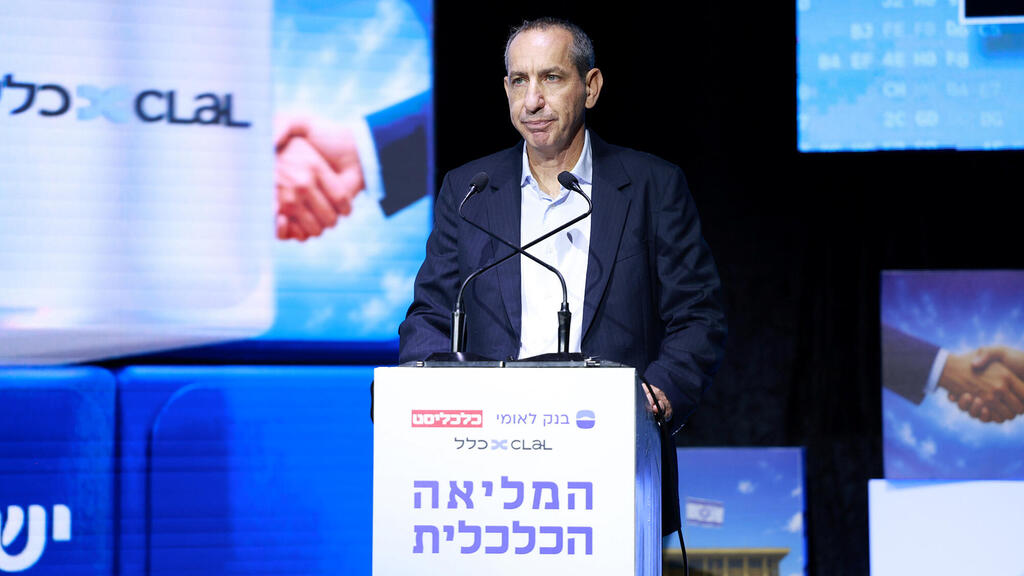
"We are convening here today in a complex period, full of challenges. But this is also a period that demonstrates, more than anything, the strength of the Israeli economy." This is how Bank Leumi Chairman Uri Alon opened the National Economic Conference of Calcalist, Bank Leumi, and Clal.
"Even after the longest war in the country's history, the Israeli economy continues to demonstrate impressive resilience, and shows unprecedented quality indicators compared to the world. Indeed, the financial markets reflected this picture."
According to him, "Despite fighting on seven fronts, the Tel Aviv 125 Index recorded a sharp rise, and outperformed leading indices around the world. This is a clear message: the Israeli economy is perceived as steadfast and possessing growth potential.
"As expected, the outbreak of the war brought a decline in economic activity, but the economy later recovered gradually and at an accelerated pace, contrary to all forecasts. Inflation too, which spiked and reared its head at the start of the war, has calmed down and currently sits around the target, about 2%. A combination of a strong shekel and the relatively limited impact of global energy price increases helped stabilize it, and this is expected to continue into the coming year as well.
"It's important to note the wise decisions of Governor Prof. Amir Yaron. In order to support the continued normal functioning of the economy, the Governor lowered the interest rate at the start of the war. He then maintained stability during periods of uncertainty, and returned again to moderate rate cuts, despite heavy pressure exerted on him from all directions. Today the interest rate stands at 3.5%, with expectations of continued decline in the coming year, which will greatly ease the burden on households and businesses.
"Prudent monetary policy management is one of the leading reasons for the resilience the Israeli economy has demonstrated in recent years. This policy will also contribute to the economy's recovery after the war."
Alon said that earlier this year he attended the economic conference in Davos, where the Bank of Israel's monetary policy and the Israeli economy received considerable praise. "The Bank of Israel, led by the Governor and the Supervisor of Banks, is a lighthouse of uncompromising professionalism, especially in a turbulent period like this. They don't make life easy for us, but they are always professional and well-reasoned, and consider the good of the public and the state.
"As part of the economy's recovery, over the next decade more than half a trillion shekels will be invested in Israel in hundreds of infrastructure projects: transportation, real estate, renewable energy, data centers, and more. These are unprecedented scales, by any measure. Investment in infrastructure is critical to Israel's rehabilitation after the war, and it will drive the economy and create thousands of jobs for the country's citizens.
"Alongside this, the high-tech sector continues to be the central backbone of the economy. In the first half of the year, capital raised by high-tech rose compared to the corresponding period last year.
"The high-tech status report by Leumi-Tech and IVC, published recently, showed that the volume of capital raised in the first half of 2026 stood at $7.6 billion, compared to only about $5 billion in the first half of 2025. That's an increase of more than 50%. There is no stronger evidence of the resilience of Israeli tech.
"High-tech is the locomotive of the economy, in the fullest sense of the word. About a third of the state's revenue from income tax on salaried employees originates from high-tech workers, and about 50% of the growth in business product in recent years belongs to this sector. Therefore, there is no doubt that high-tech is one of the greatest advantages the State of Israel has to offer the world. It's very important to protect it, especially in light of the major challenges it faces, such as the AI revolution, fluctuations in the dollar exchange rate, and more.
"High-tech is the locomotive of the economy, but the factor that enables all of the economy's activity, across every segment, is the banking system. Especially in times of uncertainty, the banking system is an anchor of stability.
"During the war, the banks continued to operate fully: systems functioned, branches stayed open, and credit was extended to households and businesses in a prudent and responsible manner. In this way, economic continuity was preserved and public trust was strengthened. The banking system, led by the Bank of Israel, initiated broad assistance measures for the public: for evacuees, for reservists, for small businesses, and for populations that were harmed. This is an expression of an outlook that sees the bank not only as a business entity, but as part of the socio-economic fabric of the state.
"At Leumi, since October 7 we have initiated a wide range of social initiatives on behalf of diverse populations in Israeli society. These days, thousands of teenagers from the confrontation line in the north are at summer camps run by the Kimama network, which we funded for them as part of the project 'Giving a Summer of Hope.' The project that housed people in their 80s in hotels because they had no safe room also received a warm response.
"The stability of the banking system is a national asset that needs to be preserved. An asset that grew over years of professional oversight, prudent and responsible regulation, and fruitful dialogue between the Bank of Israel and the banking system. That is why it's important to be wary of public discourse that could harm this stability.
"Populist initiatives against the banking system harm it and negatively affect the entire economy. Economic policy needs to be measured, responsible, and long-term. This is a public interest of the first order. Whoever truly seeks to ensure growth and prosperity and create proper competition must also preserve the resilience of the banking system, and not harm it.
"The Israeli economy has proven resilience, flexibility, and an impressive capacity for recovery. With strong growth engines, investment in infrastructure, technological leadership, and the AI revolution now in full swing, we have a real opportunity to accelerate growth and build a prosperous economic future. Let's make sure, together, that this is how it will be."



