










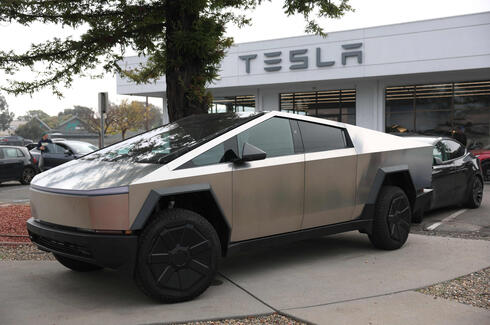
The Cybertruck was supposed to change the auto industry. Instead, Tesla is preparing to kill it
Elon Musk predicted annual sales of up to 500,000 units, but demand never came close. A series of technical problems, regulatory obstacles and an increasingly controversial public image have turned the futuristic pickup into a costly disappointment.
In November 2019, one of the most highly publicized events in Tesla's history took place: the world-renowned electric vehicle manufacturer was preparing to unveil its first electric pickup truck. Tesla had already showered the new vehicle, the Cybertruck, with superlatives, even claiming that it was bulletproof. When the unveiling finally arrived, Elon Musk, Tesla's controlling shareholder, appeared alongside the company's chief designer, Franz von Holzhausen, to present the supposedly bulletproof truck. Von Holzhausen threw a metal ball at the vehicle, shattering a window that was supposed to be shatterproof. The expletive that escaped Musk was clearly audible on the live broadcast, while his look of astonishment was watched by millions around the world.
One might have expected this to be the moment when the reality of the situation finally dawned on Musk. But it wasn't. Had something similar happened to one of the major traditional automakers, the incident might have prompted a delay in the launch, giving the company time to assess what had gone wrong and learn from the experience. For Musk, however, the show had to go on. He shrugged it off with his characteristic bravado and continued the presentation. No one made too much of the broken window. After all, Musk was a misunderstood genius. Tesla later even released a series of T-shirts celebrating the mishap, selling them alongside its branded tequila.
1 View gallery

Tesla Cybertruck in California – December 20, 2024
(Justin Sullivan/Getty Images/AFP)
The broken window was hardly the Cybertruck's only misstep. Many more followed, culminating last week when Musk announced that Tesla would likely end production of the pickup next year, just seven years after its unveiling. In Tesla terms, that is an exceptionally short lifespan. The Model S remained in production for 14 years, while the Model X lasted 11. Tesla is not a manufacturer known for abandoning models simply because they have grown old. In the Cybertruck's case, however, the company appears to be in a hurry to put an end to a project that has, to a large extent, become an embarrassment.
The Cybertruck is one of the most radical vehicles Tesla has ever developed, arguably more so than the Model X and, in the eyes of many, even the Model Y. It is also considerably more ostentatious. Start with its dimensions: the Cybertruck is a massive pickup, measuring 568 cm in length. By comparison, the Tesla Model 3 is 472 cm long. The truck is 220 cm wide, including its mirrors. Its curb weight is 2.7 tons in the base version, while the higher-end all-wheel-drive model approaches three tons. In short, this is an enormous pickup truck.
American pickup trucks are generally far from lightweight, but the Cybertruck is an especially unconventional creation within Tesla's lineup. It is a stark departure from the relatively elegant Model S, Model X and Model Y. With its long, flat surfaces and angular design, the Cybertruck is, to put it mildly, an acquired taste. Its aluminum body also comes with a limitation: Tesla has effectively told customers that they can have the Cybertruck in any color they like, as long as it is silver.
At first glance, the Cybertruck might seem like an unnecessary venture for Tesla. But the company had a reason to pursue it. The American pickup market is enormous, and demand for these vehicles was already well established when the Cybertruck was unveiled. In 2019, approximately 3.1 million pickups were sold in the U.S., of which 2.48 million were full-size models, a category that includes vehicles such as the Ford F-350, Toyota Tundra and higher-end versions of the Chevrolet Silverado. Musk's sales forecasts at the unveiling ranged from ambitious to extremely ambitious: he predicted annual sales of between 250,000 and 500,000 units. Those expectations were never met.
For starters, Tesla did not begin selling the Cybertruck in 2019, or even in 2020. Following numerous delays, the company finally launched the vehicle in 2023. In effect, it has been on the market for only about three years. Sales have fallen far short of Musk's predictions. Tesla's official reports do not disclose exact Cybertruck sales figures, but estimates from U.S. automotive research firms, including Cox Automotive, point to approximately 100 deliveries in its first year. That figure is plausible given that the vehicle only began reaching customers in November 2023. Sales rose to approximately 40,000 units in 2024, still well below even the lower end of Musk's forecast. They then fell to about 20,000 in 2025 and 12,000 in 2026.
The roof detached, and the windshield wiper fell apart
The Cybertruck's journey has been anything but smooth. Tesla appears to have ventured into unfamiliar territory, despite the considerable engineering expertise it had accumulated through years of vehicle production. As the company discovered, manufacturing a rugged pickup is very different from building a passenger car. The numerous recalls and problems that have plagued the Cybertruck reflect both the challenges of entering a new vehicle category and the difficulties of making some of its more radical design features work as intended.
In April 2024, Tesla announced its first Cybertruck recall after discovering that an unsuitable lubricant used during production could cause the accelerator pedal to become stuck. In June 2024, the motor powering the truck's enormous single windshield wiper failed under the strain. That same month, problems emerged with the vehicle's unusual manufacturing process. The rear aluminum panel had been bonded to the body, but the method proved insufficiently reliable, resulting in the panel detaching from the vehicle. In November 2024, faulty power inverters caused some Cybertrucks to lose motor power. By March 2025, further body components had come loose, this time in the roof area.
In April 2026, another problem emerged involving the rear brake discs on the rear-wheel-drive version. According to the reported defect, the discs had been installed using bolts that required four mounting holes. Those holes could widen over time, eventually causing the brake discs to break. Other problems included excessively bright lighting and the detachment of the massive light bar mounted at the front of the vehicle.
The Tesla Model 3 has had its share of problems, as have the Toyota Corolla and Xiaomi's electric vehicles. But the Cybertruck operates in a different category. A pickup truck is expected to withstand demanding conditions. It does not necessarily have to be used by farmers hauling hay across a ranch in the freezing wilderness of Wyoming, but for millions of Americans, a pickup must be rugged enough to handle a wide range of challenges, both on and off the road. The Cybertruck has struggled to meet that expectation.
Tests conducted in the U.S., some of them admittedly extreme, have shown that the vehicle's chassis can break under heavy loads. The load in question was excessive by almost any standard, but a conventional Ford pickup would likely have been better equipped to withstand similar conditions. Meanwhile, several American manufacturers have introduced electric pickups of their own, including the Ford F-150 Lightning and the electric Chevrolet Silverado. The return of Donald Trump to the White House, however, has dealt a major blow to the electric pickup market in the U.S.
The Cybertruck has faced another obstacle: its radical design and Musk's extraordinary claims have made it difficult to sell in certain markets, where regulators have questioned whether the vehicle meets local safety requirements. For years, the Cybertruck appeared on Tesla's Israeli website. Although it was never officially available for purchase, there were occasional indications that it might eventually arrive through regular import channels. In Israel, even vehicles brought in through personal imports can attract the attention of the Ministry of Transport, particularly when their owners post pictures of their new purchases online. In the Cybertruck's case, the ministry reportedly focused on Musk's claims that the vehicle was bulletproof, raising concerns that it could be exploited by criminal elements.
The Ministry of Transport consequently blocked Cybertruck imports for an extended period, eventually allowing only personal imports. There are no regular commercial imports, and none are expected. In Australia, meanwhile, Tesla informed customers about two weeks ago that their deposits would be refunded after years of waiting for the Cybertruck. The country's regulatory authorities had raised concerns that the vehicle's sharp edges could make it particularly dangerous to pedestrians in a collision.
The Cybertruck has also developed something of an image problem. When Ramzan Kadyrov, the head of Chechnya, known for his record of torture and persecution of the LGBTQ+ community, sought a vehicle to match his status and ambitions, he acquired a Cybertruck despite the absence of an official Tesla dealership in the region. Kadyrov equipped the vehicle with machine guns. He later claimed that Musk had remotely disabled it. Kadyrov, who also holds the title of "Hero of Chechnya," subsequently complained about the alleged intervention.
But one does not need to look to authoritarian leaders to understand the damage to the Cybertruck's image. After U.S. President Donald Trump appointed Musk to lead the Department of Government Efficiency (DOGE), critics increasingly directed their anger at Musk's most visible symbol: the Cybertruck. Owners reported vandalism, deflated tires and other acts of hostility. The vehicle went from being one of the coolest pickups on the road to something of a badge of shame, particularly as Tesla's popularity among Democratic voters in the U.S. came under pressure.
Will the Roadster become the next Cybertruck?
Given all these problems, it is easier to understand why Tesla is considering ending Cybertruck production so soon after deliveries began. According to the company, the factory in Texas that produces the pickup is slated to be repurposed for the Cybercab, and Tesla lacks the resources to manufacture the truck elsewhere. That explanation may make sense. But it raises another question: only a few weeks ago, Tesla unveiled another vehicle, the Roadster.
The Roadster is every bit as ambitious as the Cybertruck, if not more so. Some versions are supposed to feature special thrusters that release compressed air and enable the car to fly. It also incorporates a unique mechanism designed to press the vehicle against the road and generate exceptional grip. The similarities to the Cybertruck are difficult to ignore: extravagant promises, an uncertain production timeline, technologies that may struggle to secure regulatory approval outside the U.S., and an attempt to enter a market that is both potentially lucrative and highly specialized.
In other words, the Cybertruck's failure has almost overnight turned the Roadster into a leading candidate for the title of Tesla's next flop. Did the Cybertruck fail solely because of Musk and Tesla? Certainly not. It is an extraordinary pickup, perhaps simply ahead of its time, or perhaps too radical for the market it was designed to conquer.
There is, however, an ironic coda. Tesla has already raised the Cybertruck's price on its U.S. website by approximately 10%. After all, thanks to Tesla, the vehicle may soon become a rarity.



