










Trump's remarks on U.S. military aid leave Israel's defense establishment in the dark
Israeli officials and defense executives are seeking clarification over the future of the $3.8 billion annual aid arrangement, with uncertainty over whether Washington is considering an immediate halt or an end to the current agreement in 2028. The implications could extend from military procurement to Israeli companies' manufacturing operations in the United States.
Israeli defense officials are still trying to make sense of U.S. President Donald Trump's remarks suggesting that he had agreed with Prime Minister Benjamin Netanyahu to immediately halt the $3.8 billion in annual American military aid that Israel uses to purchase weapons from U.S. defense manufacturers.
"No one told us anything about such an understanding, and Trump's words fell on us like a bomb. If the prime minister agreed with him on strategic issues related to the alliance between the two countries, it would have been appropriate, and necessary, to hold a professional discussion beforehand. Under no circumstances should such agreements be revealed to us by chance, through an interview the American president gives to Fox News, as if Israel were a banana republic led by a single leader who makes all the decisions alone," a senior security official said.
The uncertainty has been compounded by the political climate in Washington, particularly following the midterm elections. Israeli officials are also increasingly concerned about initiatives to impose sanctions on Israel, which could threaten weapons supplies. Such efforts are being driven in part by frustration with the government's response to rising Jewish violence in the West Bank, settlement expansion and the continued deterioration of American public opinion toward Israel.
1 View gallery
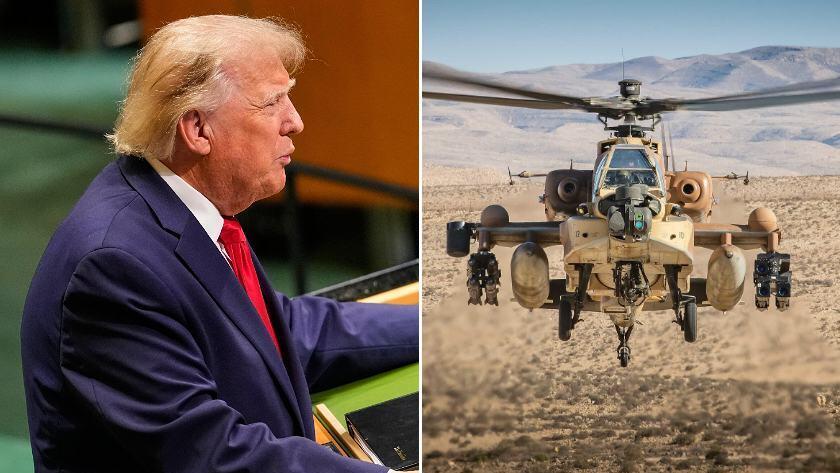
An Air Force Apache helicopter, U.S. President Donald Trump
(Israeli Air Force, AP Photo/Yuki Iwamura)
Defense and military officials assessed that the disclosure of the understandings reached between Trump and Netanyahu over the future of security assistance was intended, at least in part, to score political points for the Republican Party while voting was still underway in the United States.
Brig. Gen. (Res.) Reem Aminoach, a former financial adviser to the IDF chief of staff, told Calcalist that the political dynamics surrounding American support for Israel have changed dramatically. "During the presidential election, both Joe Biden and Trump sought to demonstrate which of them was more supportive of Israel and would continue to be more supportive. Only two years have passed, and today the situation is completely reversed. Any show of support for Israel has become a liability for a candidate."
Aminoach warned that any reduction in American aid would ultimately be paid for by Israeli taxpayers. "The IDF will not absorb a cut of even a single shekel. Instead, the entire burden will be shifted onto the public, amounting to a monthly hit of NIS 430 per person, whether through higher taxes or cuts to public services."
Executives at Israeli defense companies are among those waiting for clarification about the future of the aid arrangement. In private conversations, several said they had no idea whether Trump intended to halt the funding as early as the beginning of 2027 or was referring to the end of 2028, when the current aid agreement is due to expire.
"Whether the aid is halted immediately or only in about two years, common sense dictates that any new Israeli prime minister must fly to Washington to fight for an extension of the agreement," the CEO of one defense company, which also operates manufacturing facilities in the United States, told Calcalist. "In the coming years, Israel will not be a capital-rich country, given the massive expenditures required to finance the war. It will need every single dollar. Just a few weeks ago, the government had to implement an urgent, across-the-board budget cut to scrape together NIS 1 billion to finance the purchase of Apache helicopters.
"The entire world, including Israel's enemies, is increasing its defense spending. This is simply not the right time for such a move. Furthermore, these aid funds help cultivate Israel's relationship with the United States and strengthen the alliance between the two countries."
The uncertainty is also raising questions about the future of Israeli defense manufacturers' operations in the United States. Over the past two decades, many companies have established joint manufacturing facilities and production lines with American partners, partly to improve their access to Israeli procurement contracts financed through U.S. aid.
"We will now need to reassess our production in the United States," a senior executive at one of the major defense companies said. "This does not mean these operations will move to Israel. There is a labor shortage here, and wages in Israel are also very high. We will therefore need to identify more favorable locations for production, perhaps in India. In any case, these are not processes that can be completed in a matter of weeks or months. They will require a new strategic approach."
The growing diplomatic pressure on Israel is also being felt at international defense exhibitions. At the Euronaval naval defense exhibition, which opened in Paris this week, Israeli companies were required to comply with restrictions imposed by the French government and refrain from displaying offensive weapons systems.
"These restrictions no longer trigger the kind of uproar that makes major headlines in Israel, unlike at the first defense exhibitions where our standing began to deteriorate. We have grown accustomed to it. Every few months in France, we simply swallow a bitter pill and move on," a senior defense industry executive said. "But there is now a global trend toward ostracizing Israel, and recent decisions in the United States reflect this clearly. National security will suffer."
Dr. Avner Golov, vice president of the research institute MIND Israel and a former official responsible for the U.S. portfolio at Israel's National Security Council, warned that the consequences of a reduction in aid would extend beyond its immediate financial impact.
"Beyond the economic damage and the risk that Israel's priority status in the supply of American weaponry could be downgraded, the greater danger is that this move could be interpreted as a retreat from the American commitment to Israel's security," Golov said. "This aid is not American charity. It is a highly beneficial strategic investment. Instead of scaling back this partnership, we should deepen it through a technological alliance that would generate security and economic strength for both countries."
Dr. Sasson Haddad, a former financial adviser to the IDF chief of staff, argued that the United States receives substantial returns from its military assistance to Israel, estimating that the economic and strategic benefits amount to three to five times the value of the aid.
Those returns include opportunities for American defense manufacturers to secure additional arms contracts by demonstrating the operational effectiveness of their systems in use by the IDF, one of the world's most active militaries. Israel also shares operational knowledge and combat experience with the United States, which can inform American military doctrine, while the two countries cooperate closely on research and development of future weapons systems.
Haddad also described Israel's strategic position in the Middle East as a form of "forward deployment" that saves Washington the considerable expense of stationing American forces in the region to counter security threats.
"Israel's presence and the activities of the IDF reduce the need for future American deployments or costly interventions," he said. Haddad estimated that, in this area alone, the United States saves the equivalent of deploying two to three brigades annually, amounting to between $1 billion and $1.5 billion.
He also pointed to American concerns over China's growing involvement in critical infrastructure as another factor shaping the strategic relationship. The entry of Chinese company SIPG into the Port of Haifa, he said, created an "infrastructure-related loyalty issue" in relations between Israel and the United States, undermining the operational trust of the U.S. Navy.
Nevertheless, Haddad argued that Israel's support for the dollar's global dominance is another strategic asset in Washington's eyes. He cited Israel's reliance on Western payment systems and its decision not to join the BRICS+ grouping, which has sought to challenge the existing international financial order.
The deterioration in American public opinion toward Israel, which has helped create political momentum for reducing or suspending military assistance, is only part of the broader picture. The changing geopolitical landscape and a global arms race, described by some as the most extensive since the Cold War era of the 1970s, are also reshaping the economics of the U.S.-Israeli defense relationship.
For decades, American military aid served two purposes. It helped Israel maintain its military edge while directing billions of dollars in procurement toward U.S. defense manufacturers, supporting jobs and production capacity in the United States.
But global demand for weapons has surged over the past decade, accelerating further after Russia's invasion of Ukraine. American defense manufacturers now have production lines booked years in advance, even without taking Israeli orders into account. That growing demand could weaken one of the traditional arguments for maintaining the current aid arrangement, even as the strategic case for close U.S.-Israeli defense cooperation remains.



