










55% of jobs will be transformed by AI within three years
New research shows roles won’t vanish overnight, but expectations will.
After tens of thousands of employees have already experienced it firsthand, the fear of losing jobs to AI is no longer theoretical. Companies like Google, Amazon, and Meta have laid off tens of thousands of employees as they divert budgets toward AI. Jack Dorsey, founder of Block, announced layoffs affecting 40% of employees, citing AI-driven efficiency gains that allow for smaller teams. Oracle has also laid off tens of thousands of employees as part of streamlining efforts tied to AI, while Meta has indicated it expects to reduce its workforce by as much as 20%.
According to estimates, more than 55,000 workers in the United States were laid off due to AI in 2025, and in the first quarter of this year alone, over 60,000 workers were already laid off for the same reason.
In the local high-tech arena, companies like Amdocs have also cut staff to redirect resources toward AI. The Israeli company Fiverr laid off 250 employees in order to build an “AI-focused infrastructure,” and the Israeli unicorn Firebolt has laid off dozens of employees. The fear among employees, who wonder whether they are next, seems more justified than ever. However, according to studies by Microsoft and BCG, the more relevant question may be different.
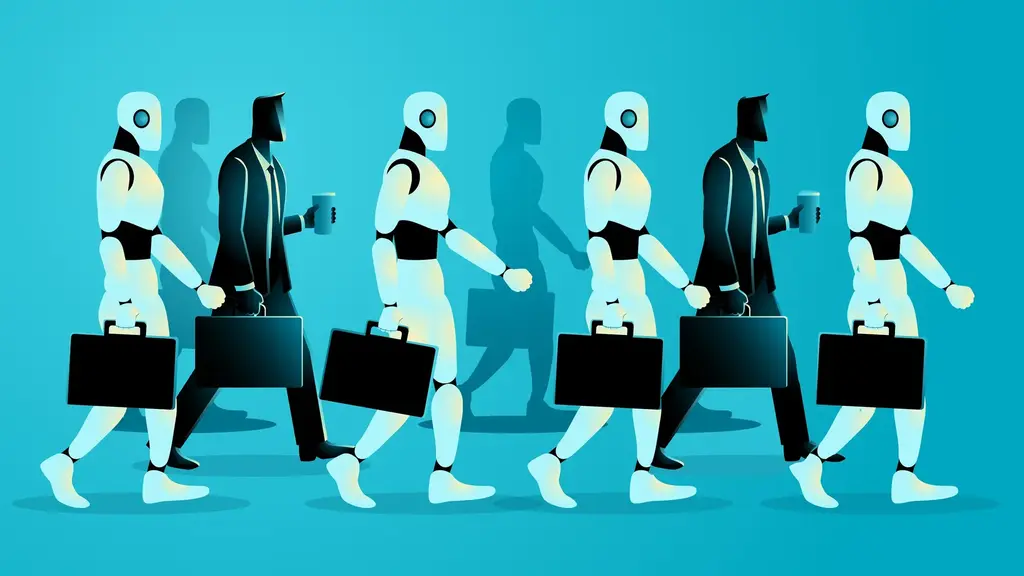
Researchers argue that the scenario in which artificial intelligence completely replaces a person in an existing role is the least likely outcome. What is already happening is a period of transition: a redesign of work routines and job definitions.
BCG’s research divides the impact of AI into short-term and medium- to long-term effects. In the next two to three years, 50-55% of jobs are expected to undergo significant change. Job titles and salaries may remain the same, but expectations will shift dramatically. Organizations will demand higher productivity, greater speed, and improved quality, all while requiring extensive use of AI tools.
In the medium to long term, however, BCG predicts actual job losses of between 10-15% of roles in the United States and, by extension, across much of the Western world. This creates a two- to three-year window of opportunity for employees and managers to prepare, managers by training their teams, and employees by upgrading their skills or reinventing themselves.
Who’s in the crosshairs?
The jobs most at risk are those that generative AI can already perform relatively well. A Microsoft study, which examined 200,000 real-world interactions with AI tools and ranked 80 professions, found that roles involving text analysis, coding, or customer service are particularly vulnerable.
The list of the 40 most “exposed” professions includes programmers and web developers, along with translators, content writers, advertisers, customer service representatives, telemarketers, and even financial analysts. These are all roles that language models can already perform to a large extent independently.
On the other hand, at least for now, blue-collar workers, who were heavily impacted by previous technological revolutions, can take some comfort. AI still cannot weld, install roofs, or draw blood in a laboratory. Professions such as nursing, construction, and heavy equipment operation were ranked as less vulnerable because they require complex physical interaction that AI cannot yet replicate.
However, researchers caution that as AI converges with advanced robotics, something that is already beginning to happen, these professions may also come under threat.
These are the ten occupations with the highest exposure to AI, and therefore at greater risk:
- Translators and interpreters
- Historians
- Flight attendants
- Service sales representatives
- Writers and authors
- Customer service representatives
- CNC machine programmers
- Call center operators/switchboard operators
- Ticket and travel agents
- Radio broadcasters and DJs
These are the ten occupations with the lowest exposure to AI, and therefore at lower risk:
- Laboratory phlebotomists
- Paramedics
- Hazardous materials removal workers
- Painters and plasterers
- Embalmers
- Industrial plant and system operators
- Oral and maxillofacial surgeons
- Automotive glass technicians
- Marine engineers
- Tire installers and repairers
The study ranked 80 existing professions, but it does not account for jobs that do not yet exist. There is also an optimistic side to the story: history shows that technological progress creates new roles. BCG estimates that efficiency gains from AI will significantly boost productivity. Higher productivity and lower costs are expected to increase demand for products and services, which in turn will require organizations to hire more people who can work with these new tools, and even create entirely new roles.
However, the ultimate decision on how to respond to these changes will remain with employers. Researchers note that business responses to AI-driven productivity gains are unpredictable. If a software developer becomes 50% more productive with AI tools, one company may choose to reduce headcount, while another may hire more developers to gain a competitive advantage.
AI is also changing career paths
One of the key insights from the BCG study concerns the transformation of traditional career paths. Historically, early-career employees performed routine tasks to gain experience, junior lawyers reviewed case law, junior programmers wrote basic code or fixed bugs, and entry-level analysts spent long hours organizing data in spreadsheets. This process helped them build expertise over time.
Now, AI can perform many of these tasks faster and more efficiently than humans. As a result, some companies are already reducing junior hiring. AI is cheaper, does not tire, and can handle repetitive work at scale. But if entry-level employees cannot gain experience, how will they develop into experts?
BCG researchers warn that without intervention, companies could face a severe shortage of senior talent in the future.
Their proposed solution is to redefine early-career roles. Junior employees will need to focus on supervising AI systems, interpreting outputs, and connecting insights to business strategy. In effect, they will be expected to adopt higher-level thinking much earlier in their careers, skipping traditional execution-heavy stages.
This shift will require companies to invest in accelerated training programs, mentorship from senior staff, and simulation-based learning environments to provide practical experience.
For employers, the message is clear: invest in reskilling and upskilling employees to prepare for the new reality. For workers, the imperative is to become proficient in using AI tools as part of daily work. Another option is to transition into roles that are currently less exposed, but even that may only offer temporary protection as technology continues to evolve.



