









“No one in Iran is waiting for Israel to ‘liberate’ them”
Iran historian Prof. Lior Sternfeld challenges a central assumption in Israeli discourse, arguing that while opposition to the regime exists, most Iranians reject foreign military intervention and do not view Israel as a liberating force, warning that war, civilian disruption, and widening perception gaps are more likely to entrench hostility than trigger internal change.
Prof. Lior Sternfeld (46) is a historian of modern Iran who has been studying it for more than 20 years and serves as a senior faculty member at Pennsylvania State University. His first book, "Between Iran and Zion," dealt with the country's Jewish communities, and his new book, "Iran: Life Itself," published this year, surveys the history, politics, and culture of modern Iran in order to "bridge the knowledge gaps and manipulations" for the Israeli reader. "I wrote this book because I couldn't believe how in Israeli society, where everyone talks about Iran and is literally obsessed with the subject, there isn't even a single history book that tries to explain it," he says. "The media here feeds the public sugar, which is easy to digest, which generates ratings. But that's not how you understand a country of 93 million people."
What, for example, do we not understand?
"We like to think that there is a positive consensus around Israel in Iranian society, as if it is just waiting for us to overthrow the regime for it. But this is a misreading of reality. Even among those who oppose the regime and express pro-Israeli positions, there is no longing for Israel to conquer Iran or 'liberate' it. Many of them remember us only as a rhetorical tool against the regime, a way to defy and put pressure on it."
2 View gallery
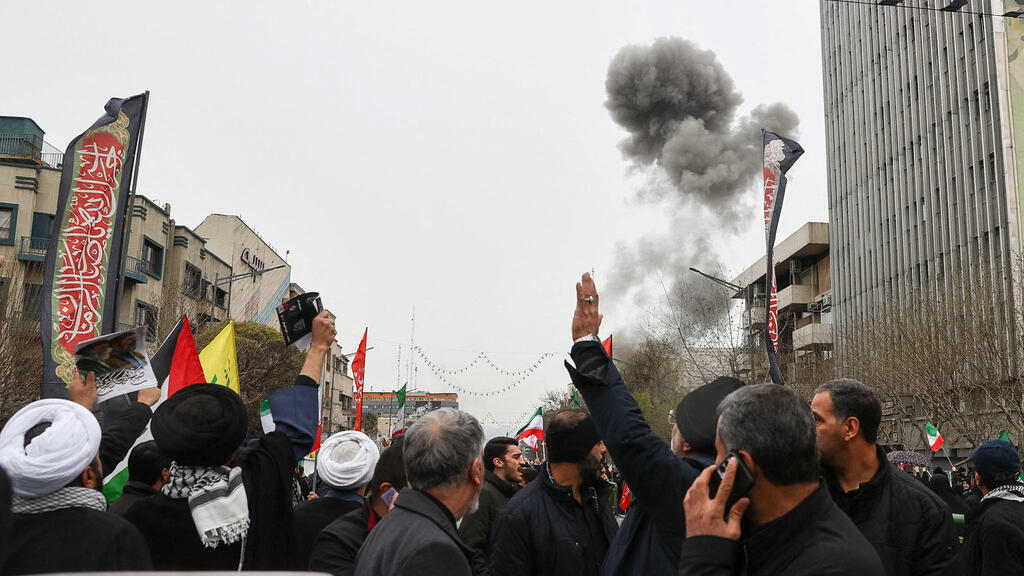
Protest against Israel in Tehran against the backdrop of an explosion from an Israeli attack, earlier this month.
(Mohammad Mahdi Dehghani/Reuters)
It's understandable that they would be angered if Israel bombed a school, for example, but what about the surgical strike on the Basij forces with drones, don't they perceive it as a positive external intervention, helping them overthrow the government?
"Any talk of a 'surgical' operation is completely disconnected from the way reality is experienced in Tehran. While in Israel they talk about precision, targeted strikes, and measured blows against the Basij, on the ground we are talking about the collapse of civilian routine: thousands of deaths, damage to infrastructure, and the lives of many others in danger. The attack on oil facilities around Tehran, for example, made the air unbreathable for days. People were waiting for rain so they could breathe. Do you think anyone there really felt gratitude to Israel then? The gap between what Israel says and what the Iranians experience only deepens the alienation toward us and strengthens the narrative of their regime."
But we have all seen demonstrations around the world, with hundreds of thousands of people carrying Israeli and Iranian flags and supporting an American-Israeli attack, as well as images from inside Iran showing support for attacks and assassinations. Doesn't that indicate widespread support for such a move?
"There are people in Iran who hoped for external intervention, who even waited for an Israeli-American attack and thought it would hasten the fall of the regime. I don't deny that it exists. But it is very far from being a majority. I don't understand on what basis people say with confidence that 'the Iranians want this'. I talk to people there and I hear mainly despair, not anticipation of bombings. No one wants to be bombed. And the idea that this is the position of the majority of the public is simply unrealistic, it is only convenient for Israeli discourse."
If not through external pressure, how does the opposition in Iran believe that change will come?
"They want change that comes from within, through a popular revolution, and not foreign intervention. We also saw this in the leaflets distributed by student organizations on the 40th day of the regime's massacre of protesters. They wrote very clearly: 'We are fighting the dictatorship of the Islamic Republic, but overthrowing the regime is the work of Iranians, not outsiders, and we oppose war.'
"This is not a complex position. They want both change and justice. There are even those who say that the assassinations of senior regime figures harm this, because they prevent the possibility of seeing those responsible stand trial. From their perspective, in order to build a different Iran, the victims need to see those who harmed them stand trial. Their struggle is not only to overthrow a regime, but also to redefine what responsibility looks like, what justice looks like, and what society looks like after years of oppression."
What did the war do to the Iranian protest?
"It brought it back to square one. In the period leading up to the current war, one could see a re-formation of the protest movement: labor organizations that began coordinating actions with student organizations, a union of Kurdish parties against the dictatorship, and a gradual return of demonstrations to the streets. But the war interrupted this continuity.
"It's not that the protesters suddenly love the Islamic Republic, but in situations like this, the very fact that Iran is under attack changes the dynamics. When you damage civilian infrastructure and create public panic, it puts another cog in the wheels of the opposition and gives the regime legitimacy and tools to tighten its repression. If the republic survives the war, the repression after it will be much more severe than it was before."
From Israel’s perspective, the main interest in going to war was to stop the nuclear weapons. Doesn’t that justify the attack?
“We already had a real window of opportunity to stop the escalation and change the direction from within, but we missed it. I’m referring to Barack Obama’s nuclear agreement, signed in 2015, which placed significant restrictions on the nuclear program in exchange for the lifting of sanctions and Iran’s return to the international market. Beyond the security aspect, there was a broader logic behind it: creating a gradual process of building trust between Iran and the powers, alongside a controlled opening of its economy and society. But its implementation remained only partial, and the sanctions were not fully lifted, partly because lifting them is much more complicated than imposing them. Then Trump came along, stopped the process, and later reversed it completely.”
Trump’s sanctions were intended to weaken the regime, to undermine its grip.
“But in practice, not only did they not weaken the regime, but they did the opposite: they wiped out the middle class and dramatically strengthened the Revolutionary Guards, which became the dominant force in the country, unrivaled, neither militarily, politically, nor economically.”
Why did the sanctions strengthen the regime?
“Because once you impose severe restrictions on legal trade, you only strengthen the gray and black markets. All the industries that collapsed because of the sanctions gradually passed into the hands of the Revolutionary Guards, trade with Russia and China, oil exports, imports of goods, construction, the financial system, everything. And that gave the Guards a power they could not even dream of before. Since 2018, they have effectively become a class in their own right within Iran.”
So were the protests in Iran actually about economic hardship, and not a demand to overthrow the regime?
"The wave of protests that began in late December did not come from one direction, but from a series of crises that accumulated and exposed the regime in its shame. You can live with a bad state, but you can't live with a dysfunctional state. At the center of the demonstrations was an acute water crisis: in certain areas of Iran, residents were stuck without running water for weeks, partly due to drought, but also due to mismanagement of water resources. Even in Tehran, water rationing was imposed for two days a week.
"This crisis was further aggravated by the economy: sanctions from the Security Council accelerated inflation, which was already high, and damaged confidence in the local currency, to the point that merchants in the bazaars refused to accept it. So, unlike previous waves of protest, which focused on concrete demands, such as subsidies in 2017 and 2019 and the modesty police in 2022, this time there was a broader sense among the public of functional collapse. People felt that the state simply wasn't working anymore."
And maybe the sanctions actually achieved their goal? After all, the economy collapsed, and the public took to the streets demanding a change of government.
"For a revolution, you need a strong middle class and an open civil society. But in practice, the sanctions have weakened the middle class to the point that they have erased it. The bourgeoisie has become another poor stratum that is busy surviving, so they cannot resort to political protest, and certainly not to building an alternative to the government.
"We need to understand that the Iranian regime came to the talks in Geneva in February with its back to the wall and was ready for more concessions. This was an opportunity that could have been used not only to talk about the nuclear program, but also about broader issues, such as the state of civil society and internal repression. As early as 2015, as part of the confidence-building measures between Obama and Rouhani, they talked about this as the first step on the way to a different relationship. At this moment, the regime could be pushed to give more space to society from within."
But that's how they preserve the dictatorship.
"Many of the activists in Iran themselves were divided on this issue. On the one hand, such an agreement would give them some oxygen, even if it prolongs the life of the regime. On the other hand, the collapse of the talks would make life unbearable, but it might also hasten the end of the regime. This is a real dilemma, and it has no simple answer."
Reza Pahlavi, the Shah's son, is mentioned as someone who could stage a coup and lead Iran. How realistic is this scenario?
"It all depends on the willingness of the United States to intervene. To bring back the exiled crown prince, an American military presence on the ground and a commitment to stay there for years to come is required. This is not something that will happen organically from the internal dynamics in Iran. If things are allowed to develop from within, for movements to generate their own momentum, it will not end with the return of Pahlavi."
Why?
"Because his image is problematic. Until about ten years ago, there was a broad consensus in Iran and among the exile communities that Pahlavi was a passive man who had never worked a day in his life and lived off the wealth his father had taken from the country. He was perceived as someone who had never really worked for Iran."
What caused his image to change?
“About a decade ago, Iranian exile satellite channels, most of them Saudi-funded, such as Iran International, began promoting Pahlavi as an authoritarian figure, mainly for media visibility rather than any real political basis. In 2022, when the ‘Women, Life, Freedom’ protest broke out following the killing of Mahsa Amini, who was arrested by the modesty police on the grounds that she was not wearing the hijab properly, there was a rare attempt to unite different factions in the opposition, during which Pahlavi was placed at the head of the coalition because the public knew his name.
“But then he simply missed the momentum. At a public panel held in 2023 at Georgetown University, in the midst of the protest, when people were still being killed in the streets, he talked about bringing in water experts from Israel. It was completely disconnected. Instead of addressing the Iranians, he spoke to Washington and Jerusalem. The event marked the beginning of his decline in status again, and his partners distanced themselves from him."
This could also explain his zigzagging about the war. He initially supported it, but this week he made it clear that he wanted only the regime and not the infrastructure to be attacked, arguing that “Iran is not the Islamic Republic. Iran’s civilian infrastructure belongs to the Iranian people. Iran must be defended, the regime must be dismantled.” If not Pahlavi, which opposition leaders do stand out in Iran?
"There are several prominent examples. For example, human rights activist Narges Mohammadi, a 2023 Nobel Peace Prize laureate, who continued to issue statements from Evin prison through her lawyers and associates, or Mostafa Tajzadeh, former deputy interior minister in the Khatami government and one of the central figures in the reformist camp, who has become a significant voice from prison in recent years, offering political alternatives to the regime and succeeding in influencing public discourse. Alongside them are cultural figures such as director Mohammad Rasoulof, who fled Iran after being sentenced to years in prison, and continues from his exile in Europe to leverage his international status to give resonance to the struggle for civil liberties."
Are you in regular contact with people inside Iran itself?
"Yes, but this contact has recently become very problematic, because the restrictions on the Internet have been tightened. There are people with whom I used to be in regular contact and now it is impossible to reach them at all. Friends tell me that the most efficient way to communicate is actually via landline phone, because WhatsApp and the Internet simply do not work regularly. But for security reasons I do not initiate direct contact with them, but am content with the information that comes from them indirectly, through friends."
Apart from friends, where in Iran does your information come from?
"Despite the situation, information continues to flow from the field from independent journalists who manage, in one way or another, to publish photos and reports, and there are also foreign media outlets that maintain a presence in Tehran."
So based on what you hear and know, how do you think this war will end, in complete surrender or again a unilateral break by American order?
"There will be no complete surrender here, certainly not outside the framework of negotiations. I don't see a scenario where the Islamic Republic simply says: 'Take the hundreds of kilograms of enriched uranium, and we're done.' The only way to reach an agreement on the nuclear issue is through diplomacy. It won't work any other way."



