










Israel approves $840 million in cuts for classified defense spending
The government says the money is urgently needed for defense procurement, but the public cannot assess the purchases or their timing. The Finance Ministry’s legal adviser warned of the cuts’ impact and pointed to alternative sources.
The government approved a NIS 2.6 billion ($840 million) cut to civilian ministries on Sunday to fund urgent defense procurement, but the classified nature of the spending leaves the public with little information about where the money will go or why the transfer is needed now. The cuts amount to approximately 4.9% of the government’s flexible procurement budget, which covers spending not earmarked for salaries or specific policy initiatives.
The decision also raises questions about why other potential sources of funding were not used first. In his legal opinion on the measure, Dudi Koppel, the Finance Ministry’s legal adviser, noted that discussions with professional staff had identified alternatives that could have had a less severe impact on government operations.
1 View gallery
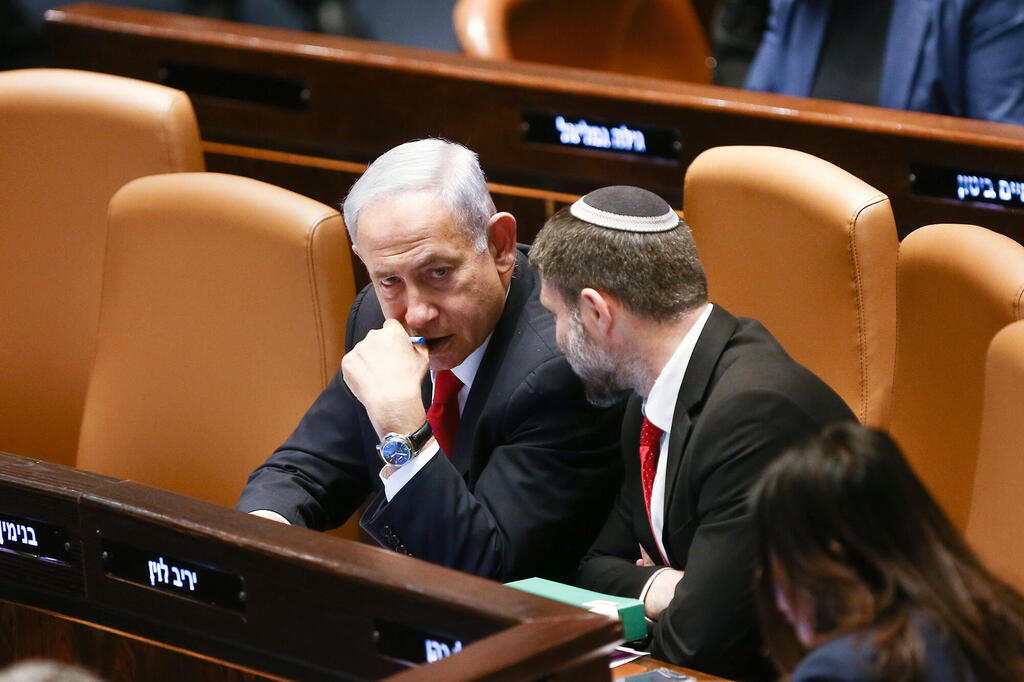
Prime Minister Benjamin Netanyahu and Finance Minister Bezalel Smotrich.
(Photo: Alex Kolomoisky)
“Discussions with professional staff indicate the existence of alternative funding sources, sources whose impact on ministry operations would be different and less severe. These include, for example, utilizing budget allocations earmarked in government decisions that have yet to be implemented, or funds that are not strictly essential for the ongoing operations of government ministries,” Koppel wrote.
His language is measured, but the alternatives he describes include coalition funds, discretionary allocations associated with political parties that have yet to be distributed. Koppel’s position suggests that such funds and other unimplemented allocations should be considered before imposing a broad reduction on civilian ministries.
The legal adviser also highlighted the scale and timing of the cuts. Given their “very significant” size, their approval at the end of the fiscal year and their likely impact on ministry operations, he argued that the government should explicitly address those consequences in its deliberations.
Related articles:
The reductions are substantial across several areas. The Ministry of Transport faces a cut of NIS 423 million ($136.5 million), while a budget line for “supervisory authorities” will be reduced by NIS 387 million ($124.8 million). That figure includes cuts to rehabilitation budgets for the northern and southern regions. The combined reductions to the Education, Welfare and Health ministries will amount to approximately NIS 420 million ($135.5 million).
The central unanswered question, however, concerns the defense spending itself. The government has approved the transfer to meet urgent procurement needs, but the underlying requirements are classified. The public therefore has no way to independently assess the urgency of the purchases, the specific systems or projects involved, or why the funding must be approved now, on the eve of an election.
The government has disclosed only that the allocation is divided into two categories: spending that requires approval from the Ministerial Committee on Procurement and spending that does not. Defense projects costing more than NIS 150 million ($48.4 million) annually, or more than NIS 400 million ($129 million) over several years, require the committee’s authorization.
Koppel’s legal opinion offers some indication of the rationale for the timing. He wrote that defense officials had indicated that any delay in approving the budget could compromise essential security responses.
He nevertheless concluded that the decision did not impose a “significant constraint on the discretion of the next government.” In his view, the measure does not establish a “new or long-term policy,” but is intended solely to fund a specific defense requirement for 2026.



