









Sam Altman admits he underestimated how slowly the economy would embrace AI
The OpenAI CEO says he expected much faster disruption from AI, but companies and consumers have proved far more resistant to changing established habits.
When performance disappoints, explanations follow. After OpenAI reported relatively modest second-quarter revenue growth, CEO Sam Altman acknowledged that he had misjudged the speed at which AI would reshape the economy, while pointing to the difficulty companies and individuals have in changing established habits.
Last week, The Wall Street Journal reported that OpenAI generated $6.7 billion in revenue in the quarter ended in June, up 17.5% from $5.7 billion in the first quarter. At the same time, its operating loss surged to $12.3 billion, an increase of 32.3% from the previous quarter.
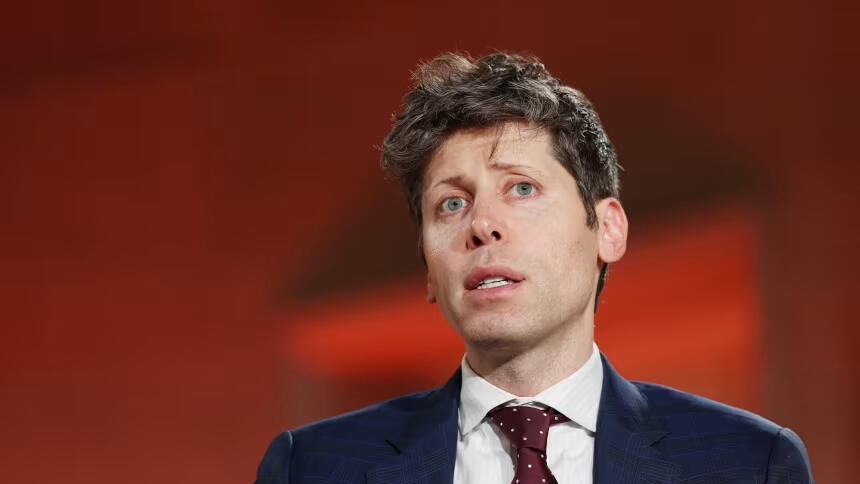
In an interview with freelance journalist David Senra, Altman did not directly address those figures. But his comments offered a possible explanation for why the economic impact of AI has so far been slower to materialize than he once expected.
"I thought when we got to GPT-4, which was back in 2023, that very quickly after that there was going to be much more disruption, software businesses up for grabs right away, than it turned out to be," Altman said. "I think I was wrong about a few things, but one in terms of the speed: the economy just has so much inertia. People keep doing the same things, buying from the same company, wanting to use their tools the same way. I think this is actually a positive in many ways, and it's going to make this big transition go smoother and slower. I'm grateful for it. But it means we've all been too ambitious on timelines. Even with this incredible technology, society and the economy will adapt more slowly."
Altman acknowledged that the gap between AI's capabilities and its adoption is visible even in his own work. Despite the tools OpenAI has developed, he said, people still switch between applications, scroll through email and copy and paste information, habits that have persisted for years.
Altman's comments highlight a tension at the heart of the AI boom. The technology industry has spent years predicting that increasingly capable AI would rapidly transform software development, knowledge work and the broader economy. If adoption is slower than expected, companies may have to wait longer for those productivity gains, and the revenue they are supposed to generate.
"I also think a lot of the people building AI have been off saying there's a 25% chance we're going to destroy the world, and yeah, we're going to race ahead to do it because otherwise those bad guys will do it first," said Altman.
"Or, man, this thing is going to be really terrible, and there's going to be 50% of the jobs gone in the next year, and we hope you all are okay, but seems really scary.
"We have not, as a field, done a very good job of explaining to people what the benefits are and how the downsides can be mitigated.
"And even where people have had answers - well, there's going to be universal basic income, or work will be optional - there's been very little discussion about how and why it's important that people have more power and personal freedom in the world, not less."
That concern is particularly notable given OpenAI's own transformation. In less than four years, the company has evolved from a research organization into one of the most influential companies in the technology industry.
Altman said that when OpenAI was founded in 2016, its founders did not have a clear plan for what the company would ultimately become. They gathered, bought a whiteboard and tried to determine what they should work on.
The company spent roughly four and a half years before achieving a significant breakthrough, he said, a trajectory that contrasts with Silicon Valley's conventional emphasis on launching quickly, finding customers and adjusting according to market feedback.
Even after ChatGPT was launched, Altman said, it was not immediately obvious to everyone at OpenAI that the chatbot was the right direction. Some employees believed its growth was unsustainable, while the company continued exploring other possibilities.
Altman said investor Peter Thiel was among those who encouraged him to focus on the chatbot, which he compared to a new interface, similar to Google's search box.
Despite his belief that AI will continue to improve rapidly, Altman does not expect humans to become redundant.
Asked what would remain for people in a world where AI could perform almost any task better than humans, he pointed to something technology cannot easily replace: human connection.
Even if AI can produce better content, hold more capable conversations or perform work more efficiently, he argued, people will continue to want to interact with other people.
As more activities become digital and automated, human, physical and authentic experiences could become rarer, and therefore more valuable.
That may ultimately be the most revealing part of Altman's argument. The obstacle to AI's economic impact, he suggests, is not necessarily technological capability. It may be the much slower process of changing how people, companies and entire economies behave.
For OpenAI, where revenue growth has slowed and losses have mounted, that argument is undoubtedly convenient. But it is also a significant admission: Even one of the companies driving the AI revolution underestimated just how difficult, and slow, it would be to change the way people work.



