










HiBob CEO dismisses IPO as "unrealistic" after Salesforce leads $166 million round
Ronni Zehavi says the company is focused on reaching $1 billion in annual sales as AI reshapes the workplace and creates a new role for enterprise software.
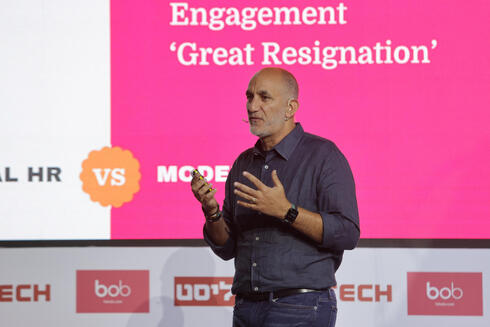
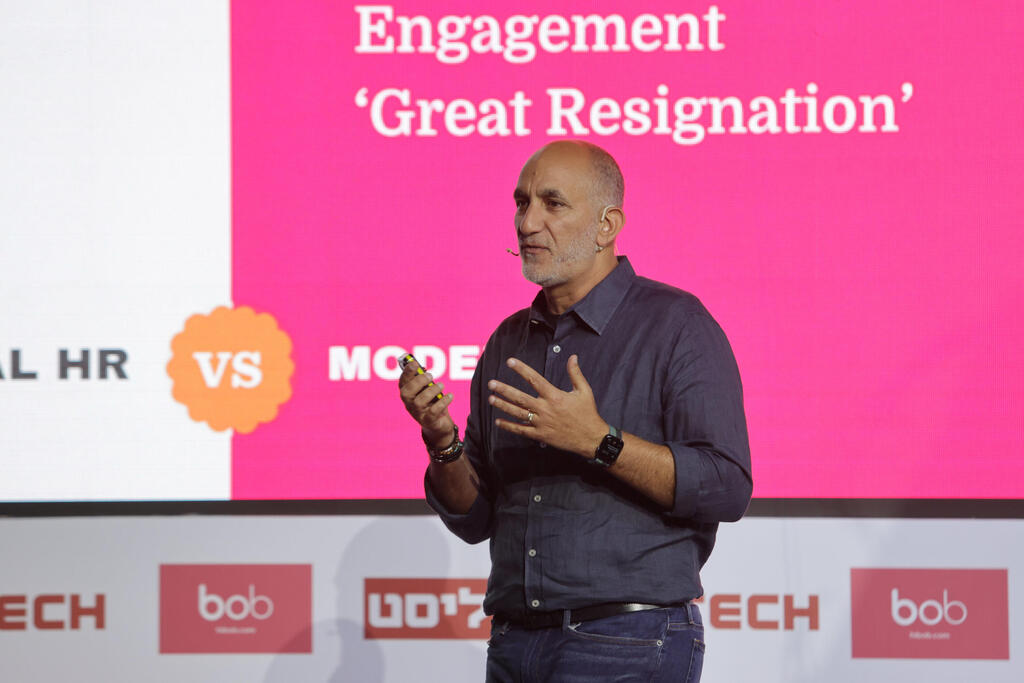
The biggest change artificial intelligence will bring to companies may not be the disappearance of employees, but the emergence of a workplace in which humans and AI agents are treated as two parts of the same workforce, according to HiBob CEO and co-founder Ronni Zehavi.
“Work from now on will immediately be a combination of people and agents,” Zehavi told Calcalist following the $166 million Salesforce-led investment in the Israeli workforce-management software company. “Every company in the world, heading into 2027, is asking itself what work will be done by people and what by agents, what roles will disappear, what skills should people have for whom AI takes responsibility for the execution, which teams have adapted to the organization and which have not, where does AI have a big business impact?”
Zehavi’s comments offer a glimpse into how one established enterprise software company is thinking about the upheaval that AI could bring to the corporate world. While much of the discussion around AI has focused on whether software agents will replace workers, or the software products workers use, Zehavi argues that companies will instead need a new layer of infrastructure to manage the combination of human and machine labor.
That could ultimately strengthen the position of established enterprise software companies, he argues, rather than make them obsolete.
Salesforce’s investment, the largest funding round in HiBob’s history, is significant in this context. Zehavi said the vast majority of the $166 million came directly from Salesforce, with no significant secondary component.
“This is a very important recognition from one of the largest software companies in the world that says that if they look at the world of work, they think that we are the company that will take forward,” he said. “This is not a small market.”
Zehavi said he recently spoke with Salesforce founder Marc Benioff about the future of AI agents and the companies’ potential collaboration in the field.
The investment comes at a time when the traditional software industry is confronting a difficult question: If AI agents can perform tasks that once required employees to interact with software, what happens to the software companies that charged businesses for each human user?
Zehavi's answer is that the most deeply embedded enterprise software may be difficult to displace.
“Enterprise and veteran software companies that have existed for many years still have a very important role,” he said.
AI model companies, he added, also understand that established software providers still have considerable room to operate.
“The model companies also understand that companies like Salesforce and like us still have a lot of room in the world and it is very difficult to get companies like us out of companies with software built using new software tools,” Zehavi said.
His argument is based partly on the difficulty of replacing systems that have accumulated years of organizational data and become embedded in how companies operate. Building an AI application may be relatively fast; persuading a large enterprise to abandon software deeply integrated into its operations is another matter.
HiBob itself now generates more than $400 million in sales, according to Zehavi, and he said the company wants to reach $1 billion in sales within the next few years.
For Zehavi, however, the most consequential impact of AI is not on the software industry itself but on the nature of work.
“We have not lost deals because of AI,” he said. If disruption comes to HiBob’s market, he expects it initially to be concentrated among smaller customers that the company does not serve.
But he believes the impact on larger organizations will be profound.
“The insight that I feel about AI is not only a technological tectonic shift and this is a once-in-a-generation revolution, but the fact that the way we work, what it works, what skills, all of this is being reborn.”
That means companies will have to reconsider basic assumptions about their workforces.
Which tasks should remain with employees? Which can be handed to agents? If an AI system performs part of a job, what skills does the employee responsible for that work need? And how should a company measure the cost of a workforce when some of its labor comes from software rather than people?
Zehavi believes even the way companies budget for labor will change.
“In the 2027 budget, if you go for an agent, you have to take into account its pricing beyond the salary per employee,” he said.
HiBob is already working on a product aimed at this emerging problem. Zehavi said the company is developing a system that will be able to price an employee, an agent or shared work.
The concept reflects a potentially significant shift in corporate accounting and workforce management. For decades, companies have largely organized their labor around employees, departments, salaries and headcount. An organization in which software agents perform a growing share of tasks could require a different way of measuring how work is allocated and what it costs.
Zehavi believes the change could eventually reshape the size and structure of companies themselves.
“The era of huge companies with many employees is over and companies will shrink and become dynamic,” he said.
He does not expect that to mean mass replacement of employees by machines.
“I don't think agents will eliminate the existence of employees, but organizations will define what is done with them and what is not done.”
In that sense, the AI transition may be less about a simple substitution of humans with machines and more about companies redesigning their internal division of labor.
That process, Zehavi said, is already underway but remains incomplete.
“The way people work today is changing from end to end,” he said. “Work processes are still lagging behind.”
The gap between what AI can technically do and what organizations are prepared to do with it could therefore become one of the biggest challenges facing companies over the next several years.
AI may be able to execute a task, but businesses still need to determine who is responsible for that task, how it fits into an existing workflow, what information the system can access, how its performance is measured and whether the work should have been automated in the first place.
For a company like HiBob, which sits at the intersection of workforce data and organizational structure, that could create a new market.
But it also creates a paradox. The same AI revolution that has fueled predictions about the decline of traditional software may make the underlying systems that understand an organization more important.
Despite HiBob’s growth and the new investment, Zehavi said the company is not preparing for an initial public offering.
“The IPO is something that is unrealistic today and not relevant in the current market,” he said.
Instead, he sees two eventual possibilities: HiBob remains independent and continues to grow, or it becomes a strategic acquisition target.
He stressed, however, that there are no acquisition discussions with Salesforce.
“There is no such talk with Salesforce and we have not had one,” Zehavi said.
The company has enough capital to continue pursuing its plans, he added.
“I have a lot of money in the coffers to go forward. I would not raise money if I wanted to be sold.”



