











Israel set to reject $4.2 billion Zim sale despite buyers’ concessions
Hapag-Lloyd and FIMI have pledged 16 ships, hundreds of jobs and a debt-free Israeli company, but regulators remain concerned about Zim’s independence.
The discussions that will culminate in the state's decision on whether to approve the sale of Zim to German shipping giant Hapag-Lloyd and the FIMI fund are expected to gather momentum over the coming month, with current estimates indicating that the deal is unlikely to be approved.
Calcalist has learned that a meeting scheduled for this week between the eight government agencies expected to submit their positions on the transaction has been postponed by a month and will now take place on September 9. A majority of the agencies are expected to oppose the deal. Only afterward will Hapag-Lloyd and FIMI be given a hearing at the Companies Authority, in what could be their final opportunity to present their case and try to persuade the state to change its position.
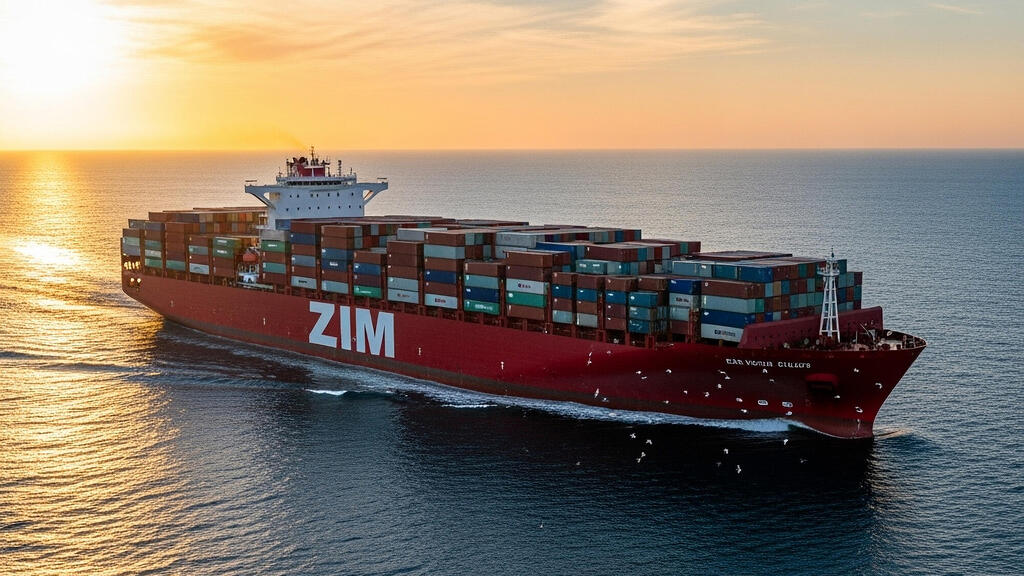
Calcalist has also learned that Tzadok Radker, head of the Shipping and Ports Authority, submitted a second opinion on the transaction last week, reiterating his opposition to the deal. The authority is the professional body on which most of the government agencies involved in the approval process rely, even if they are not formally required to adopt its position.
Radker's letter was submitted after Hapag-Lloyd, FIMI and Zim provided the government with a detailed presentation outlining what they say are the benefits of completing the transaction. The buyers, who agreed in February to acquire Zim for $4.2 billion, presented Hapag-Lloyd's commitments to Zim Israel, which would be spun off from Zim International and operate 16 ships.
The German company has pledged to establish a new Israeli regional division within Zim, employing 200 people, as well as a technology center with 250-300 full-time employees. The buyers have also pledged to maintain a regional network of third-party agents in Israel, jointly provide services to other countries and guarantee employment for workers for 10 years.
The new Zim Israel, which would be separated from the current company whose international activities would be merged into Hapag-Lloyd, was presented as a company that would be 100% focused on Israel, compared with roughly 25% today. It would also begin operations without debt, compared with Zim's current debt of $2.9 billion, while retaining access to a global network of shipping lines and major ports.
To support their case, the buyers submitted opinions from three parties: Ernst & Young, consulting firm BCG and Yigal Maor, the former head of the Shipping and Ports Authority. The buyers received 174 questions from the eight government agencies, answered 120 of them and submitted 40 files totaling about 600 pages in support of the transaction.
In the opinion obtained by Calcalist, Radker said the additional information provided by the buyers did not change the authority's overall assessment and failed to adequately address what it considers the fundamental issues surrounding the transaction.
"The cumulative weight of the positive data presented is limited in relation to the fundamental issues relating to effective control, economic and operational independence, the company's sustainability over time and the preservation of the national interests underlying the special share (the golden share)," the opinion stated.
"Therefore, the position of the Shipping Authority remains unchanged. There is no additional information presented that indicates a change in the position conveyed in the past, and therefore there is no reason to approve the transaction in its current form."
Radker did acknowledge several positive elements in the buyers' proposal, including a commitment to continue employing existing Israeli seafarers and an intention to train additional Israeli seafarers. He also noted commitments regarding Zim's independent relationships with suppliers and ports, as well as the operation of an independent information system developed by Zim for the new company.
But the authority continues to argue that the proposed Zim Israel would remain heavily dependent on Hapag-Lloyd.
"Even after the additional information, Zim Israel continues to be deeply dependent on a foreign factor that influences Zim Israel's activities," the opinion stated. "Control over capacity, accessibility to the international route network, access to key markets, means of production, operating infrastructure and commercial power centers remains with Hapag-Lloyd. Even if a separate Israeli company is established, it is difficult to see it as a fully independent entity in terms of strategy, business and operations."
The authority's concerns center in part on the fact that Zim Israel would be separated from Zim's existing international route network, which would become part of Hapag-Lloyd. It also argues that the new Zim would be a relatively small company and could struggle to meet the requirements associated with the state's golden share.
The buyers have committed to placing 16 ships in the new company, compared with the 11 ships currently required under the golden-share mechanism. But the authority argues that if the new Zim encounters financial or operational difficulties, many of the commitments could become difficult to fulfill.
The authority's assessment does not, however, address the buyers' argument that the new company would begin operations without debt, in contrast to the current Zim, which carries approximately $2.9 billion in debt.
Hapag-Lloyd and FIMI are furious about what they describe as the tone and handling of the process. They argue that, apart from three short meetings with representatives of the Accountant General's Department at the Finance Ministry, the Defense Ministry and the Shipping and Ports Authority, they have not been given a meaningful opportunity to present their position.
According to the buyers, the decision now taking shape has emerged without a serious substantive discussion of the transaction and is based largely on the Shipping and Ports Authority's position. They also suspect that elements within the management of the former company that submitted a competing offer, as well as the workers' union, are working to derail the transaction in various government ministries.
As of now, the Defense Ministry, Economy Ministry, Agriculture Ministry and, most importantly, the Transportation Ministry are opposed to the deal, largely relying on the Shipping and Ports Authority's assessment. The Finance Ministry and the National Maritime Administration have yet to submit their positions, although the Accountant General's Department within the Finance Ministry is known to oppose the transaction.
As a result, the chances of approval currently appear slim. The expectation is that the official decision will be made next month, after the Companies Authority, headed by Roi Kahlon, receives the formal positions of the various government bodies.
FIMI said in response that "the Shipping Authority's position is based on fundamentally incorrect factual assumptions."
"To date, only one general meeting has been held with the director of the authority. The authority said it had additional questions, but these have not been asked to date. Throughout the process, FIMI has made significant improvements and adjustments to the outline to address the concerns raised, and has submitted external opinions from leading bodies and approximately 600 pages of responses."
"It is difficult to shake off the impression that the authority has no real desire to return Israeli control to an Israeli shipping company, the new Zim, in the face of 88% foreign control today, to preserve the future of shipping and seafarers in Israel, and to clarify the facts."
FIMI added that it wanted to hold meetings with the relevant authorities "to present the full facts and documents and answer every question."
"The new Zim will be an independent and strong Israeli company at all levels of its activity, independent of any foreign entity. The new Zim's shipping lines include activities to Israel, including the Mediterranean, major cargo ports and the U.S. Control of the core business, operations, strategy and future growth will be in its sole hands. The company will be debt-free, and its information system is proven and widely deployed worldwide."
FIMI also questioned the timing of Radker's opposition, noting that the authority's director had expressed his position as early as February 15, before the deal was announced and without knowing its details. By contrast, former authority director Yigal Maor submitted a detailed professional opinion supporting the transaction.
"We are convinced that a professional examination of the full material and of the deal in its current form will prove that the new Zim constitutes a significant upgrade for Israel's security and national interests," FIMI said.
In their presentation, the buyers requested additional time and the opportunity to meet with the relevant government bodies. FIMI is not expected to petition the state if the deal is rejected. Hapag-Lloyd, however, may consider legal action, while also hoping that the formation of a new government after the elections could lead to a more substantive reconsideration of the transaction.



