










The race to build a robot housekeeper is on. Five contenders put to the test
From 1X's $20,000 NEO to Unitree's $13,500 G1 and Sunday's laundry-folding Memo, companies are taking different paths toward the automated home. But the machines still face major challenges involving reliability, safety, cost and mass production.
Folding a pile of laundry, unloading the dishwasher, tidying up toys in the living room. It is easy to think of countless household tasks we would love to hand over to a robot. Companies such as Tesla, 1X and Figure are trying to turn that dream into reality with humanoid robots: machines designed to move around human environments and take care of some of our chores. But there is still a wide gap between the ambitious promises and what these robots can actually do today.
So what exactly is a humanoid? It is a robot with a physical structure that resembles a human, typically featuring a torso, arms and legs. Ofir Ozeri, a computer engineer and robotics content creator (@0fir0z on X), explains that the idea behind humanoid robots is to create machines that can operate in environments designed for people.
"We have engineered the world to suit our needs, designing it to fit our physical form. If the goal is to build a robot capable of performing everything a human does, then a humanoid shape allows it to utilize all the tools that humans use. There is no need to invent a new type of Velcro or a new kind of car," he says.
In the past, developing a robot required expertise in several fields, including mechanics, electronics and software. For example, teaching a robot to navigate a room and avoid obstacles meant planning its movements, writing the necessary software and selecting sensors capable of providing the required information. In recent years, however, the AI revolution has begun to transform the field. According to Ozeri, AI tools are simplifying the development process and making it easier to teach robots a wide range of tasks. He expects this progress to accelerate.
"Once everything comes together, converges and advances, it will be possible to develop robots with great ease, much like how apps are built today," he says.
So what is actually available today, and what remains little more than a promise? We examined five robots seeking to enter the household market through different approaches, looking at what each can do, how much it is expected to cost, how its developers address safety concerns and when, if ever, it might reach our homes.
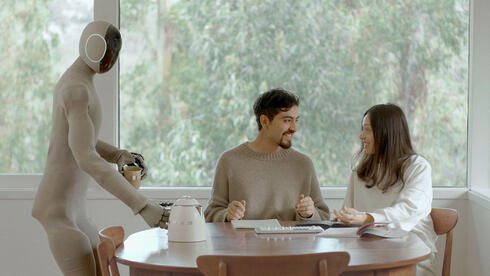
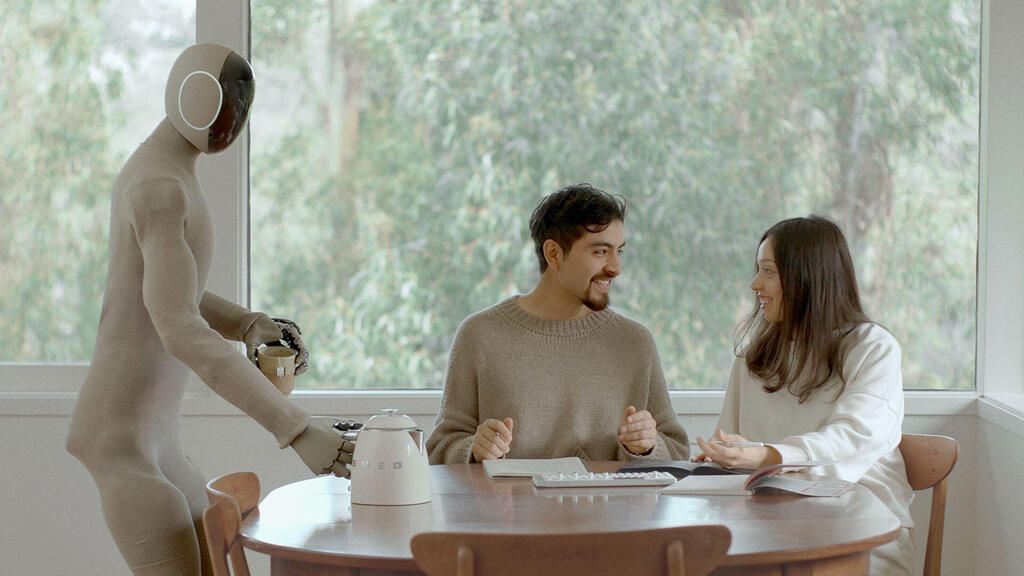
1X's NEO: A household assistant that still needs some help
NEO is a humanoid robot developed by 1X, a robotics company that originated in Norway. The company develops robots designed to work alongside people, and NEO is its model intended specifically for home use. According to 1X, users will be able to give it voice commands to open doors, fetch items and perform household chores such as tidying up and folding laundry.
If NEO encounters a task it does not know how to perform, its owner can arrange for a 1X employee to connect remotely, guide the robot through the task and help it complete the action. The idea is that the robot will then be able to learn how to perform the task independently in the future.
"When considering which humanoid will capture the market, NEO is definitely my favorite," Ozeri says. One reason is its mechanical design: its movements are powered by cables pulled by motors, a system designed to enable delicate and controlled motions. In Ozeri's view, the combination of its capabilities, price and safety-focused design makes it a strong candidate for household use.
When will it arrive in homes? NEO is currently available for pre-order, but it cannot yet be purchased for immediate use. 1X plans to begin delivering the first units to customers in the United States soon, although it has not provided a specific date. Customers who pay $20,000 will receive priority delivery, while a subscription option priced at $499 per month is expected to become available later. The company has said it plans to expand into additional markets starting in 2027, but has not announced a launch date for Israel.
Figure 03: Already making beds, but its arrival in homes remains uncertain
Figure 03 is the third-generation robot developed by the American company Figure. The company presents it as capable of doing laundry, cleaning and clearing away dishes. For now, however, most demonstrations of its capabilities have come from the company's own trials.
In September, Figure reported testing the robot in 30 homes it had never encountered before. During the trials, it gathered toys, folded towels and made beds. According to results published by the company, the robot successfully completed its assigned task in 56% of attempts.
Ozeri considers Figure a significant competitor. "You cannot take away the innovation and capabilities the engineers have developed," he says, adding that he believes "they have a strong chance of capturing a large market share."
Unlike NEO, Figure is focusing on integrating visual and tactile sensors with its Helix AI system. The company is training the system on vast amounts of data so that the robot can perform tasks even in unfamiliar household environments. Ozeri believes this approach could allow Figure to tackle a broad range of activities.
"It's generating hype and expectations. If Figure fails, it will be a major event that reshapes the entire industry," he says.
But Ozeri is less impressed by the safety measures Figure has presented. "There is no innovation there that I would consider noteworthy for the field," he says.
Figure has not announced a consumer price or a timeline for delivering Figure 03 to households. Ozeri estimates that the production cost could reach approximately $300,000 per unit. At that price, he suggests that the initial route into homes could be through a service model: an operator, such as a building management company, would own the robot and send it to perform tasks in several households.
"I don't need to sell it to you. I can load it into a van, drop it off at your place to get the job done, and then either bring it back to the facility or send it on to the next client," he explains.
Tesla Optimus: The promise is still a long way off
Optimus is the humanoid robot Tesla is developing to perform tasks that are repetitive or dangerous for people. The company has already demonstrated it handling battery cells and announced this month that it has begun initial production at a plant in California. These are steps toward a commercial product, but Tesla has yet to demonstrate that Optimus can independently and reliably perform a range of household tasks. Elon Musk himself recently acknowledged that work remains to be done on the AI system before the robot can handle tasks that have not been specifically defined in advance.
Ozeri sees Tesla as having significant advantages. The company has experience developing hardware, software and AI systems, as well as manufacturing products at scale. "This is a company with all the elements to succeed," he says. But the challenges Tesla faces in developing Optimus stand out precisely because of those advantages. "Two years ago I would have said he would take it easy," Ozeri says. Today, however, he believes that "Optimus is really facing very difficult challenges."
Safety is another concern. Ozeri points to the risk of the robot falling in the event of an electrical failure. Musk said in October that Tesla still needs to improve the design to ensure that the robot is safe, reliable and durable. The company has not published the results of safety tests for household use.
Tesla has not announced a consumer price either. Musk previously estimated that, if produced at scale, Optimus could eventually cost around $20,000 to $30,000. According to Musk, Tesla hopes to begin supplying robots to companies outside the company toward the end of 2027, initially for industrial use. He has also discussed eventually selling the robots to households, but has not provided a timeline.
Unitree's G1: Available to order, but not yet practical
The G1, developed by the Chinese company Unitree, is already available to order, including for delivery to Israel. The base model costs $13,500, excluding shipping and taxes. Unitree has demonstrated impressive movement capabilities, but the basic G1 model cannot understand general instructions and carry out household chores.
"If you buy one, you can control it remotely, tell it to dance or raise its hand, and it will comply. But if you ask it to 'fold the laundry,' it won't be able to do it," Ozeri says.
He believes Unitree's manufacturing capacity could become a significant advantage, provided the company or others develop the software needed to enable the robot to perform such tasks. Unitree has not announced when the G1 might become capable of serving as a household assistant.
On safety, Unitree itself advises users to maintain a safe distance from the robot while it is operating. Ozeri notes that the machine includes mechanical safeguards, but believes that "safety in the Unitree robot will primarily stem from the software, rather than the hardware."
For now, people buying the G1 are mainly doing so for research purposes rather than as a practical household assistant.
Sunday's Memo: An assistant on wheels
Memo, a home robot developed by the American company Sunday, differs from the other models in this review. It has a human-like torso and arms, but moves on wheels rather than legs, making it a semi-humanoid robot.
Sunday has demonstrated Memo clearing dishes from a table, loading them into a dishwasher and starting the cycle, preparing coffee and folding laundry. In a test published by the company in July, Memo successfully folded and stacked clothes in 778 out of 785 attempts, a 99.1% success rate. Sunday said the test was conducted in homes the robot had not previously encountered and without requiring separate training for each household.
Ozeri is particularly impressed by the method Sunday uses to train Memo. People record themselves performing household tasks while wearing a glove developed by the company, and the demonstrations are then used to train the robot. According to Ozeri, this approach makes it possible to gradually expand the range of tasks Memo can perform.
The use of wheels offers both advantages and limitations in a household environment. Sunday says the robot's stable wheelbase and low center of gravity are designed to prevent it from tipping over during a power outage. Ozeri sees this as a safety advantage, but notes the obvious practical drawback: Memo cannot climb stairs.
When will it be available, and how much will it cost? Memo is not yet on the market. Sunday is currently accepting inquiries from families interested in participating in home trials, but has not announced a date for commercial sales. The company says that manually producing a single robot currently costs approximately $20,000, but expects to reduce that figure by at least half once mass production begins.
So when will humanoid robots become a common fixture in our homes?
Ozeri expects the first robots to enter households to be far from full replacements for human help. They are also likely to remain expensive, meaning that hiring a human helper will probably be the cheaper option, at least initially.
"They might actually add to your workload," he says. "They are intended for enthusiastic hobbyists and early adopters." Even when they can perform some tasks, "you will likely still have to finish any task you assign them yourself."
He nevertheless believes this phase could be relatively short-lived. As more data is collected and used to train the robots, their capabilities should improve. "We might be on the verge of a major breakthrough," he says.
How close is that breakthrough? Ozeri estimates that robots capable of helping with at least some household chores could emerge as early as the first half of 2027. But he distinguishes between developing a robot that can assist in a home and making it available to large numbers of households.
"This isn't software that you write and can then distribute to every computer. You have to build factories and supply chains, raise capital, and establish sales, maintenance and logistics operations," he says.
In his view, it will still be "quite a few years" before an effective household robot becomes affordable and accessible to the middle class.



