









"Data is the fuel of the new world. We must make sure it remains ours."
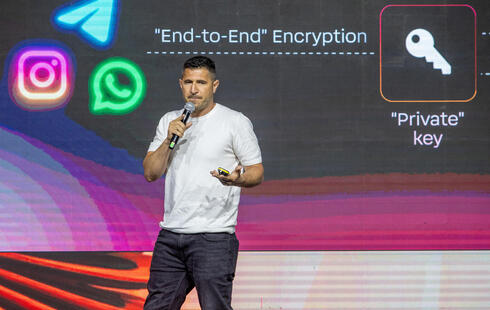
Benny Meir, co-founder and CEO of Modelyo, which is developing a platform for encrypting data during its processing, was speaking at the Calcalist and Mizrahi Tefahot Growth Conference. According to him, "Everyone is talking about AI, but the data is still completely open - it is impossible for us to continue sharing our information with AI models without control over the encryption key."
"Data is the fuel of the new world. We must make sure that it remains ours, and no one else's," said Benny Meir, co-founder and CEO of Modelyo, at the Calcalist and Mizrahi Tefahot Growth Conference. According to him, the rapid transition to a world of AI, data centers, and AI agents requires a new approach to information security, one in which even data being processed remains encrypted and under the full control of its owners.
Meir began by explaining how most cloud services operate today. According to him, users tend to trust that their information is protected, but in practice, large organizations, technology companies, and defense organizations cannot rely solely on blind trust in cloud providers. "There is encryption for data at rest, and there is encryption for data in transit. But there is also data being processed. That is precisely where one of the biggest vulnerabilities lies."
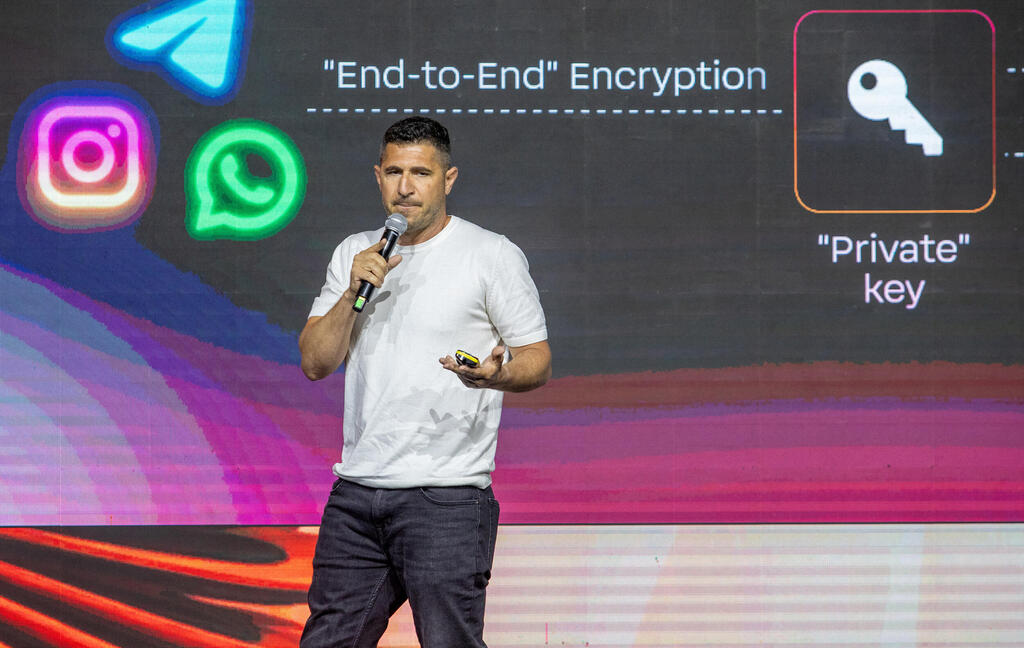
According to him, the transition to AI only exacerbates the problem. "Everyone is talking about AI and data centers. A data center is a massive infrastructure whose sole purpose is to process information, but during processing the data is completely exposed."
He went on to describe the technological evolution expected in the coming years. "Once, people communicated with people. Then we moved to sensors, then to chatbots. The next stage is that we will all communicate with AI agents. After that, agents will communicate with other agents and make decisions independently, and eventually robots will make decisions in the physical world. If I have to trust an AI agent or a robot, I am not willing to have my data and commands exposed."
Meir added that even when information itself is encrypted, understanding the context of questions and answers can sometimes reveal sensitive information. "Sometimes you don't need to hack into the cloud. It's enough to know what you asked or what you answered. That, too, is valuable information. That's why the control systems for AI agents and robots will have to be end-to-end encrypted."
He later referred to his personal experience during the Swords of Iron war. "On October 7, I returned to reserve duty. We had to process massive amounts of data, but we didn't have enough GPUs and CPUs available, so we moved to a public cloud. In the end, our data was exposed. There were also reports that data from technology units had been exposed. For me, that illustrates why we can no longer rely solely on the existing cloud model."
According to him, the solution developed by Modelyo is based on ensuring that the encryption key remains solely in the hands of the customer. "We took a vault and put it in the cloud. Each party can speak its own language, but no one shares the encryption key. The whole world understands that we cannot continue sharing all of our information with ChatGPT, Anthropic, or other AI platforms the way we do today. We need a solution where the key belongs only to me, my company, or my organization."
Meir concluded by saying that he believes this market is poised for rapid growth in the coming years. "We don't just claim the system is secure, we prove it through cryptographic and mathematical proofs. Ultimately, data is the fuel of the future, and we must make sure that it remains ours, and no one else's."



