










Analysis
US "financial attack" on Iran: Stepping up, but the test will be in China
The US Treasury Secretary presented the plan to isolate Iran's economy by expanding the possibility of imposing secondary sanctions on foreign entities operating in five sectors: shipping, aviation, technology, gold and digital assets; Will Washington act against large entities in China - Iran's main oil customer?
After the headlines about "economic D-Day" and "the largest financial attack in history," the package presented this evening by US Treasury Secretary Scott Bessent was less dramatic than the rhetoric that preceded it. Washington did not initially activate the strongest tools against the entities that allow Iran to continue trading, and especially against large financial institutions in China. However, there is a step up here as the US is expanding the focus of pressure from Iran itself to companies and banks around the world that allow it to continue conducting economic activity. Nearly 60 companies, people and vessels have been added to the sanctions lists, but it is doubtful whether this list alone will change Iran's situation. Tehran has lived for years under heavy sanctions and has built a network of shell companies, intermediaries, alternative payment channels and a fleet of tankers that change costs and flags to bypass them. The most important new effort is the expansion of the possibility of imposing secondary sanctions on foreign entities operating in five sectors: shipping, aviation, technology, gold and digital assets.
1 View gallery
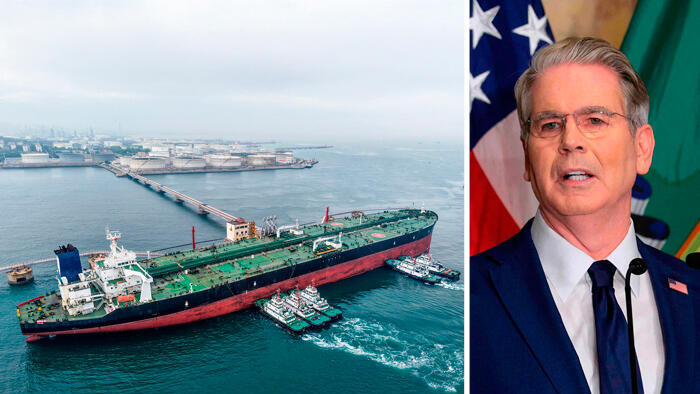
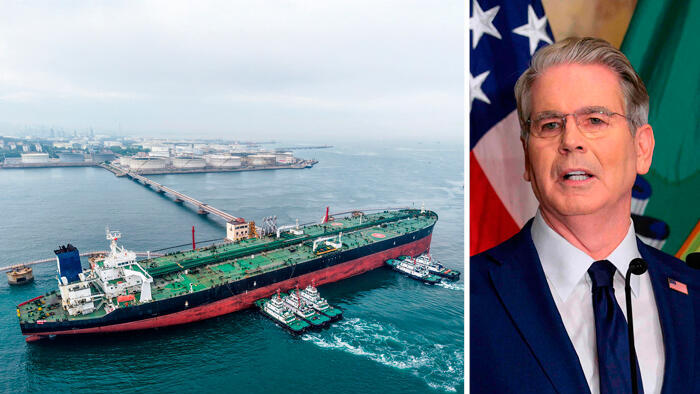
Chinese oil tanker, US Treasury Secretary Scott Bessent
(AP Photo/ Julia Demaree Nikhinson CN-STR /AFP)
This means that the Ministry of Finance does not have to focus only on a company that has already been identified as part of a certain Iranian network. It is given greater scope to act against foreign companies that provide services to these sectors. It should be emphasized that the U.S. could also previously punish foreign companies that helped Iran circumvent sanctions or worked with Iranian entities that had already been blacklisted. The new effort now is the expansion of the legal basis: Washington defined, as mentioned, five additional sectors as sectors of the Iranian economy subject to sanctions. By doing so, it makes it easier for the Office of Foreign Assets Control (OFAC) to act against foreign companies that operate in these sectors or provide services to them, even without proving in any case which are part of an indirect network that has already been identified.
Bessent’s comments indicate that the sanctions are not automatically imposed on everyone who does business with Iran, but they significantly increase the risk. A bank, shipping company or technology provider should take into account that continuing to operate with Iran could jeopardize their access to the American financial system.
At the press conference, Bessent emphasized that this is only the first step. He said that countries would be given a specific period of time to stop activities related to Iran that Washington had already identified, and made it clear that China was not exempt. Even more significant was his announcement that he expected a major financial institution to face sanctions by the end of the week. If this does happen, it will be possible to better understand the extent to which the administration intends to implement the threat and not be satisfied with deterrence.
Here lies the key test of the move. China has been the largest customer of Iranian oil for years. Large state-owned refiners generally avoid direct purchases, but independent refiners and a network of middlemen continue to absorb discounted Iranian oil. Washington has already punished small Chinese refiners and warned two major Chinese banks, but has so far refrained from putting the big banks on sanctions lists.
There is a reason for this. Action against a major Chinese bank could turn the campaign against Iran into an economic confrontation with Beijing. The United States will have to decide how much it is willing to risk broader interests with China in order to block Iranian revenues. This is the line that separates a broad threat from a real change in Iran’s ability to sell oil and receive money in return.
The starting point has also changed. According to recent data, Iranian oil shipments to China have already fallen from about 823,000 barrels per day in July to about 534,000 barrels per day in August, after the US blockade was tightened. This means that more sanctions on small companies could add pressure, but the bigger blow would come if the US succeeds in blocking the financing and payment mechanisms that keep this trade alive.
Meanwhile, the oil market did not react as if significant Iranian supplies were about to disappear immediately. Brent traded around $91-92 a barrel after the announcement, after declining throughout the day. This shows that the market is not panicking and is waiting to see whether there will be enforcement and not just declarations.
Hence, Bessent’s announcement is significant primarily because it expands the tools at Washington's disposal and attempts to get foreign companies to withdraw from Iran even before sanctions are imposed on them. The test will come in the coming weeks. If banks, refineries, and major shipping companies begin to distance themselves from Iran for fear of losing access to the dollar, the pressure on Tehran will increase to another level. If enforcement remains primarily against shell companies, brokers, and tankers that are relatively easy to replace, Iran will continue to adapt - at a higher cost, but without losing its trade arteries. China is where it will become clear which of these two scenarios will materialize.



