











Israel's construction industry fights to keep Indian and Sri Lankan workers coming
The government's decision to end private recruitment from the two countries has triggered an industry-wide pushback. Contractors warn that alternative recruitment channels could take too long to establish, threatening to deepen labor shortages and further delay housing projects.
Will the state reverse its decision to halt the private-sector recruitment of foreign workers from India and Sri Lanka? The decision, announced about a month ago, sent shockwaves through the construction industry, triggering intense pressure on policymakers from contractors, developers and other industry stakeholders.
Calcalist has learned that several government ministries have been making significant efforts in recent days to convene a committee of directors-general to reconsider the decision and assess its implications. The initiative has so far received a positive response.
The Population and Immigration Authority announced that private recruitment from the two countries would be halted from the beginning of 2027, citing international concerns over human trafficking in both countries. The move has drawn strong opposition from the construction industry, which relies heavily on India and Sri Lanka as sources of labor.
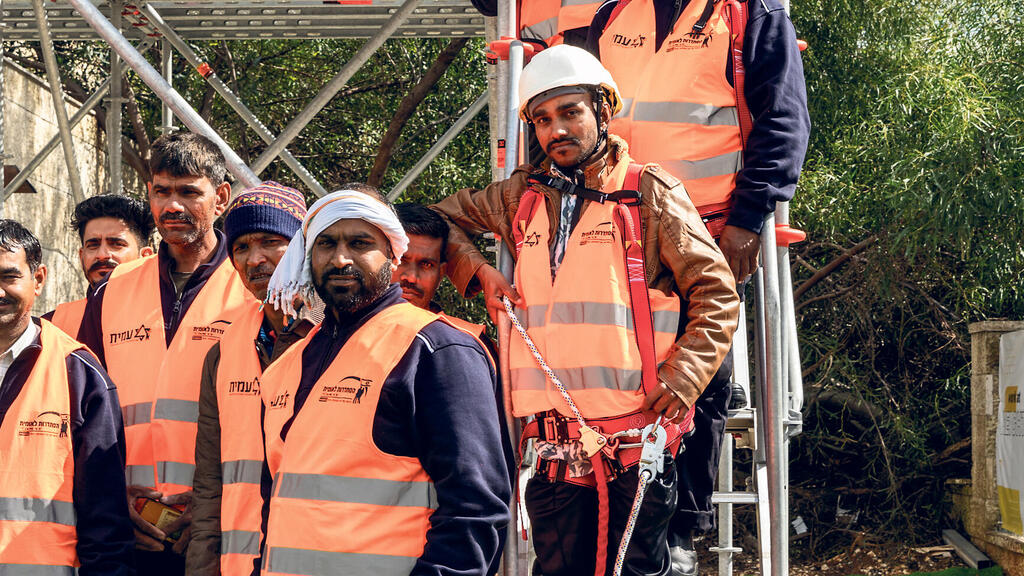
In its announcement, the authority said private recruitment would remain possible from a list of other countries, including Uzbekistan, Azerbaijan, Italy, Montenegro, Mexico, Poland, Albania, Ecuador, Brazil, Guatemala, Georgia, Hungary, Vietnam, Portugal, the Philippines, Panama, Kosovo, Romania, Thailand and Turkey. But establishing recruitment operations in a new country is a lengthy process, and contractors warn that the transition could interrupt the steady flow of workers on which the industry depends.
The risk of a renewed labor shortage is also reflected in the efforts of the Ministry of Construction and Housing to develop an alternative framework and increase the number of foreign workers permitted to enter the country. In a letter to Drorit Steinmetz, acting director general of the Prime Minister's Office and head of the committee on foreign workers, the ministry's Director General Yehuda Morgenstern said the shortage was affecting both construction schedules and costs. He put the existing shortfall at between 20,000 and 25,000 workers.
The ministry is calling for the private-sector quota for foreign workers to be increased by 20,000, a reduction in recruitment fees, and the development of an alternative model under which the public and private sectors would cooperate in countries of origin to bring workers to Israel.
The Israel Builders Association is also pressing the government to find a way to maintain a steady supply of workers. In a letter recently sent to the ministries of Housing, Interior, Foreign Affairs and Economy, the association's Director General Igal Slovik called for the decision to halt direct private recruitment from India and Sri Lanka to be reconsidered. He urged the government to keep the existing channel open until an alternative system is in place.
Slovik warned that an abrupt change to recruitment arrangements could disrupt the supply of labor, delay construction projects and raise financing costs. "A list of 'approved countries' does not guarantee the actual arrival of skilled workers. For each country, it is necessary to assess the availability of qualified professionals, their willingness to come to Israel, and the time required to set up an effective recruitment infrastructure," he wrote.
The association argues that efforts to diversify and expand the industry's sources of labor should be gradual, taking place alongside existing recruitment channels and only as new sources demonstrate their capacity to supply workers. Otherwise, it warns, a gap could emerge between regulatory approval and the actual arrival of workers needed by the construction and infrastructure sectors.
Its proposed solution is a hybrid model operating under government oversight, with candidates recruited by licensed private manpower agencies in India and Sri Lanka, subject to approval by the relevant authorities in those countries.
The announcement has been difficult for the construction industry to absorb, coming after several exceptionally challenging years for contractors and developers. The sector has faced a severe shortage of workers, which had only recently begun to ease, while the disruption has also contributed to a significant increase in housing construction costs.
The scale of the industry's dependence on foreign labor becomes clear when looking at the workforce before the October 7 attacks. At the time, Israel had approximately 130,000 construction workers, including around 80,000 Palestinians, 25,000 foreign workers, 14,000 Arab Israelis and another 12,000 workers employed by foreign construction companies operating in Israel. These figures focus primarily on workers carrying out so-called wet construction tasks, rather than the wider workforce of engineers and other professionals or employees in related industries.
After the outbreak of the war, Palestinians were barred from continuing to work in Israel, causing the available workforce to plunge and construction projects to fall behind schedule. Over the following three years, specialized recruitment corporations were established, and tens of thousands of foreign workers were brought into the country to fill the gap.
Today, approximately 90,000 foreign construction workers are employed in Israel. Although the workforce has recovered significantly, the industry still faces a shortage estimated at 20,000 to 25,000 workers. Against this backdrop, contractors fear that a poorly managed change to recruitment policy could once again undermine the sector's recovery.
The shortage has already had a measurable impact on construction timelines. Between 2023 and 2025, the time required to build an apartment in Israel increased by approximately 5.1 months. The additional time can carry substantial financial consequences for developers. Those who have not built the longer schedule into their original delivery commitments may face claims for compensation over late handovers, as well as higher financing costs.
As policymakers reconsider the recruitment decision, they will also have to contend with a widening gap between the number of homes whose construction is beginning and the number being completed. Housing starts have risen over the past decade, from approximately 57,000 units a year to around 80,000 in 2025. But the number of completed homes has remained largely stagnant over the past two years, at roughly 60,000 a year.
In other words, more apartments are entering the construction pipeline, but the time it takes to build them is increasing. The result is a growing backlog of projects still under construction, making the availability of workers a critical issue for the industry's ability to turn housing starts into completed homes.



