







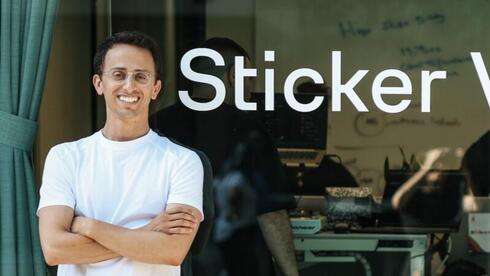



Assaf Rappaport: “I received an envelope with $30 billion written on it. I said no right away”
The Wiz CEO reveals new details of the $32 billion Google deal and discusses wealth, tech culture and his growing public role.
"I received an envelope with '$30 billion' written on it. I said no right away. Whenever a proposal comes in, when a company decides to acquire another, it’s a huge compliment... but the initial figure they present isn't the final one, so you always say no."
With these dramatic words, Assaf Rappaport, founder and CEO of cybersecurity company Wiz, described the pivotal moments behind the deal that went down in history as the largest exit in Israeli high-tech: Google's $32 billion acquisition of the company.
Rappaport made the remarks during a candid conversation on the interview program Meeting with Roni Kuban, broadcast on public broadcaster Kan 11. In the interview, Rappaport broke a long silence to discuss the behind-the-scenes negotiations over the deal, corporate culture in the technology industry, his life with billions of dollars in the bank and his growing involvement in public and media affairs.

The path to the record-breaking deal with Google was neither simple nor predictable. Rappaport revealed the sequence of dramatic interactions he had with Google's CEO, Sundar Pichai.
It began when Wiz, then valued at $12 billion, received an initial acquisition offer of $23 billion. Although the documents were ready to be signed, Rappaport and his partners decided at the last minute to call off the deal.
"We had a gut feeling it was too soon... I felt like a fool at 4:00 a.m.," Rappaport recalled. "I imagined myself as the CEO walking around with a label over my head reading, 'Here’s the fool who could have sold for $23 billion but is now worth $8 billion.' I called Sundar, dreading the conversation... but he responded graciously, saying he felt he had lost his right-hand man and asking how we could become the best of partners from that moment on."
"It was a style of leadership I hadn't encountered before."
About six months later, Pichai urgently summoned Rappaport to a discreet breakfast in a private hotel room in New York. He handed him a large brown envelope containing a $30 billion offer, accompanied by an ultimatum to close the deal within seven days.
Rappaport responded immediately: "Let's do it; we just need to work on the numbers." The negotiations ultimately raised the acquisition price to $32 billion.
Related articles:
- Wiz founders Rappaport and Costica add television to their post-exit portfolio with $120 million Reshet 13 deal
- Assaf Rappaport invests in Guardio at $1.1 billion valuation as consumer cyber hits $150 million ARR
- Before Armis and Wiz were worth billions, Rappaport and Dibrov wrote each other $100,000 checks
Beyond his business achievements, Rappaport also criticized the corporate culture prevalent in the high-tech industry, and particularly in cybersecurity, over the low representation of women. He described the field as distinctly male-dominated.
"It’s a very male world, very macho, with many veterans of the military or security agencies... It’s a world where it isn't easy to be gay, yet I’d say it’s far harder to be a woman."
Rappaport illustrated the challenge by describing the industry's day-to-day dynamics. If a senior executive meets a male CISO for coffee, he said, the encounter is viewed as legitimate networking. But a similar meeting with a female salesperson or product manager can create a sense of alienation because of the masculine codes that have developed within the industry.
"It doesn't happen out of a deliberate intent to diminish or exclude, but rather out of a lack of awareness," he said. "Yet the industry must become far more inclusive and learn to improve."
Following the deal, Rappaport and his three close partners received approximately $2 billion before tax. Rappaport admitted that, even months later, the sums remain difficult for him to comprehend.
Nevertheless, he made clear that the wealth has not caused him to slow down.
"Great wealth allows you to wake up every morning and decide, 'I’m going to do exactly what I feel like doing.' And today, I’m working harder than perhaps at any other time in my life... but everything I do is what I want to do. That is my privilege."
In recent years, that freedom and those resources have also translated into deeper social and civic engagement. Rappaport has previously spearheaded initiatives including transitioning contract workers to direct employment at Microsoft and supporting LGBTQ+ community causes.
He also became involved in a major public debate when he decided to move Wiz's funds out of Israel during the protests over the judicial overhaul. Rappaport described the decision as a business move driven by risk management.
"Wiz’s shareholders are not a charity. When a country decides one day to shoot itself in the foot, they don’t want to be part of it... We’ve learned that it’s better not to sweep problems under the rug; it is important to bring issues to light and sound the alarm."
His public engagement has more recently extended into the media industry through the acquisition of Reshet 13. Rappaport has dismissed allegations of political motives, saying his goal is to safeguard free, independent and patriotic media from government pressure.
He summed up his view of the responsibility to act and seek change by quoting the Israeli writer Amos Oz: "When a person sees a fire, it is their duty to help put it out, whether with a bucket of water, a glass of water, or a teaspoon. Everyone has a teaspoon, and this is my teaspoon."



