











“Don't even think about Wall Street until you reach $500 million in revenue”
Barclays Israel CEO Ilan Paz says the AI boom has rewritten the IPO playbook, leaving many Israeli companies too small for U.S. investors.
Wall Street stock indexes are hitting record highs, and Nvidia has become the most talked-about company among investors. On the surface, the market appears to be celebrating the artificial intelligence (AI) revolution. Beneath that optimism, however, the financial landscape is shifting: the IPO window for companies valued at just a few billion dollars has nearly closed, leaving Israeli companies at a critical crossroads.
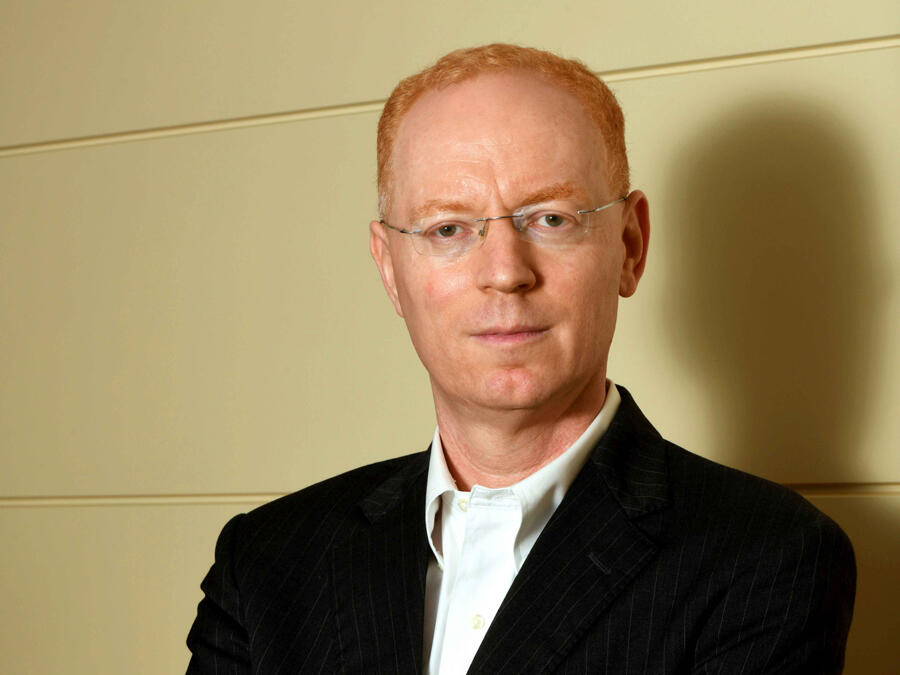
Ilan Paz, CEO of Barclays Israel, who advised Union and Harel Investments on the acquisition of Cal, represented Isracard's board in the company's sale process, and provided a fairness opinion to Zim's board during its sale, outlined in an interview with Calcalist how the new reality is reshaping the prospects for Israeli companies seeking to list on America's leading stock exchanges.
Ilan, the markets are at record highs. Is it all thanks to AI?
"It is impossible to deny that AI is an extraordinary growth engine. But that's not the whole story. The U.S. economy is showing impressive resilience. The American consumer remains strong, and large companies continue to report excellent earnings and healthy cash flows. There is a solid economic foundation supporting these market gains."
On the other hand, we're seeing a correction in defense stocks.
"That's right. The U.S. has always invested heavily in defense. Europe, however, has been different. The Americans have essentially told the Europeans: 'We spend around 5% of GDP on defense. For years, you've spent just 1%-1.5%, expecting America to come to your rescue whenever conflict breaks out. It's time for Europe to invest as well.'
"Now Europe is allocating enormous defense budgets, and many Israeli companies are benefiting. Yes, we've seen a correction, but if you look at companies such as Elbit Systems or NextVision, their shares may have fallen 10%-20%, yet they're still up roughly 300% compared with two or three years ago. I actually think this correction is healthy because valuations had risen to unsustainable levels."
Why are there so few IPOs?
"This is really the key issue. In fact, I'd go even further: there simply aren't enough IPOs in the United States. In Israel, by contrast, we're actually seeing companies go public on the Tel Aviv Stock Exchange.
"What has changed is the threshold investors expect companies to meet before they're willing to participate in an IPO. When companies like SpaceX, Anthropic, and OpenAI are preparing for offerings that could be valued in the hundreds of billions, or even trillions of dollars, they absorb nearly all investor attention.
"The largest institutional investors tell underwriters: 'Stop bringing us $1 billion or $5 billion companies. We're focused only on the mega-deals.' That's the fundamental problem today. As a result, the number of IPOs has declined, even though total capital raised remains enormous because it's concentrated in just a handful of giant companies."
Why does the market work this way now? In the past, Facebook's IPO eventually reopened the market for smaller companies.
"The expectation is that IPOs by these mega-companies will once again reopen the market for everyone else. But first, those offerings actually need to happen. Only after they've been completed do I believe the window will gradually reopen for smaller companies."
But OpenAI and Anthropic have shown that companies can continue raising billions privately for years.
"They've raised unprecedented amounts of private capital and only at a very late stage decided they wanted to become public companies.
"The private market now gives companies a major advantage: they can remain private for much longer while continuing to raise capital at attractive valuations.
"Another important change is the rise of secondary transactions. In the past, companies often rushed to go public because employees wanted liquidity for their stock options. Companies would say, 'Our valuation looks great on paper, but employees can't monetize their equity unless we go public.'
"Today, a significant portion of large private funding rounds includes secondary transactions that allow employees and early investors to sell part of their holdings. That provides liquidity without requiring an IPO, allowing companies to stay private much longer."
When you meet companies today, what do you recommend?
"I divide companies into three categories.
"The first consists of companies that have already reached true American scale, those generating at least $500 million in annual revenue while growing more than 20% a year. Every option is available to them: they can pursue an IPO or lead significant M&A transactions.
"The second category includes companies approaching that scale. Our recommendation is unequivocal: stay private until you cross that threshold. Don't go public too early. Today's public market is focused almost exclusively on giant companies, and if you list prematurely, you simply won't receive the attention you deserve.
"The third category consists of companies that, three, four, or five years ago, assumed they could go public once they reached $100 million to $200 million in annual revenue. For them, that goal has become much more distant.
"My advice is straightforward: develop a Plan B. The U.S. public market has moved beyond that size and is unlikely to become a realistic option over the next year or two. If shareholders need liquidity, begin exploring M&A opportunities. For some companies, we even recommend listing on the Tel Aviv Stock Exchange."
Are you really recommending companies list on the Tel Aviv Stock Exchange?
"Absolutely. We recently received an underwriting license on the Tel Aviv Stock Exchange. Our goal isn't to compete with local underwriters but to bring international investors into offerings in Israel.
"For companies that don't yet have the scale required by the U.S. market, the TASE represents an excellent alternative. At the same time, they should seriously evaluate M&A opportunities if they want to generate liquidity for shareholders.
"The U.S. IPO market has simply moved further away, and we don't expect it to become relevant for these companies again anytime soon."
Paz also praised reforms implemented by the Tel Aviv Stock Exchange, including adopting a book-building process similar to those used internationally and aligning trading days with global markets.
"Initially I was skeptical about moving trading to Monday through Friday," Paz said. "But the results speak for themselves. Friday trading volumes are now four times higher than Sunday volumes were under the previous system. That's remarkable and demonstrates the growing participation of foreign investors.
"We no longer automatically tell Israeli companies to run to New York or Nasdaq. Today we can bring international investors directly to the Tel Aviv Stock Exchange, and that's a profound change."
Should companies be discouraged from pursuing a U.S. IPO too early?
"The U.S. public market is so focused on mega-cap companies that even Israeli companies valued at $1 billion to $5 billion are often viewed as micro-cap stocks. They simply struggle to attract investor attention.
"As attention shifts toward larger companies, analyst coverage gradually disappears, damaging both liquidity and valuation. If you don't have genuine American scale, think very carefully before pursuing a U.S. listing."
Has the slowdown in IPOs made M&A easier?
"I wouldn't say easier, but it's certainly becoming a more attractive alternative.
"The pressure increasingly comes from shareholders rather than management. Venture capital funds invested five to ten years ago are reaching the end of their fund lives. They need liquidity.
"They tell management: 'If you can't go public because the bar has moved so much higher, then let's begin a sale process.' We're seeing that dynamic much more frequently."
Which Israeli companies do you expect to go public in the U.S. over the next year?
"Looking at the broader market, my realistic expectation is that, with only a few exceptions, we're unlikely to see an Israeli company complete a U.S. IPO before 2027."
Are companies aware of this new reality?
"Many are. We take management teams to meet investors, and they compare their private valuations with those of publicly traded peers. They realize they probably won't achieve a higher valuation than in their last private funding round.
"So they ask themselves: 'Why rush to become public?'
"We completely agree. We have no interest in encouraging companies to make the wrong move."
So what's the right strategy?
"Wait. And if the company or its investors still need liquidity, the answer is secondary transactions in the private market."



