










Opinion
Israel is not losing its growth market. It is reorganizing it.
Behind the surge in mega-rounds, Israeli tech is witnessing a broader shift in how startups build, raise capital, and create long-term value.
Most of the conversation around Israeli tech today is dominated by mega rounds in AI infrastructure and cybersecurity. Those financings are real, and in many cases entirely rational. But they are only part of the story.
Two paths now run in parallel
Israel’s private tech funding recovered to $13.7bn in 2025, up 46% year over year. But the recovery did not look like a simple return to the old market. More capital is moving earlier, and more of it is concentrating in fewer, larger rounds.

For years, the venture journey in Israel followed a familiar stage-based pattern: Seed funds backed formation, venture funds led Series A once product and initial customers emerged, and growth investors entered later as companies began to scale. That pattern still exists, but it is no longer the only one.
Today there are two distinct paths:
The first path is the frontloading model:
Startups raising a very large amount of capital early, often enough to compress what used to be Seed, Series A, and even Series B into a single upfront financing round. The logic is straightforward: if the market is moving fast enough, capital can be used to accelerate product development, hiring, and market capture before the category settles.
We see this mainly in the AI infrastructure and cybersecurity sectors, typically led by repeat founders with fast access to global capital.
The data support this shift: Seed-through-Series B companies accounted for 17.6% of Israeli mega-round activity in 2019, totaling $330m. By 2025, that increased to 33.3%, or $2.7bn.
Recent examples include Tenzai’s reported $75m seed round, Fundamental emerging from stealth with $255m across seed and Series A financing, Factify’s reported $63m seed round, and Majestic Labs’ reported $90m Series A. These are the types of financings that, only a few years ago, would more typically have appeared later in a company’s lifecycle.
A stage-adjusted outlier view shows the same pattern even more clearly.
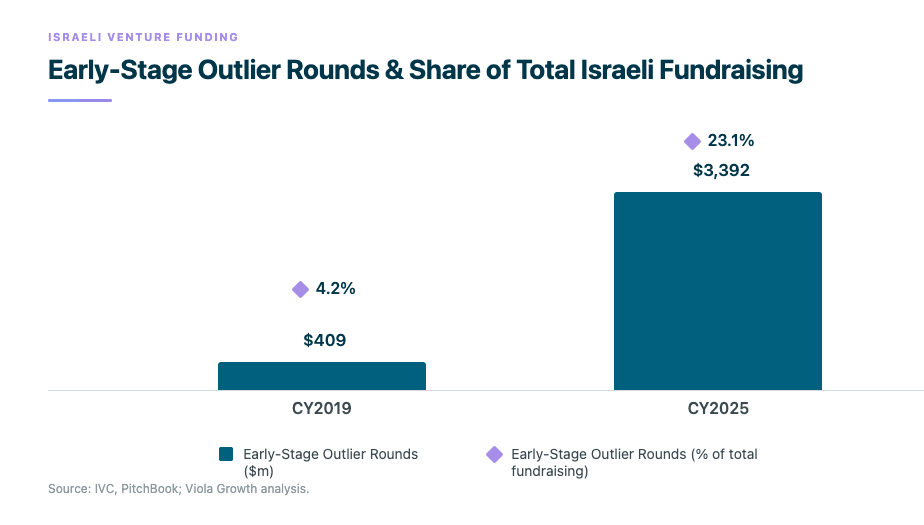
Early-stage outlier rounds represented only 4.2% of total Israeli fundraising in 2019, but rose to 23.1% in 2025. In dollar terms, that is a shift from roughly $409m to $3.4bn.
In other words, more capital is moving earlier, not only in headline mega rounds, but also in rounds that are unusually large for their stage.
The second one is the PMF-to-scale path.
Companies reach product-market fit, demonstrate real customer adoption, and then raise capital to scale a business that is beginning to show repeatability. This remains the path most companies follow, and it is still a critical part of the ecosystem.
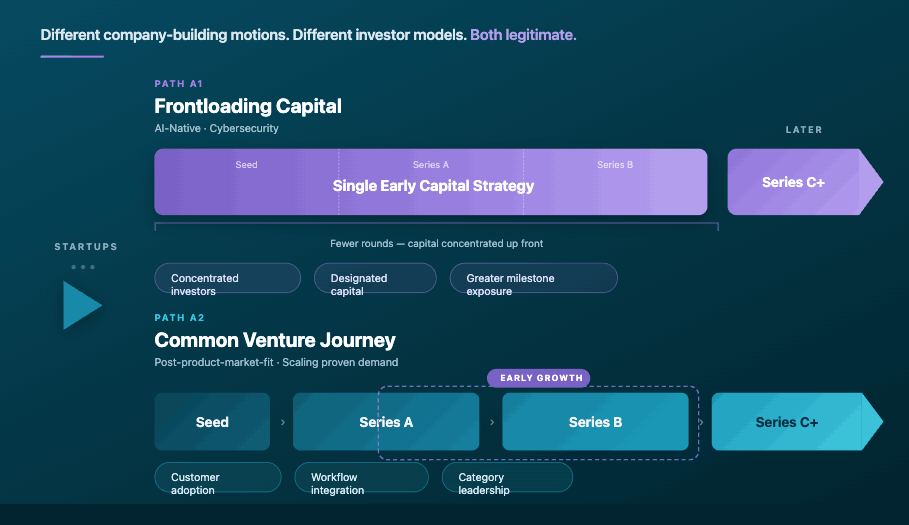
The point is not that one path is better than the other. They are different capital strategies, built on different assumptions about speed, capital intensity, ownership, risk, and value creation.
AI is expanding the Early Growth market, not collapsing it
The dominant narrative is that AI pushes everything earlier and bigger. Sometimes it does. But the more interesting effect is that AI lets more companies reach commercial traction faster. Teams can build more quickly, automate earlier, and deliver measurable value to customers sooner.
The result is more companies arriving at the post-product-market-fit stage with real momentum, often without taking the mega-round path.
For many companies in Israel, reaching product market fit, which we define as early-growth, is the window where much of the value-creation curve still lies ahead: go-to-market expansion, international growth, product deepening, and the long climb to category leadership. As a testament, in 2025, the early growth segment attracted roughly $4.7bn of capital across Israel, up more than 40% year on year.
We believe the opportunity set at early growth is expanding, not shrinking.
Some markets cannot be compressed as easily by capital alone.
Healthcare and Fintech are good examples. Both are large global markets. Both involve complex, regulated workflows. Deep integration, compliance, licensing, and customer trust all take time, and cannot always be accelerated simply by adding more capital.
AI can accelerate development, go-to-market, and workflow automation. But in these sectors, adoption still depends on becoming embedded inside high-stakes operating environments. This emphasizes the need for the early growth window, as companies need to prove product-market fit, build trust, and then scale deliberately.
These categories also align with the Israeli ecosystem's longstanding strength in building technical products for demanding environments. In Viola Growth’s portfolio, companies such as Scopio Labs, Chargeflow, and Buildots reflect this pattern across diagnostics, payments operations, and construction execution.
The broader point
The next chapter of Israeli tech will not be defined only by the companies raising the biggest early rounds.
It will also be shaped by companies that turn product-market fit into durable market positions: category-defining software in real industries, deep workflow adoption, and substantial value creation still ahead.
That part of the market is quieter than the headlines suggest.
It also looks like one of the more interesting places to be building, and backing, right now.
Ilan Stein is a Principal at Viola Growth.



