










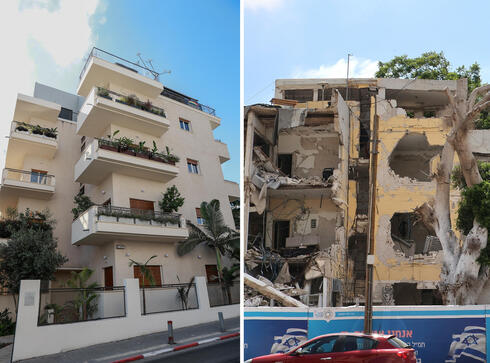
How one Bauhaus landmark survived an Iranian missile and came back to life
While many buildings damaged in last year's Iranian missile attack remain tied up in bureaucracy, the residents of 7 Pinsker Street organized themselves, worked directly with the Property Tax Authority, and completed a multimillion-shekel restoration in just months.
When the Abraham Goldberg House was built in 1933, no one imagined it would one day have to withstand the impact of a half-ton missile exploding just dozens of meters away. Remarkably, the building survived, although it sustained severe damage.
On the night of June 15-16, 2025, an Iranian missile struck the end of Pinsker Street near Allenby Street, severely damaging every building in the immediate vicinity. Even today, the street remains much as it was in the aftermath of the strike. But unlike neighboring buildings that were destroyed and whose renovations have only recently begun, or others still mired in bureaucratic procedures, the residents of 7 Pinsker Street have already returned to their restored apartments.
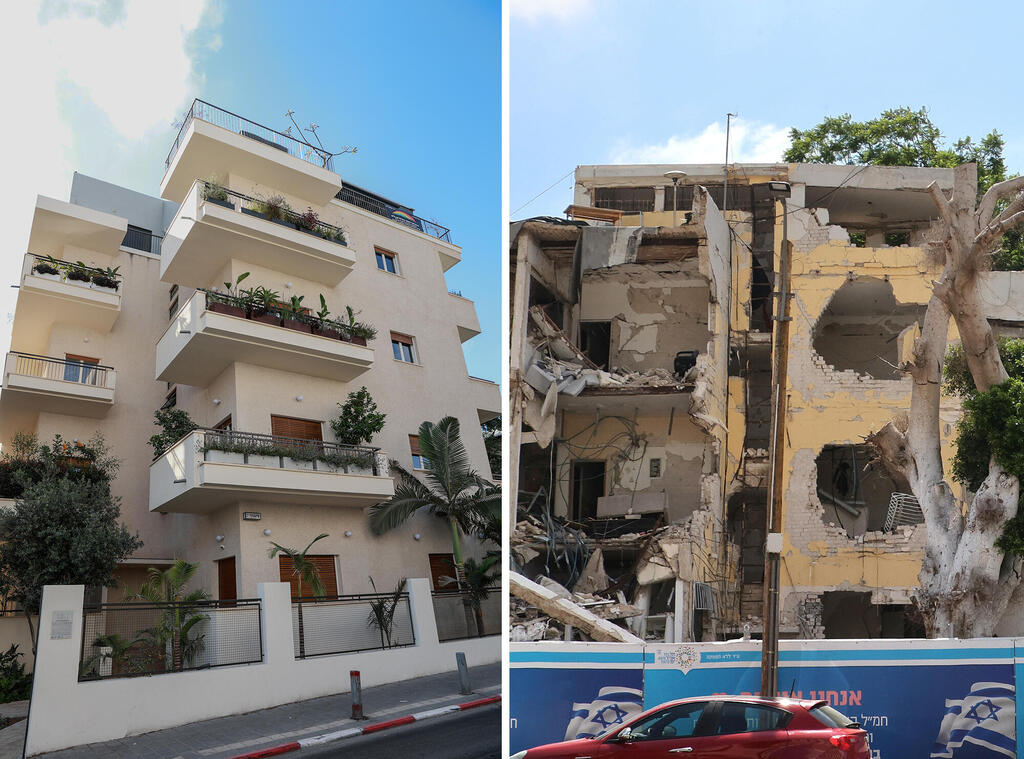
Their relatively swift return was made possible by a determined tenants' committee that took charge of the rehabilitation effort. The committee was led by Yehudit Raviv, an artist who bought an apartment in the building only about a year before the missile strike, and Tamir Odei, a real estate professional who rents an apartment in the building and helped accelerate the restoration process using his industry experience.
"All the buildings within the immediate impact zone on Pinsker Street were severely damaged, and we were all evacuated to hotels," Raviv recalled. "Our building was classified as a red building, it was uninhabitable, but it wasn't designated for demolition. The ceilings collapsed, the windows were blown out, and most of the contents were destroyed. At first, the only thing we were allowed to do was clean the building. We cleared away the debris and were left with bare walls. Only then was the building reclassified as orange, allowing us to begin repairs."
How did you know what to do?
"We decided that the tenants' committee would effectively become the building's management team for dealing with the Property Tax Compensation fund. Within a month, we began interviewing construction supervisors and contractors. We opened a dedicated bank account solely for the restoration project and our work with the Property Tax Authority.
"We also decided not to hire an appraiser because we feared that a higher damage assessment would lead to lengthy disputes with the Property Tax Authority. In retrospect, that was the right decision. Buildings around us that relied on appraisers became entangled in lengthy disagreements and struggled to secure approvals."
How was the experience of working with the Property Tax Authority?
"The Property Tax Authority didn't approve everything we requested, but we decided to begin the work first and resolve disagreements later. For example, the front of the building sustained heavy damage while the rear was less affected, but structural cracks were later discovered. That led to disputes over whether the cracks were part of the building's structural frame, something the Property Tax Authority initially disputed.
"We hired engineers at our own expense and submitted their professional assessments. In the end, the authorities accepted our position. We were fair with them. It's easy to exaggerate damages, but if you're caught, you're in trouble. We told the truth, documented everything professionally, and they treated us fairly in return. The Property Tax Authority isn't naïve. Residents of another building on the street who submitted inflated damage estimates still haven't received approval for repairs and remain stuck."
What were the unique challenges of restoring a preservation building?
"We had to find a contractor specializing in historic preservation. Many of the original architectural elements had to be restored exactly as they were. This is an original Bauhaus building, and that also became a point of disagreement with the Property Tax Authority.
"The work included dismantling balconies, restoring them, and preserving the façade. We had original historic windows, and replacing them alone cost millions of shekels. The Property Tax Authority ultimately recognized that expense. The same applied to the original staircase. Even the building's mailbox is a unique historic piece, and restoring it cost 56,000 shekels. Initially, the Property Tax Authority refused to cover it. I tracked down the original manufacturer, who was still in business, and convinced him to restore it.
"The building also featured distinctive terrazzo flooring. We brought in a specialist who recreated the damaged sections exactly and repaired the remaining floors."
And what about the apartments themselves?
"Each apartment owner dealt directly with the Property Tax Authority and managed the renovation of their own apartment independently."
In total, restoring the building cost several million shekels, while renovating the individual apartments cost approximately 600,000 shekels (about $200,000) per apartment.



