










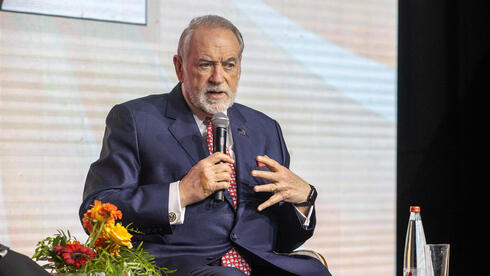
US Ambassador: Iran no longer driving Israel-Lebanon negotiations
Mike Huckabee says diplomatic process is decoupling regional talks from Tehran’s influence.
Mike Huckabee
(Go Live Stream)


Mike Huckabee, the United States ambassador to Israel, said ongoing diplomatic efforts between Israel and Lebanon are beginning to redefine a decades-long conflict, while insisting that Iran remains the central destabilizing force in the region and that Israel’s security environment has materially improved despite continued war.
Speaking at Calcalist and Bank Mizrahi-Tefahot’s Growth Conference on Monday following recent meetings in Washington, Huckabee described a series of negotiations aimed at producing a framework agreement between Israel and Lebanon that would “take away” the conflict between the two countries and redirect it toward Hezbollah.
“Last week was the 5th in a series of meetings that we had had in Washington to work on some kind of a framework to bring Israel and Lebanon to a point where the conflict was really taken away between the two countries and put toward Hezbollah,” he said.
He argued that a central obstacle to progress has been the longstanding perception that Israel and Lebanon were formally at war, when in reality, he said, “Israel was not at war with Lebanon. Lebanon was not at war with Israel. But both Israel and Lebanon were at war with a non-state actor… the Iranian-backed Hezbollah.”
Huckabee described one moment in early talks that he said captured the significance of the diplomatic shift: Israeli and Lebanese military representatives speaking informally during a break in negotiations.
“There was one particular moment… when we had an Israeli general and a Lebanese Armed Forces general… and I saw the two generals standing over talking to each other. They were smiling, even laughing,” he said.
“That was a very, very special moment to realize that now you have people who are talking to each other rather than at each other.”
He said the most significant breakthroughs in the process were twofold: the formal recognition that Israel and Lebanon are not at war, and the explicit identification of Hezbollah as the central problem.
A key outcome of the talks, Huckabee said, was the separation of Israel-Lebanon negotiations from Iranian influence.
“The key is that the two countries that Iran was trying to maybe get in the middle of, they've sort of been moved to the side because the Lebanese and the Israelis have said no, we don't want Iran making this decision,” he said.
Asked about competing frameworks involving Iran and the United States, Huckabee rejected the idea that Tehran should play a determining role in Lebanese sovereignty or regional arrangements.
“The Iranians can't make that decision,” he said. “The key is that the two countries that are directly involved… are Israel and Lebanon, and it's really not for Iran certainly to make the decision.”
Pressed on whether the diplomatic framework could ultimately lead to Hezbollah’s disarmament, Huckabee was cautious.
“Let's hope so,” he said. “I don't have any illusion that they're going to voluntarily lay down their weapons.”
Instead, he pointed to incremental strengthening of the Lebanese army and potential Israeli redeployments from contested areas, while emphasizing Israel’s security red lines.
“One thing became very clear… they're not redeploying out of any area that would endanger the security of Israel,” he said, “particularly the people in the north.”
Iran: nuclear ambition and historical grievance
Huckabee returned repeatedly to Iran, framing it as a persistent strategic threat. He reiterated that both Washington and Jerusalem oppose Iranian nuclear capability.
“Both Israel and the United States have made it very clear that Iran is not going to have a nuclear weapon,” he said.
While acknowledging diplomatic efforts through a memorandum of understanding, he downplayed its significance.
“An MOU… is not an agreement with the details,” he said. “Now the real detailed work begins.”
He also expressed deep skepticism about Iranian intentions based on historical experience.
“The Iranians don't have a history at all of being honorable people when it comes to making an agreement and certainly not when it comes to keeping an agreement,” he said.
Drawing on personal memory of the 1979 hostage crisis in Tehran, Huckabee framed Iran’s regional posture as historically consistent.
“I remember the humiliation that we experienced… embassy employees… being frog marched across the lawn,” he said.
“I've often tried to say to people, you cannot separate the threat to Israel and the threat to America… Israel was the appetizer and the US was the entrée.”
Despite ongoing conflict, Huckabee said his personal sense of security in Israel has improved due to what he described as degradation of Iranian military capabilities.
“I do [feel safer],” he said, citing diminished Iranian air and naval capacity.
He also pointed to Israel’s missile defense systems and civil defense infrastructure as central to its resilience.
“92% of all the incoming missiles… were intercepted,” he said, referring to recent conflict data.
He added that Israel’s shelter system had proven highly effective: “Not one person was injured or killed who was in a shelter at the time of the impact of a missile.”
On American military assistance to Israel, Huckabee said the relationship is likely to be reframed rather than reduced.
“I think it's going to be moved from an aid package to more of a trade package,” he said.
He argued that US funding ultimately cycles back into the American economy through Israeli procurement.
“Israel takes that money and they turn around and purchase hardware from the US. We get as much if not more from Israel than we give to Israel.”
He described the relationship as a strategic partnership rather than a one-way transfer.
“This is going to be restructured so that it is far clearer… that there's a partnership between the US and Israel.”
Looking ahead, Huckabee said he sees signs of broader regional normalization efforts reviving.
“I really do,” he said when asked about expanding the Abraham Accords.
“I think we're seeing the beginnings of a realignment throughout the region.”
He argued that attacks attributed to Iran in other parts of the Middle East have shifted perceptions among Gulf states.
“It gave them a wake up call to realize that Israel is not their real enemy… Who's doing that? The Iranians are.”
He suggested additional countries could join normalization frameworks.
“I'm hoping that helps other nations… to decide that being in the Abraham Accords… are in the best interest of their future.”
Huckabee closed with a broader endorsement of Israel’s economic trajectory, despite sustained conflict.
“I've been through five wars, and yet the Israeli economy has actually had a growth in GDP,” he said.
“The stock market is up almost 100% since October the 7th of 2023.”
He added that continued foreign investment from major global firms signals long-term confidence.
“Companies that are investing mightily in Israel… Why would they do that? Because there is a future here.”



