











Israel keeps Ben Gurion open under fire in bid to break Iran’s economic playbook
Rather than shutting down airspace after missile attacks, Israeli officials are attempting to preserve aviation, energy production, and economic activity as repeated confrontations with Tehran become a recurring reality.
The decision to keep Ben Gurion Airport operating despite the latest Iranian missile attacks reflects an effort to break the pattern that has emerged since the beginning of the confrontations between Israel, Iran, and the Houthis in Yemen, under which missile launches toward Israel were routinely followed by the closure of Israeli airspace and an almost immediate halt to civil aviation.
Ben Gurion Airport is still far from recovering from the disruption caused by the outbreak of the Second Iran War at the end of February. Before the conflict, 64 airlines operated flights to Israel; today, that number has been cut roughly in half. Traffic at the start of the summer tourism season has also been constrained by operational challenges stemming from the use of approximately 70% of the airport’s aircraft parking areas by U.S. Air Force refueling planes. During the war, Iranian missiles struck the airport, damaging several aircraft parked on the ground.
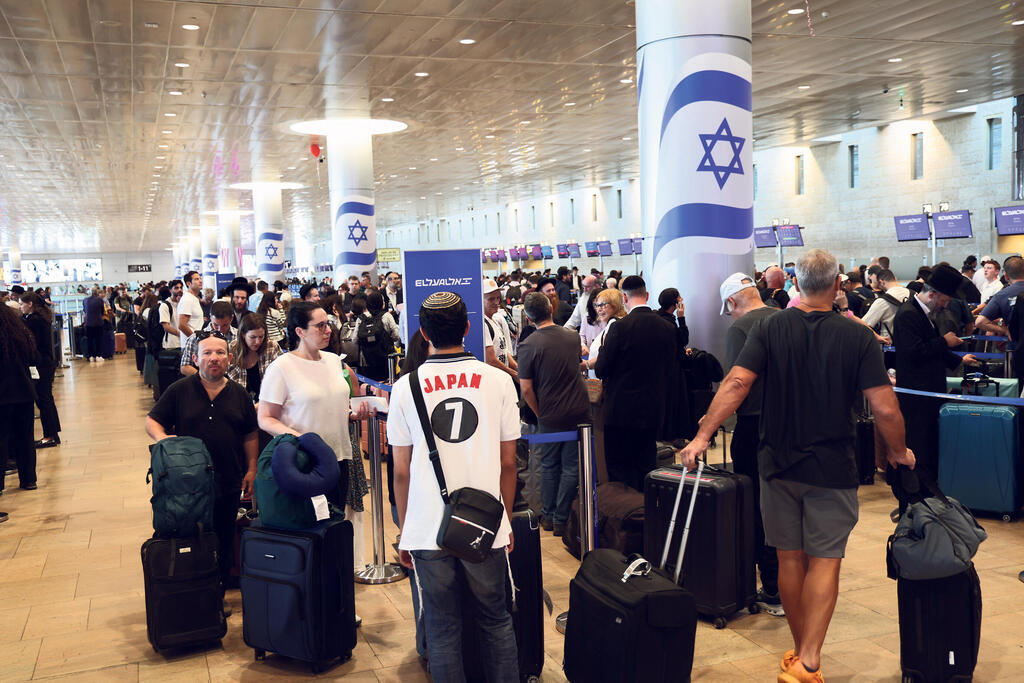
Against this backdrop, the Ministry of Transportation, Ben Gurion Airport management, the Civil Aviation Authority, and security agencies decided not to close Israel’s airspace following the Iranian missile attack on northern Israel on Sunday evening. Instead, they opted to allow operations at Ben Gurion Airport to continue.
Officials said the decision was based on a framework of ongoing risk management and continuous situational assessments. Under this approach, operations can be suspended immediately should new intelligence indicate a heightened threat.
Israel also kept natural gas production running uninterrupted at offshore facilities in the Mediterranean. During the Second Iran War, production at Energean’s Karish field and at the Leviathan field, operated by the NewMed Energy, Chevron, and Ratio partnership, was suspended for weeks.
Israeli policymakers are increasingly concerned that repeated rounds of conflict with Iran could create a new reality in which disruptions to transportation, energy production, and economic activity become routine. In that context, the automatic closure of airspace and shutdown of strategic infrastructure during previous conflicts effectively handed Iran and its proxies a measure of deterrent leverage.
Some officials appear to be drawing inspiration from the United Arab Emirates, which continued operating key infrastructure during periods of regional escalation. During previous missile attacks in the Gulf, Dubai International Airport remained operational despite security threats.
“Dubai Airport is one of the world's busiest airports and continued to function under fire because it is a symbol of national and economic power,” aviation and tourism expert Yossi Fisher told Calcalist. “In 2025, 95 million passengers passed through it, and shutting it down because of Iranian missile attacks would have been interpreted as a strategic victory for Tehran.”
Fisher noted, however, that the comparison has limits.
“Dubai Airport was not serving as a base for U.S. Air Force refueling aircraft, as Ben Gurion has in recent months,” he said. “What international airline wants its aircraft parked next to dozens of military refueling planes, some carrying massive quantities of jet fuel?”
According to Fisher, Israel appears to have concluded that the current security environment requires a broader risk tolerance than in previous conflicts.
“It is likely that decision-makers have expanded the acceptable risk envelope within the traditional risk-management process,” he said. “At the same time, the reality facing Ben Gurion Airport today is significantly more complex and potentially more dangerous than during the first war with Iran.”



