










Hormuz first, nukes later: The real logic behind the emerging US-Iran deal
As Washington and Tehran edge toward an interim agreement, the global economy, not Iran’s nuclear program, appears to be driving the urgency.
Over the weekend, optimism grew over a potential agreement between the United States and Iran on a memorandum of understanding aimed at reopening the Strait of Hormuz and paving the way for negotiations on the remaining disputed issues, including the nuclear program, sanctions, and frozen Iranian assets. Despite conflicting reports leaked to the media regarding the clauses of the memorandum, one thing appears clear: the arrangement’s immediate priority is not Iran’s nuclear program, but the Strait of Hormuz. That is hardly surprising given the strategic importance of the shipping lane, which Iran has effectively disrupted.
The Strait of Hormuz has shaken the global energy market. In 2025, nearly 20 million barrels per day of oil and petroleum products passed through the strait, accounting for about 25% of global seaborne oil trade. In addition, around 93% of Qatar’s LNG exports and about 96% of the United Arab Emirates’ LNG exports passed through Hormuz, together representing roughly 19% of global LNG trade, figures that explain why the strait is such a critical component of global energy pricing.
1 View gallery
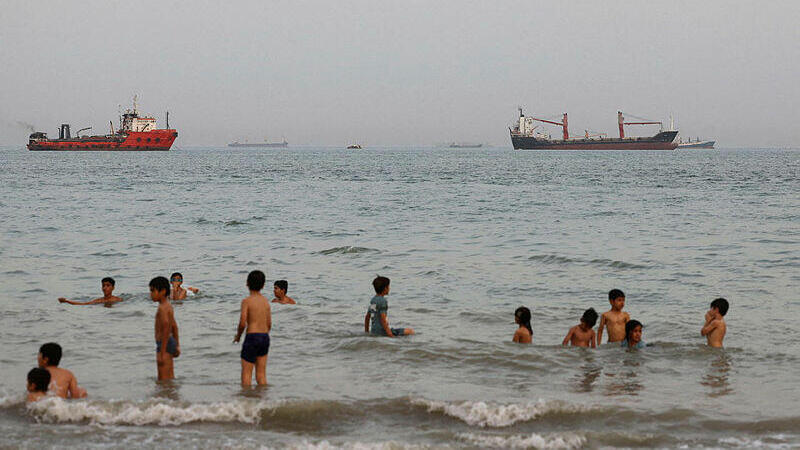
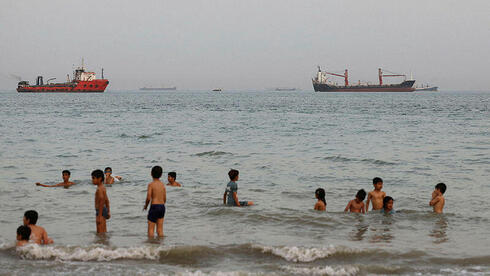
Iranian children on the beach of Bandar Abbas against the backdrop of tankers stranded in the Strait of Hormuz
(Majid Asgaripour/WANA)
But even here, a caveat is necessary. Even if the memorandum of understanding is signed, the true test will be physical rather than political: will oil tankers, LNG carriers, and merchant ships resume normal transit at a pace sufficient to reduce the geopolitical risk premium? As long as shipping remains partial, heavily supervised, or unpredictable due to a lack of trust between the parties, energy prices will continue to reflect security concerns rather than pure supply-and-demand fundamentals.
Even before news of the memorandum emerged, the oil market had already begun cautiously pricing in the possibility of talks with Iran. Last week, Brent crude closed at $103.9 per barrel, down from the peak reached during the crisis, but still roughly 60% above its level a year earlier. A recent report by the International Energy Agency illustrates why the market remains tense. According to the agency, more than 10 weeks after the outbreak of the conflict, cumulative losses among Gulf producers exceeded one billion barrels, with more than 14 million barrels per day of oil removed from the market. Observed global inventories, including oil stored at sea, declined by around 250 million barrels in March and April, equivalent to roughly 4 million barrels per day.
An agreement to reopen the Strait of Hormuz could therefore lead to lower oil prices, but for the decline to become sustainable, markets would need to see more than political declarations. They would need evidence of a consistent return of flows, lower marine insurance costs, greater ship availability, fewer inspections and restrictions, and restored confidence among traders and shipping companies. If the strait is gradually reopened, prices may decline while remaining above pre-crisis levels until inventories stabilize.
Qatar: A Sensitive Link in the Gas Market
If oil has limited bypass alternatives, the situation is more complicated for liquefied natural gas. According to the IEA, Qatar is expected to export more than 112 billion cubic meters of LNG in 2025, and almost all of its exports to global markets pass through Hormuz. The loss of nearly 20% of global LNG supply due to the effective closure of the strait disrupts market fundamentals in the short term, while damage to liquefaction facilities in the Gulf also alters the medium-term supply outlook. In other words, even if a political arrangement is reached, the gas market may not quickly return to normal.
For Qatar, reopening Hormuz is not merely a national security issue but a prerequisite for the functioning of its economic model. For the United Arab Emirates and Saudi Arabia, the stability of the shipping route remains critical even though some exports can be rerouted through alternative infrastructure. Higher oil prices may increase revenues in the short term, but disruptions in Hormuz ultimately damage export capacity, raise insurance costs, undermine long-term contracts, and increase pressure from Asian customers.
Inside Iran, markets reacted quickly to the possibility of an agreement. Prices for the dollar, gold, and foreign currencies fell. According to Iranian economic media, the dollar in the free market dropped by about 2.7% on Sunday to roughly 171,000 tomans. The price of 18-karat gold fell to around 17 million tomans per gram, while the “Imami Sakah” gold coin declined by approximately 8 million tomans to 180 million tomans.
Still, the reaction should be interpreted cautiously. A weaker dollar and a stronger stock market do not necessarily signal an improvement in the real economy. They primarily reflect a temporary decline in the geopolitical fear premium. Experts in Iran outline three possible scenarios for the economy by the end of the summer: a successful agreement and easing political risk; prolonged uncertainty; or a collapse in talks followed by renewed escalation. Under an agreement scenario, the stock market is expected to rise while the dollar and gold decline as demand for safe-haven assets weakens. Under the uncertainty scenario, currently viewed as the most likely, the dollar would continue rising due to structural inflation, gold would remain the preferred defensive asset, and the stock market would struggle to establish a stable trend.
In other words, even Iranian economic discourse does not treat the memorandum of understanding as a complete solution. It is viewed as a framework capable of changing expectations. The impact could still be significant: if some frozen assets are released, maritime exports become easier, and oil sales stabilize, the Central Bank of Iran would gain more room to stabilize the foreign exchange market. But it would still be unable to quickly solve high inflation, the erosion of the rial, and the public’s deep lack of confidence in the local currency.
According to the International Monetary Fund, Iran’s economy is expected to contract by 6.1% in 2026, while inflation is projected to approach 70%. These are baseline figures for an economy in deep crisis, not one on the verge of rapid recovery. An arrangement surrounding Hormuz could provide the regime with temporary financial and monetary breathing room, but it would not solve Iran’s structural problems: sanctions, low investment, dependence on oil revenues, corruption, budget deficits, weak infrastructure, capital flight, and declining confidence in the national currency.
Global Impact: Open Hormuz, Lower Inflation
The broader global significance of such an arrangement is primarily anti-inflationary. In April, the IMF warned that the war in the Middle East was harming the global economy through three main channels: energy prices, supply chains, and financial markets. Under a limited-conflict scenario, the IMF projected global growth of 3.1% in 2026 and 3.2% in 2027, but warned that a prolonged or wider conflict could weaken growth and destabilize markets.
Europe is among the most exposed regions. The European Commission forecast that the eurozone would grow by only 0.9% in 2026, down from a previous estimate of 1.2%, while inflation was expected to rise to 3.0% instead of 1.9%. The Commission noted that Europe, as a major net energy importer, is particularly vulnerable to the consequences of instability involving Iran.
Asia is even more exposed. Around 80% of the oil passing through Hormuz is destined for Asian markets. China and India alone accounted for 44% of the crude oil exports transported through the strait in 2025. An arrangement restoring stability would therefore be especially beneficial for large energy importers by reducing pressure on currencies, fuel subsidies, trade balances, and domestic inflation.
For the United States, which is less dependent on Gulf energy than in the past, the main impact is indirect: fuel prices, inflation expectations, bond yields, and consumer sentiment. Lower oil prices are not merely an energy issue; they could also ease pressure on the Federal Reserve, households, and transport-intensive industries.
Ultimately, three broad scenarios remain possible.
The first is an effective interim arrangement in which Hormuz gradually reopens, tanker and LNG traffic stabilizes, and Iran receives limited access to frozen revenues or assets. Under such a scenario, oil prices could continue to decline, gas markets would calm, the Iranian rial would strengthen, and the Tehran stock exchange would benefit from improved sentiment. Europe, Asia, and even Israel could benefit from lower imported inflation and improved economic expectations.
The second scenario, currently the most likely in the short term, is a partial and fragile arrangement. Hormuz would reopen only partially, without a full return to normal. Iranian oversight, fears of renewed conflict, uncertainty regarding sanctions, and the absence of a broader nuclear agreement would keep the geopolitical risk premium elevated. Oil prices could fall, but not quickly return to pre-war levels. In Iran, volatility would persist between temporary strengthening of the rial and renewed demand for gold and dollars whenever tensions rise again.
The third scenario involves a collapse in negotiations, leaving Hormuz disrupted, oil and gas prices rising again, and investors rushing back to safe-haven assets. For Iran, this would mean renewed pressure on the rial and greater economic instability. For the Gulf states, it would mean reduced export capacity. For Europe and Asia, it would mean another inflationary shock.
In conclusion, the arrangement now taking shape with Iran, at least according to the various reports and statements available so far, is not a comprehensive solution to the broader regional crisis. Rather, it is an attempt to buy time by reducing risk in the area where the economic consequences are most immediate and measurable: the Strait of Hormuz.
If the maritime corridor stabilizes, oil and gas prices could decline, Iranian markets could receive temporary relief, and the Gulf, Europe, and Asia could all benefit from meaningful economic easing.
But there is no automatic return to normal. As long as issues surrounding Iran’s nuclear program, sanctions, frozen assets, missiles, and regional proxies are postponed to future negotiations, markets may receive temporary relief, but not certainty. From the perspective of the global economy, even that respite matters. From Iran’s perspective, it could be critical. From the perspective of Israel and the Gulf states, however, the agreement will ultimately be judged not by diplomatic statements, but by the movement of ships, the price of oil, and whether Iran emerges more stable, or simply buys itself more time.



