










Mapping Israel’s WasteTech sector: 80 startups up against a 76% landfill problem
A newly released map from PLANETech details the companies tackling Israel's waste management crisis, from reducing waste at the production stage to converting waste streams into raw materials, fuels, and energy.
In Israel, 76% of municipal waste still goes to landfill, according to a July 2025 report by the State Comptroller of Israel. With traditional, linear waste management models under increasing strain, municipalities, government bodies, and regional waste associations are looking to the Israeli tech sector for solutions.
“Waste management is undergoing a long-overdue technology transformation,” said Rotem Trivizki, CEO of PLANETech, a non-profit community focused on climate change tech in Israel. “From local municipalities tackling landfill challenges to governments working toward global climate goals, the demand for scalable WasteTech solutions is unprecedented.”
Trivizki continued: “Israeli deep-tech startups are stepping up to meet this urgent market need, proving that converting waste streams into high-value resources is both an environmental imperative and a major commercial opportunity.”
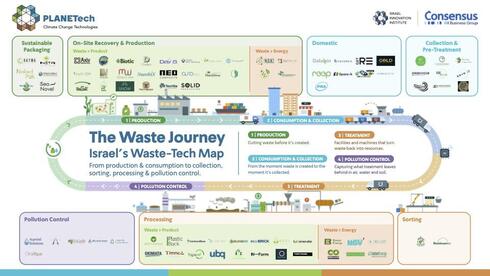
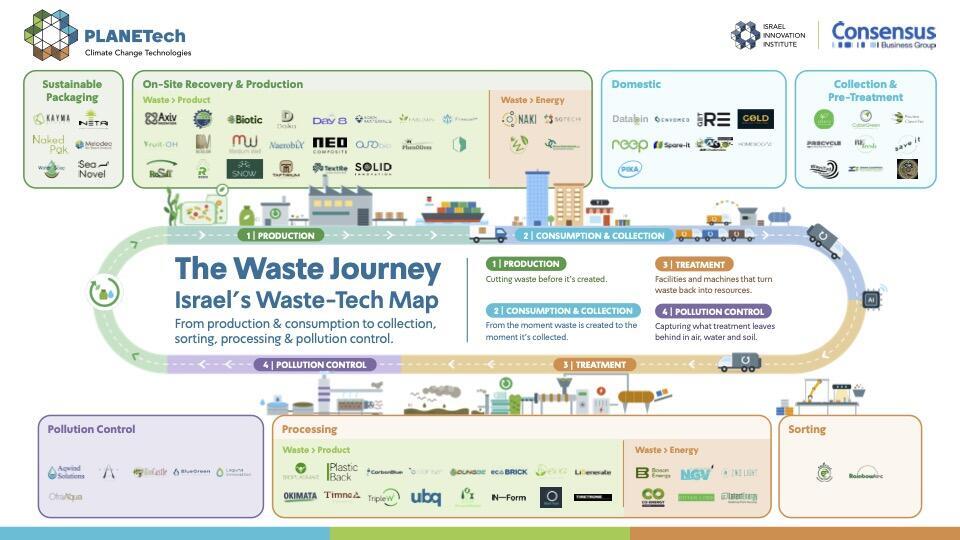
To capture the scope of Israel's WasteTech sector, PLANETech has released a map identifying 80 active startups either founded in Israel or with Israeli R&D operations across four stages of the waste journey.
The map shows 32 companies focused on reducing waste at the production stage through sustainable packaging and on-site recovery. Another 18 startups target the consumption and collection of household waste. Treatment accounts for 24 companies processing waste into new materials or fuels, while six startups address pollution control, treating wastewater and nutrient runoff.
The highest concentration of startup activity is in resource conversion. Nearly 60% of the mapped companies (48 startups) convert waste into raw materials, fuels, food ingredients, or energy.
“Keeping waste out of landfill, whether it’s demolition debris or food industry sludge, already saves money,” said Dan Bakola, Ecosystem Manager at PLANETech. “The next generation of Israeli WasteTech goes further, turning waste into products that create new revenue streams. When those products can compete with conventional materials on both quality and price, the business case is won.”
Most companies are running pilots, with three having reached the growth stage. Companies moving into commercial applications include LiGenerate, which recovers high-value metals from battery black mass; TextRe, which converts synthetic fashion waste into recycled plastic pellets for the plastics industry; and ReSalt, which uses industrial waste salt for low-carbon construction materials.
Over the past three years, startups on the map secured their largest funding rounds in 2023 and 2024, led by UBQ Materials ($70 million), BlueGreen Water Technologies ($17.5 million), FreezeM ($14.2 million), and CarbonBlue ($10 million). More recently, grants and early investment have supported companies moving into pilots, including a $3 million BIRD Foundation grant to Plastic Back for a PVC recycling pilot with Freepoint Eco-Systems in Ohio.
According to the UN Environment Programme, global municipal waste is projected to grow from 2.1 billion tonnes in 2023 to 3.8 billion tonnes by 2050. Governments are moving to cut the share sent to landfill, and the European Union’s Landfill Directive limits landfilled municipal waste to 10% by 2035.



