










SpaceX lays out its $100 billion vision after first public earnings
The company outlined aggressive AI, satellite and mobile ambitions while warning investors that heavy spending is here to stay.
SpaceX's revenue nearly doubled in its first earnings report since going public, as booming demand for its Starlink satellite communications business and rapidly expanding AI operations fueled growth. But executives warned that the massive spending required to support the company's ambitions is far from over.
The Elon Musk-led company said it expects to reach a $100 billion annualized revenue run rate by December, promised a payback period of less than one year on new AI computing investments, and forecast it would launch at least 1,000 next-generation V3 Starlink satellites over the next year. It also outlined plans to compete directly with mobile phone providers.
1 View gallery
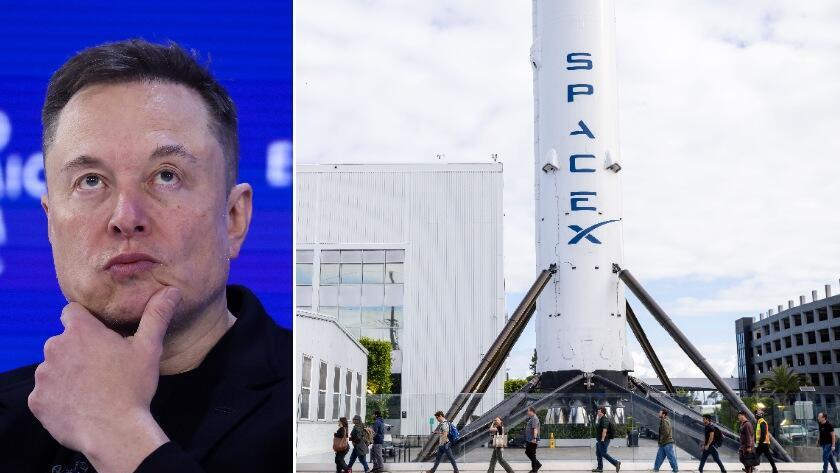
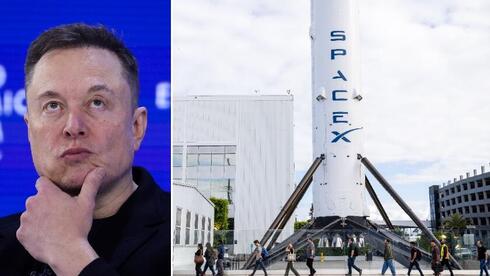
Elon Musk next to SpaceX's Falcon 9 launcher
(Ethan Swope, Krisztian Bocsi/Bloomberg)
The results for the quarter ended June 30 offered investors an early test of the investment case behind SpaceX's $1.75 trillion valuation: that profits from its fast-growing Starlink business can finance its costly expansion into artificial intelligence, data centers and next-generation rockets until those businesses become major profit contributors in their own right.
While the company's AI division showed signs of gaining commercial traction, management emphasized that the investment required to scale it remains enormous.
"We're building AI compute capacity at scale faster than anyone else, we believe, and we're significantly improving our AI models," Musk said during the post-earnings conference call.
SpaceX reported second-quarter revenue of $7.8 billion, up from $4.1 billion a year earlier and ahead of Wall Street expectations, according to LSEG data. Starlink, which accounted for more than half of total revenue, posted 66% growth, while revenue from the company's AI business, which Musk has positioned as its next major growth engine, surged about 250%.
However, the company's spending accelerated even faster. Capital expenditures jumped to more than $18 billion, compared with $2.83 billion a year earlier, as SpaceX poured $15.83 billion into AI infrastructure during the quarter, up from $749 million a year ago. Chief Financial Officer Bret Johnsen said capital spending is expected to remain at roughly similar levels over the next several quarters.
"The central question for SpaceX's first earnings report as a public company was whether the machine underneath the story actually works, and on that question Elon Musk and his team delivered several positives," said Thomas Monteiro, an analyst at Investing.com.
SpaceX shares fell 7.5% in after-hours trading after gaining 9.4% during the regular session ahead of the results. The stock has declined about 8% since its record-breaking IPO in June.
The company could also face additional pressure as its post-IPO lock-up period begins expiring on Thursday, potentially releasing a wave of insider and early investor shares onto the market.
Starlink and SpaceX's broader connectivity business remain the company's primary profit engine, providing the cash flow to support Musk's aggressive investments in AI and Starship. Critics, however, argue that relying on Starlink profits to fund both businesses until they become self-sustaining may prove difficult.
Second-quarter operating losses narrowed to $143 million, from $970 million a year earlier, as losses in the AI business declined and Starlink's operating income increased 79%.
"That's a tremendous upside surprise. The fact that AI is already monetizing itself means they're not relying solely on Starlink to fund operations there. I think that's a huge part of the story," said Brian Mulberry, chief market strategist at Zacks Investment Management.
SpaceX President Gwynne Shotwell said the company expects to capture "quite a few" customers from T-Mobile, AT&T, and Verizon as Starlink expands into mobile connectivity. The company plans to complement its satellite network with terrestrial infrastructure to create what she described as "a true mobile service." Shares of the three telecom companies fell in after-hours trading.
Starlink ended the quarter with 12 million subscribers, double the number a year earlier, driven by growth across consumer, enterprise, aviation, maritime and government markets. However, average revenue per subscriber fell 22% as the company expanded internationally and introduced lower-priced service plans.
SpaceX's AI business, which includes xAI, Grok, social media platform X, and a rapidly expanding data center operation, has become the company's largest area of investment. The division is already generating revenue from AI computing contracts with Anthropic, Alphabet's Google, and Reflection AI, although management said some recurring revenue has yet to be recognized.
"SpaceX expects to have built more than two gigawatts of computing capacity this year and close to 10 gigawatts by the end of next year," Musk said.
The company plans to build its AI infrastructure exclusively using Nvidia hardware. Nvidia CEO Jensen Huang has previously estimated that every gigawatt of AI computing capacity can generate roughly $40 billion to $50 billion in annual revenue.
Revenue from SpaceX's space business, which includes commercial launches, government missions and Starship development, increased 29% from a year earlier.
The segment remains one of the company's largest sources of investment and uncertainty. In recent years, SpaceX has increasingly prioritized launches for its own Starlink constellation over third-party payloads while continuing to absorb the substantial costs associated with developing Starship.



