










SpaceX IPO: Record valuation, record expectations, and record uncertainty
The company swings between profit and heavy losses as it scales AI and space ambitions.
The largest IPO in history, Elon Musk’s SpaceX, is set to launch today. The company plans to raise up to $75 billion at a valuation of $1.78 trillion, positioning it among the largest public companies in the world at listing. The IPO is attracting record demand, with orders reportedly twice the planned offering size. While oversubscription of this magnitude is not unusual in major IPOs, bankers and investors say that for SpaceX it is a particularly significant milestone, given the scale and expectations surrounding what would be the largest IPO ever.
The success or failure of the IPO is also expected to shape the path for two other giant listings planned for this year, Anthropic and OpenAI, which are expected to go public in the fall. Calcalist maps the numbers behind SpaceX’s IPO, its business operations, and how markets are likely to respond.
1 View gallery
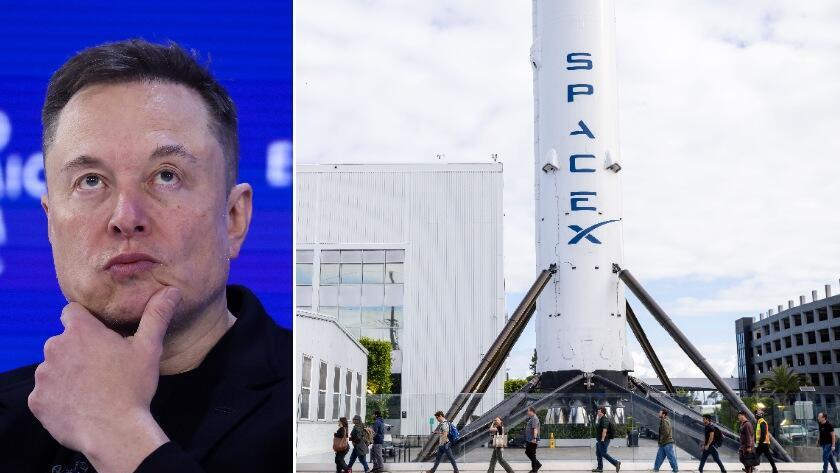
Elon Musk next to SpaceX's Falcon 9 launcher
(Ethan Swope, Krisztian Bocsi/Bloomberg)
The Bottom Line
Swinging Between Profit and Heavy Losses
SpaceX’s revenue is growing at an impressive rate, but not at the pace typically expected from a company approaching an IPO of this scale. In 2025, revenue rose 33.2% compared to 2024, following a 34.9% increase in 2024 compared to the previous year. In other words, revenue growth is slowing rather than accelerating.
The bottom line is even more volatile: SpaceX swung from a loss of $4.63 billion in 2023 to a profit of $791 million in 2024, and back to a loss of $4.94 billion in 2025. A sharp surge in R&D spending, up 150% annually to $8.64 billion in 2025, helps explain this dramatic volatility.
The company is also undertaking massive capital expenditures in AI infrastructure and space. In 2025, capital expenditures reached $20.7 billion, of which $12.7 billion was directed toward AI data centers such as Colossus and Colossus II. As in other companies in the sector, investment continues to rise. In the first quarter of 2026, AI infrastructure spending already reached $7.7 billion.
These investments come at a cost, but also generate substantial long-term commitments. Anthropic has agreed to pay the company $1.25 billion per month until May 2029 in exchange for access to computing power being built by SpaceX. Last week, the company signed a similar agreement with Google, worth $920 million per month through mid-2029.
Areas of Activity
From Satellites and AI to Connectivity
SpaceX’s space operations recorded revenue growth of 7.64% last year to $4.09 billion, the slowest among the company’s divisions. This was accompanied by a shift from an operating profit of $21 million in 2024 to a loss of $657 million.
Its revenue is also less than $1 billion higher than the AI segment, and within the company’s broader mix, the space segment can be seen as relatively small in revenue terms given its lower growth profile compared to AI and connectivity. However, its strategic value is far greater than its income suggests: rockets from this division deploy thousands of Starlink satellites, the company’s primary revenue engine, and underpin Musk’s long-term, and still uncertain, vision of building data centers in space to accelerate AI operations.
In this sense, the space segment is critical infrastructure for the company’s other divisions, even if it does not generate significant standalone revenue.
Artificial intelligence represents both the most prominent narrative driver and a major component of the company’s valuation. It is tied to xAI activity (which Musk merged into SpaceX and which also includes the social network X, formerly Twitter). In revenue terms, it is the smallest segment, generating $3.2 billion in 2025, reflecting annual growth of 22.2%. It is also responsible for the largest losses, with an operating loss of $6.36 billion, up 307.1%.
The company’s models are considered less advanced than those of Google, OpenAI, and Anthropic, and are not widely used beyond X’s relatively limited user base. However, the AI infrastructure built to support this division could become a meaningful revenue stream in its own right, including through the sale of computing capacity to external customers, as already seen in agreements with Anthropic and Google.
The connectivity division is the strongest both in absolute terms and growth, driven by Starlink satellite internet services. Last year, it generated $11.39 billion in revenue, a 49.9% increase year on year, and operating profit of $4.42 billion, up 120.5%. In the first quarter of 2026, Starlink reached 10.3 million paying subscribers, an annual increase of 105%.
This is currently the company’s main revenue engine and the division that enables it to sustain heavy investment in AI while maintaining overall financial stability.
The First Trillionaire
Musk Retains Control of the Company
SpaceX’s IPO could, on paper, make Elon Musk the first trillionaire in history. With nearly half of the company’s shares, a valuation of this magnitude would significantly increase his personal wealth by hundreds of billions of dollars.
But the more consequential issue is control. Through a dual-class share structure, Musk retains 85% of voting power, effectively guaranteeing continued absolute control over the company. For investors, this represents a key consideration: they may be buying shares in a public company, but one that could still operate like a tightly controlled private empire.
How much risk that represents ultimately depends on how much confidence investors place in Musk’s leadership and decision-making.



