











A Chinese wake-up call and a Google comeback: AI’s road into 2026
Competition intensifies as the industry enters a more fragmented era.
If someone had fallen asleep at the beginning of 2025 and woke up just now, they would struggle to believe that only a single year had passed. In the age of AI, a year feels like a decade in any other field. Technologies are advancing at a dizzying pace, and a product that seemed revolutionary in March can feel outdated by December. If we once eagerly awaited the annual developer conferences of the tech giants, today a world-changing product can be launched at any moment - live on X, with no advance warning. When we compare the models we used at the start of the year with those we are ending it with, it is hard not to be amazed by the scale of the leap, even if the pace of progress sometimes appears slower than in previous years.
2025 was a year of many players, intensifying competition, and the erosion of hegemonies that once seemed unassailable. The year opened with panic over China’s DeepSeek and closed with Google’s dramatic comeback. Those who believed image models had reached their peak discovered that the line between AI-generated content and reality has become almost completely blurred; and those who expected AI browsers to revolutionize the internet were left somewhat disappointed. Calcalist summarizes the year in AI, and looks ahead to what 2026 may bring.
The shattering of ChatGPT’s hegemony
The year opened with turmoil in the large language model market following the January launch of DeepSeek R1. According to the Chinese company, the model was trained using just $6 million worth of computing power, a claim that sent shockwaves through the markets. Over time, however, the surprise effect faded, the claims were questioned, and markets recovered. Since that initial storm, DeepSeek has failed to introduce major innovations, and today its market share stands at around 4% (according to SimilarWeb), largely driven by users in China.
The companies that did post significant achievements in 2025 were Google, xAI, and Anthropic, each of which managed, for the first time, to pose real competition to OpenAI. In February, Elon Musk’s xAI launched Grok 3, marking its entry into the top tier of models. Grok 4, released in July, represented a major leap forward and was crowned by many as the smartest model available at the time. The most advanced version today, Grok 4.1, has delivered no major breakthroughs relative to competitors, while xAI has also faced allegations that its models spread misinformation, racism, and antisemitism.
Anthropic began the year with Claude 3.7 Sonnet and ended it with Opus 4.5. While Claude has never been a mass-market favorite, due in part to weak search capabilities and a less intuitive interface, it has earned a devoted following among programmers, many of whom were particularly enthusiastic about Opus 4.5.
The biggest surprise of the year, however, came from Google. The launch of Gemini 3 in November showcased impressive capabilities and cut meaningfully into ChatGPT’s market share. ChatGPT’s share fell from 72.9% before the launch to 68% by December, while Gemini rose from 13.3% to 18.2%.
Google’s resurgence stands out against widespread disappointment with OpenAI. The August release of GPT-5 failed to meet expectations, and GPT-5.1 arguably represented a step backward. Still, OpenAI should not be written off: the December launch of GPT-5.2 returned the company to the spotlight, though it remains unclear whether this will stem the flow of users toward Gemini.
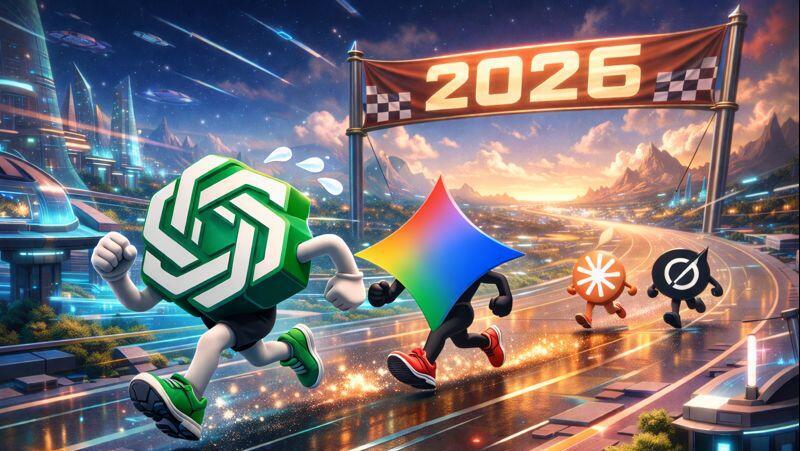
On the one hand, compared with earlier breakthroughs such as GPT-4 and GPT-o1, the pace of progress in 2025 appears to have slowed. On the other, the gap between where the year began and where it ended remains astonishing. Above all, 2025 marked the intensification of competition, a reality captured by a meme circulating online, updated every few months as a new company claims to have released the world’s best model. In 2026, the key question is whether this competition will finally cost ChatGPT its long-held primacy.
Image models
The line between AI generation and reality is blurring
The most dramatic advances of 2025 occurred in image models. The shift began in March, when OpenAI launched a new image model that sparked widespread excitement. For the first time, users could generate images based on existing photographs, flooding social media with portraits rendered in the style of Studio Ghibli, Van Gogh, and others. The model also enabled limited in-image editing, though its ability to follow complex instructions remained constrained.
That same month saw the release of the lesser-known Reve model, which enabled highly realistic image generation, including depictions of celebrities. Google responded in May with Imagen 4, offering extremely high-resolution images but still falling short of ChatGPT’s broader creative capabilities.
The real turning point arrived in late August with the launch of Nano Banana, which outperformed ChatGPT in detailed image-editing tasks. Days after the debut of Gemini 3, Nano Banana Pro raised the bar again. It excelled in editing and emulating elements from existing images and became the first model to properly support Hebrew captions, including the creation of complex, high-quality infographics.
For many users, Nano Banana Pro became the primary reason to switch to Gemini. OpenAI’s latest image model, released last month, is also strong, but struggles to compete. The leap in image models during 2025 has democratized design, threatening professionals in the field. While designers remain essential for certain tasks, their role is increasingly limited to more specialized work.
2025 also marked the beginning of an era in which distinguishing between reality and AI-generated imagery has become genuinely difficult, opening the door to misuse and manipulation. In 2026, attention will turn to how companies respond, and whether regulators step in.
Browsers
Still not delivering the goods
AI browsers made their debut in 2025, but so far have failed to live up to expectations. The first entrant was Perplexity, which launched Comet in July, the first browser to feature autonomous agent capabilities. OpenAI followed in October with Atlas, which more than two months after launch remains available only on Mac. Microsoft introduced Copilot Mode, embedding agent functionality directly into Edge, effectively transforming it into an AI browser. Arc also entered the space before evolving into Dia, which lacks agent capabilities but remains a notable contender.
Despite the hype, AI browsers have yet to threaten Google Chrome’s dominance. Habit plays a role: even with easy migration tools, users are reluctant to abandon familiar workflows. More importantly, the products remain immature. Agent capabilities are slow, unreliable, and often fail to deliver sufficiently strong results. While features like price comparison and vacation booking are appealing, it remains unclear what truly mass-market use cases agents will serve. Security concerns further limit adoption.
Looking ahead to 2026, attention is focused on Google. The company currently offers a Gemini extension for Chrome only to U.S. users, without agent functionality, though such capabilities are reportedly in development. If Google cracks the formula, it could cement Chrome’s dominance for years to come.



