










“The positive scenario is regime change in Iran and a short war”
Israeli markets rally on hopes of strategic transformation despite global declines.
From the moment Israel launched its strike on Iran on Saturday morning, the local capital market shifted into a state of heightened alert, focused on how the Tel Aviv Stock Exchange would respond to a second war with Iran in less than nine months.
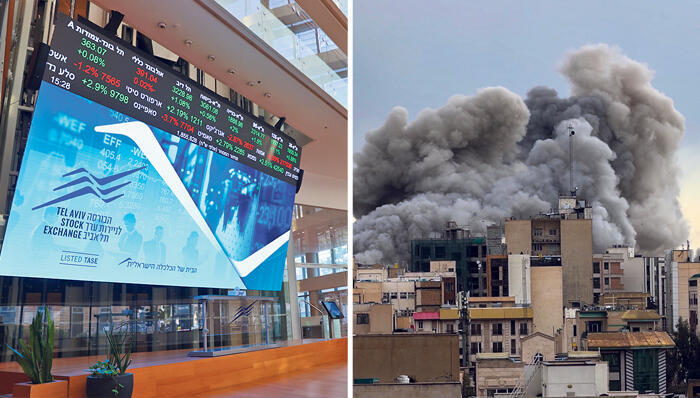
When trading opened on Monday on Ahuzat Bayit Street, screens flashed bright green. Investors appeared to be betting that the conflict could ultimately strengthen Israel’s strategic and economic position.
1 View gallery
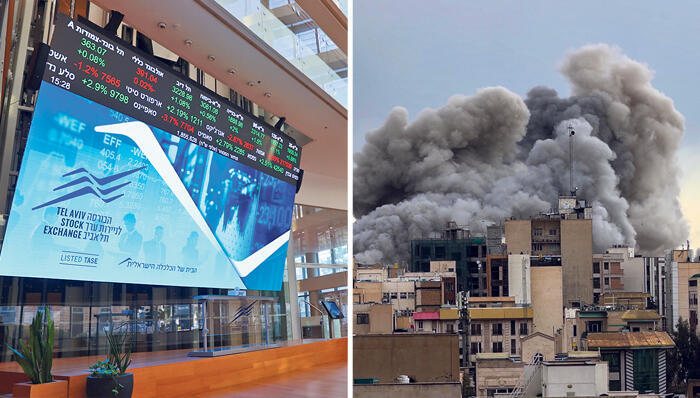
Tel Aviv Stock Exchange and an attack in Tehran.
(Photos: Bloomberg, AP / Mohsen Ganji)
The TA-125 index, the exchange’s broad benchmark, jumped 4.75%, while the blue-chip TA-35 rose 4.6%. It was the stock market’s sharpest daily gain since April 2020, when it rebounded from the coronavirus crisis.
Sector gains were even more pronounced. The TA-Oil & Gas index climbed 9.3% amid rising global energy prices. The TA-Insurance index advanced 8.5%, reflecting the perception that insurance companies function as a leveraged play on broader economic growth. The TA-Construction index rose 6.7%, as investors anticipated a potential reconstruction boom following the conflict. Government and corporate bond indices also ended the day higher.
“A surge in Israel alongside declines in the U.S. is highly unusual,” said Barak Bansky, Chief Investment Officer at Clal Insurance. “For Israel, the developments in Iran are far more acute, so the market reaction is stronger. In the U.S., the concern is over being drawn into a prolonged conflict. Here, investors are focusing on the positive scenario.”
According to Bansky, if the previous war aimed primarily at damaging uranium enrichment capabilities, the current objective is broader. “The positive scenario is regime change and a short war. If both occur, which is far from guaranteed, it would be especially optimistic for Israel and could attract foreign capital. The downside scenario is a prolonged regional war without regime change, which would be highly negative.”
Ronen Capleuto, Chief Investment Officer at Harel, described the situation as “a significant anomaly.” Globally, he noted, investors are fleeing risk, buying gold and pushing up oil prices. “Israel’s risk premium, as measured by CDS contracts, has not yet declined. The shekel and the local stock market are almost alone in moving against the global trend. The market may be displaying excessive optimism.”
Moshik Yosipovich, Head of Israeli equities at Migdal Insurance, offered a different view. “Historically, the Israeli market rises after wars,” he said. “In the past, it took days to recover losses. This time, the rebound began immediately.”
He pointed to public sentiment, describing a broadly supportive mood around the operation. “A positive outcome could reduce Israel’s risk premium and even allow the central bank governor to lower interest rates. Inflation has already moderated. There is often a post-war rebound in consumption.”
Still, some questioned whether a 4% daily jump signals euphoria.
Yosipovich rejected that interpretation. “Last week the market posted sharp declines, following a 12%-13% rise since the start of the year. Much of today’s gain simply reverses last week’s losses.”
Bansky cautioned against broad valuation comparisons. “You have to examine sectors individually. Some defense, semiconductor and green energy stocks trade at very high multiples. Future earnings growth could justify them, but in some cases, prices may already be stretched.”
Micha Malka, founder of the Tulip hedge fund, noted that defense companies may enjoy years of strong demand. “It’s difficult to price them,” he said. “You wouldn’t want to buy at a multiple of 70 or 80, but sustained growth can compress those multiples over time.”
Lior Kagan, CEO of Meitav Mutual Funds, argued that markets are forward-looking. “There is a perception of a meaningful reduction in Israel’s strategic risk following the opening phase of the operation. That clarity matters.”
He suggested that short covering may also be amplifying gains. “Some investors positioned defensively ahead of the conflict. As those hedges unwind, it creates a short squeeze.”
Malka believes retail investors are playing a significant role. “We feel it through the mutual funds,” he said. “Institutional investors are buying as well, and foreign investors appear to be participating, particularly in bank shares.”
Yosipovich added that foreign investors are not rushing to sell. “On the contrary, some are looking to buy. They see what local investors see.”
The most optimistic scenario, investors say, would involve a significant weakening or even collapse of the Iranian regime. A more realistic scenario might involve a substantial reduction in Iran’s capacity to threaten Israel. The pessimistic outcome would be a prolonged period of missile attacks and economic uncertainty lasting months or years.
Financial stocks have led the rally, reflecting expectations of economic stabilization and eventual recovery. Defense stocks have also gained, as countries worldwide reassess security spending.
Still, structural challenges remain. Israel’s political polarization, budgetary constraints and rising deficit have not disappeared. “On days like these, investors focus on momentum and ignore other factors,” Kagan said. “But markets do not rise indefinitely.”
Malka struck a similar note. “When there are major political events, investors focus on the positive narrative rather than valuation metrics. But for optimism to be justified, many things still need to go right.”
Technology stocks remain exposed to global concerns over artificial intelligence disruption, though Israel’s market has less concentration in software than the U.S. “There could be some impact on office real estate and consumption,” Yosipovich said, “but finance and real estate carry significant weight here.”
As for the IPO market, Capeluto said a major defense-sector listing could emerge, potentially involving Rafael or Israel Aerospace Industries. “It could happen this year or next, depending on how long the conflict lasts,” he said, noting that such offerings could provide meaningful support to state revenues.



