











"AI won't make the gaming industry any easier"
Ido Yablonka, founder and CEO of Kooply, warned at the Gaming Conference, hosted by Calcalist, Google, and Playtika, that AI tools are available to everyone and do not guarantee a competitive advantage. Lior Kenan, an Executive Vice President at Playtika, noted: "90% of developers work with AI. Tasks that once took 50 days can now be completed in five hours."
"90% of developers work with AI. Tasks that once took 50 days can now be completed in five hours," said Lior Kenan, Executive Vice President of Growth at Playtika, during a panel at the Gaming Conference hosted by Calcalist, Google and Playtika. The panel also featured Ido Yablonka, founder and CEO of Kooply. The two discussed the transformations artificial intelligence is driving in the gaming industry, how established companies and startups are adopting the technology, and the challenges it poses to the sector.
Kenan said: "Until two years ago, we were asking ourselves to what extent AI could transform the industry. Now, the only question is how quickly it will happen." He offered two perspectives on the changes underway: that of Playtika, and that of Kooply, a startup in which Playtika has invested.
Yablonka said: "Nothing is theoretical anymore. A year ago, we decided to rebuild the company around AI, integrating it into internal processes such as design and strategic planning. Interestingly, we've found that its contribution is greatest in our new games and the new environments we are developing, where it can leverage existing infrastructure. By contrast, its impact has been more modest in one of our older, more established games."
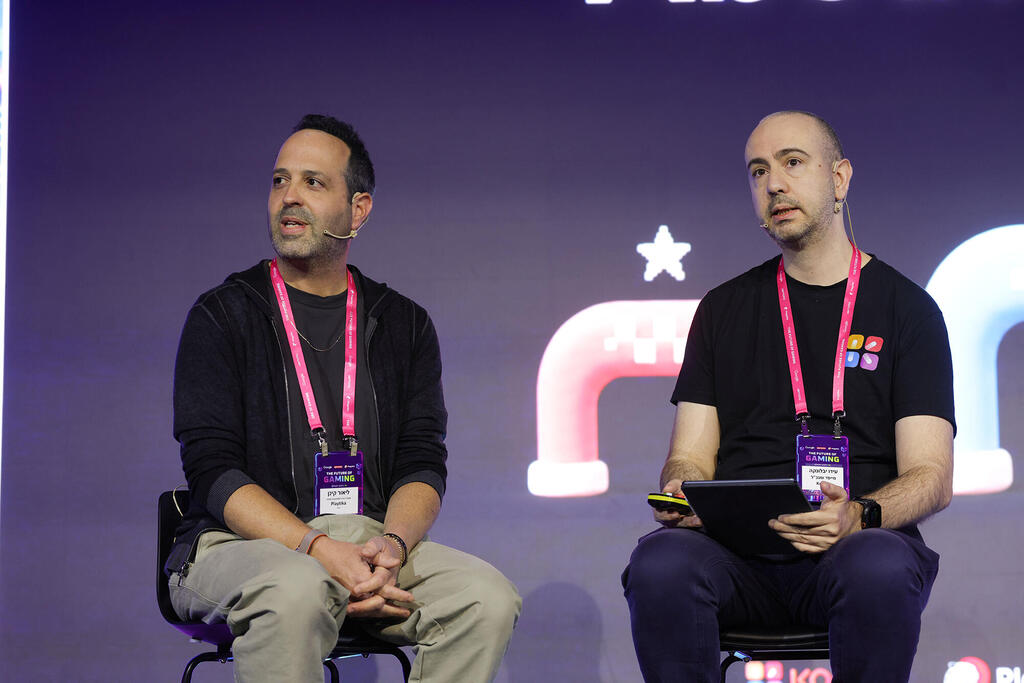
Kenan said: "For us, the bottleneck isn't so much creating new games as producing rich content and ensuring constant innovation. At the beginning of this revolution, we charged ahead at full speed, but things have evolved since then. Over the past year, AI engines have made dramatic advances, and we're seeing a major boost in efficiency. Today, 90% of our developers use AI. Tasks that once took 50 days can now be completed in five hours. The progress is substantial and clearly evident."
Yablonka said: "For us, efficiency has made a real difference. I drew up a plan that projected we would need 1,000 employees. Today, we don't even need 50. Decision-making is much faster. As I mentioned earlier, there is no such thing as an 'instant hit' created at the push of a button, but we do move quickly. People say that gaming is essentially an insurance business with graphics: the better you can forecast, the greater your competitive advantage. For a startup, we've invested heavily in this infrastructure. You end up with a kind of 'super-analyst' that refines data and makes it accessible."
Kenan said: "We've had data for many years. There's a huge amount of it, and people want answers to their questions. This created long backlogs for analysts in every studio. Today, however, anyone in the studio, regardless of their role, can ask questions and get answers. This democratization of data enables us to create better content."
Yablonka said: "For us, using data allows us to keep making improvements until we achieve results that justify further investment, for example, in monetization or user acquisition (UA). A game without these elements is worthless. If you can move 10% faster than your competitors, that's a significant advantage. Data is critical to achieving that."
Yablonka also addressed the impact of artificial intelligence on creativity. "We considered making AI tools accessible to creators, but found that doing so could lead to a loss of uniqueness. No one gets excited about a game level created by a machine," he said. He noted that Kooply distinguishes between using AI tools internally and making them available directly to creators.
Kenan said: "For us, content is king. The focus is on determining what is right for our players, for each individual player in every game. This allows us to produce the right content and choose the best possible option. However, artificial intelligence also raises concerns. The machine is learning us very well, and I fear the day when we might lose the ability to challenge it. I'm constantly thinking about how to preserve human knowledge."
Yablonka said: "In our world, humans make mistakes too. It's not just machines. AI tools are not a competitive barrier for any gaming company around the world; they're universal tools. To me, the real risk is commoditization. Where does your differentiation come from? The pace at which these technologies are evolving is unprecedented. We need to keep our feet firmly on the ground."
Kenan said: "These tools are accessible to everyone. Our decision to embrace the AI revolution at Playtika stems from the realization that things need to be done differently. We constantly encourage collaboration across the organization, allowing teams to learn from one another, sharing what worked and what didn't. This also helps preserve institutional knowledge."
Yablonka said: "For us, this represents a complete transformation of the organization."
Kenan said: "The question is: What cannot be copied? We've been on a journey with our players for a decade, and they keep coming back day after day. You cannot replicate the depth of that emotional connection or the sheer volume of data involved. Sure, a game can be copied, but the bond with the player cannot. We intend to build on that further using AI."
Yablonka said: "The community is also crucial. An AI model like Claude cannot create an audience that genuinely loves your product. Community, depth and networks hold long-term value, especially as competition intensifies. By 2027, it will be even more challenging."
Yablonka added: "Looking ahead, I believe the market will become more polarized. People will gravitate toward specific spaces or platforms, driven by their interactions with the people already there. AI won't make the gaming industry any easier."
Kenan said: "As a large company, the winner of this race will be the one that effectively harnesses data to create content. Things are changing, and those who adapt their organizational structures and roles are the ones who adapt their structures and roles are the ones who will move forward."



