









Growth+
"When you position yourself correctly in the value chain and quantify the impact in billions, investors understand immediately"
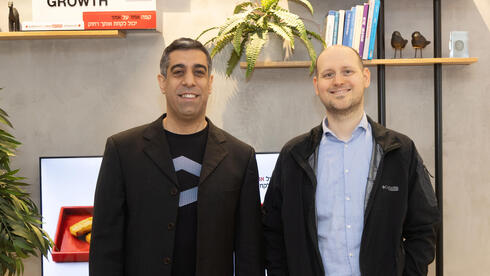
As part of the Growth+ initiative by Calcalist and Poalim Tech, Elad Raz, co-founder of NextSilicon, met with Moshe Noy, CEO of Caesarea Labs, to offer advice, support, and insights on entrepreneurship, startup management, and scaling companies for growth.
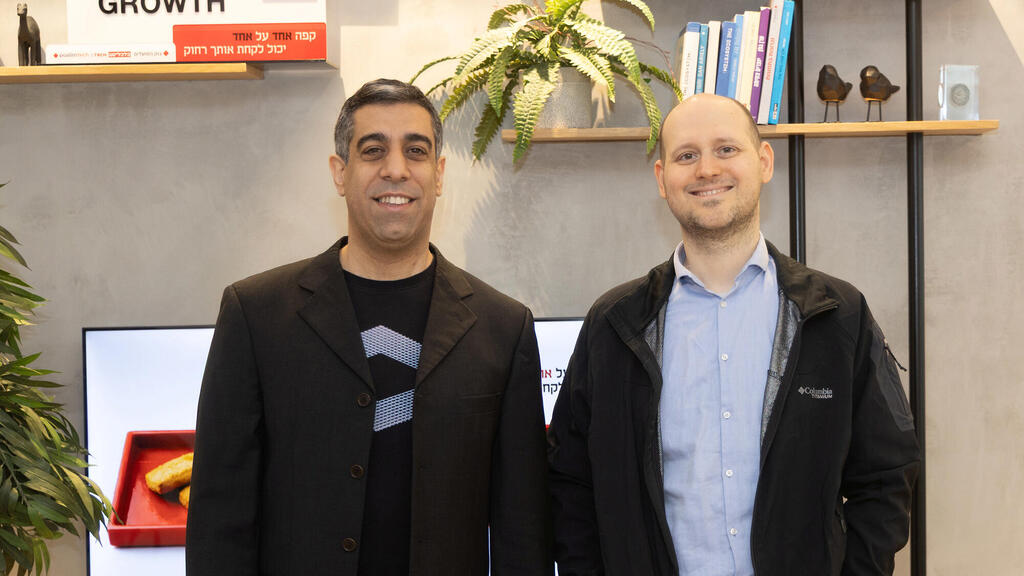
Elad Raz, technology entrepreneur, co-founder and CEO of NextSilicon, met with Moshe Noy, CEO of Caesarea Labs, which develops tools for chip testing.
The conversation was held as part of the Growth+ project by Calcalist and Poalim Tech, now in its third year, a series of one-on-one meetings between founders of leading tech companies in Israel and entrepreneurs of promising startups. The goal is to provide advice, support, and practical tools on entrepreneurship, creativity, startup management, and building companies for growth.
Elad, tell us about a crisis you encountered early on and what you learned from it.
"I come from the world of software. When I founded NextSilicon and moved into the world of chips, I was exposed to unimaginable costs and timelines. Producing a chip costs about $120 million and takes years of development before you receive the first sample from the manufacturing plant. At the end of the process, the chip arrives, you place it on the tester, turn it on, and hope it doesn’t burn out. This is the most stressful moment in a company’s life, determining whether it will continue to exist or not.
“The first time we received a chip, we turned it on, and nothing worked. It triggered hours of panic, especially when you’re a CEO who has to project confidence to employees while continuing to raise money. In the end, it turned out that the post-validation engineer had simply connected the cable to the wrong port.
“There are many examples like this, highly technical situations that seem catastrophic but ultimately have simple explanations. What looks like a major failure can sometimes come down to something as trivial as a misconnected cable or a reversed indicator."
Moshe, what was your biggest challenge this year?
"The main difficulty was raising our seed round. We are trying to modernize an industry that has operated in largely the same way for 50 years. We specialize in post-silicon testing, helping chip companies validate their products faster so that development investment translates into revenue.
“A significant amount of time is spent on testing to ensure everything works properly. Unlike software bugs, which can be fixed remotely with updates, hardware bugs require recalls, which are costly and can severely damage a company’s reputation. Investors tend to be cautious about backing solutions that sit slightly outside the mainstream."
Elad, what advice did you give Moshe?
"We both operate in deep tech, a complex field built around heavy hardware. Most investors come from financial, not technological, backgrounds. Early on, I made the mistake of explaining computing architecture in detail, and lost my audience.
“My advice to Moshe was to speak in numbers. Instead of explaining technical validation processes, I suggested framing the problem in business terms. For example, Jensen Huang, CEO of Nvidia, recently introduced a chip that cost $10 billion to develop and generates $25 billion in quarterly revenue. If that chip fails or is delayed by a quarter, that’s a $25 billion loss. That’s exactly the type of problem Moshe’s technology addresses.
“When you position yourself correctly in the value chain and quantify the impact in billions, investors understand immediately."
What did you learn from each other?
Moshe: "I learned how to pitch more effectively. As an engineer, I naturally focus on the technology and tend to dive into details. Elad taught me to step back and communicate in financial terms, to define the business pain for large companies and quantify how much it costs them."
Elad: "As someone from a software background working in hardware, every conversation with chip engineers exposes me to the complexity and challenges of that world. Moshe shared valuable insights on how to optimize and accelerate hardware development processes using advanced tools, which we are now exploring internally."
Is there anything surprising you discovered about each other?
Elad: “The truth is, we’re both engineers, so we mostly talked about technology. Neither of us seems to have hobbies beyond what we do. Put two engineers in a room, and they’ll forget everything else and dive straight into work."
Elad Raz's Golden Advice
“Sometimes we forget that it’s not enough for technology to be impressive. An entrepreneur must know how to translate the product for non-technical audiences, build a go-to-market strategy, identify the right stakeholders within organizations, and continuously validate the market, both in the early stages and during growth.”



