










“It’s not enough to write prompts”: Intel warns AI won’t replace the need to study
Intel Israel’s innovation chief, Avi Salmon, says the engineers who thrive in the AI era will be those with deep knowledge, curiosity and the ability to learn independently.
Five years ago, the advice given to young Israelis interested in technology was relatively straightforward: study computer science, build a startup and aim for an exit.
The rise of artificial intelligence has complicated that formula. If AI tools can write code, analyze information and solve increasingly complex technical problems, what is the value of spending years at university?
For Avi Salmon, Evangelist of Innovation at Intel Israel, the answer is that artificial intelligence is changing the skills engineers need, but it is not eliminating the need for education.
"I lead innovation at Intel Israel, but I'm also an engineer," Salmon said at the Future of Industry conference hosted by Calcalist and the Holon Institute of Technology. "My children ask me why they should study and what they should study."
The question, he said, is one that universities and technology companies are also struggling to answer.
"At Intel, we host hundreds of deans who ask us exactly this question. I have excellent forecasts about the past, but regarding the future we're having a bit of difficulty. The answers come from the field."
Salmon argued that the growing use of AI tools makes fundamental knowledge and curiosity more important, not less.
He pointed to a recent hackathon Intel held for students at the Technion, where participants were asked to solve software challenges. Some students attempted to rely heavily on AI tools rather than developing their own solutions.
"One of them later wrote an amazing post," Salmon said. "He admitted that he had tried to cut corners and ended up in 15th place. He wrote: 'I had no chance of finishing higher, because the people who took the higher places were the ones who studied and were curious, and I understood why it's not enough to write prompts.'"
According to Salmon, AI can accelerate work, but it cannot replace the deeper understanding that allows engineers to solve new problems.
"A large part of what we look for in engineers is knowledge, but also the ability to learn independently," he said. "So why start studying? Because even when artificial intelligence is perfect, the difference is in the ceiling, which remains very low, and the real value is seen in people who have an understanding of the profession."
He added: "I tell my children: I'm not sure what you should study, but it's clear that you have to study. There's no question."
Companies want adaptable workers, not just technical knowledge
The changing role of education is also reflected in how technology companies are hiring.
Sigal Gill More, Chief Human Resources Officer at Check Point, said companies are no longer looking for the same type of entry-level employees they once did.
"I've been in industry all my life, and I taught in academia for many years, so I'm close to this subject," she said. "From Check Point's perspective, we no longer recruit what we used to recruit, because we need fewer juniors."
Gill More said that while technical foundations remain essential, employers increasingly prioritize people who can learn independently and adapt to changing technologies.
"Even when I taught at the university, my core message was: study and come prepared. I believe that's an important foundation," she said. "At the same time, today we recruit curious people who know how to learn on their own and who have a high ability to acquire knowledge."
She argued that the balance between knowledge and skills has shifted significantly.
"We need broad, critical thinking and a diverse workforce, including managers with a solid knowledge base, but it is specific skills that transform a good professional into an excellent one."
"Today, we need academia to demand the same thing from students that we do: the ability to learn independently. In the past, the ratio was 80% knowledge to 20% skills; today, it's the reverse. Knowledge is less critical than skills."
Yaniv Yancovich, Head of Engineering at SAP's development center in Israel, said companies must focus on developing employees who can adapt quickly to new technologies.
"At SAP we chose our best people and made a shift in their knowledge," he said. "I expect my employees to know how to learn quickly, to know how to write prompts and to know how to understand the code."
But he emphasized that AI tools also introduce a new challenge: the ability to distinguish between useful answers and incorrect ones.
"ChatGPT is good because it gives quick answers with complete confidence," Yancovich said. "But I went traveling in Europe and asked ChatGPT about the trip, and in practice I realized it was talking nonsense. Then you understand that you have to be critical."
Beyond technical skills, Yancovich said both companies and universities need to encourage broader thinking.
"Another key aspect is a systems-level perspective. I want both my employees and academia to adopt this kind of holistic view, ensuring that different disciplines communicate with one another."
"In an academic setting, I would assign multidisciplinary projects right from the start. Academia needs to shift from merely imparting knowledge to fostering capabilities: teaching students to think critically and to work with artificial intelligence."
Academia: Don’t abandon the fundamentals
While industry leaders called for major changes in education, Dr. Nava Shaked, an AI expert at the Holon Institute of Technology, argued that the traditional academic model should evolve rather than be discarded.
"I'm a hybrid creature because I spent 20 years in industry and then returned to academia. I teach artificial intelligence and have a doctorate in it," Shaked said.
"The familiar model has not collapsed. It has changed, and there are things in the model that need improvement and things that need to be preserved."
Shaked agreed that universities need to incorporate more practical experience and industry input into their programs.
"Yes, we must bring much more practical application into our curricula. That means we must talk about critical thinking, but it has to be in context."
She called for closer cooperation between universities and companies, including bringing more industry professionals into classrooms.
"We have to bring many more industry people to teach in academia. I saw how projects are carried out in a holistic way. With us, people sit together. We have to speak the same language as industry."
At the same time, she warned against replacing theoretical education with purely practical training.
"If I'm talking about preservation, I don't believe in throwing out the baby with the bathwater. The theoretical aspect is important."
"Students in my course see a wave signal and know how to identify it. I turn to the industry to tell us what it needs, and together, we must define those requirements."
A new model of collaboration
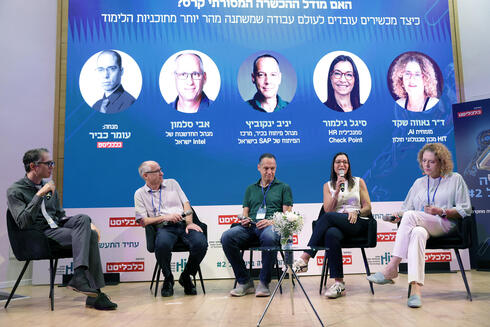
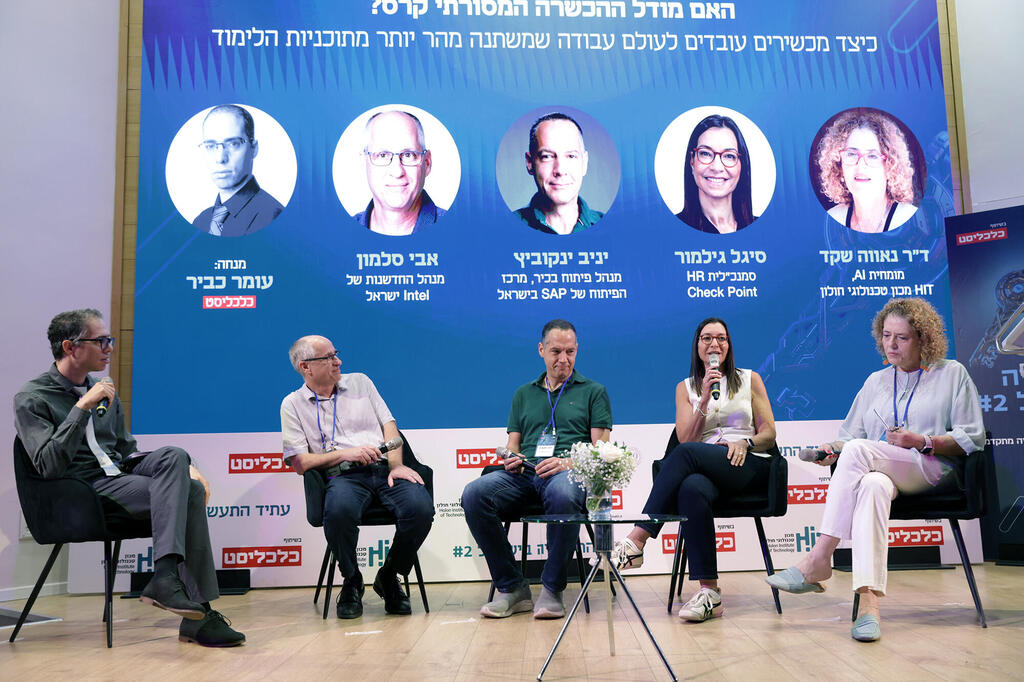
The panel, moderated by Calcalist technology correspondent Omer Kabir, focused on the growing gap between academia and the technology labor market.
All participants agreed that the traditional separation between universities and industry is becoming increasingly outdated.
Shaked said HIT is already trying to build more practical and socially oriented projects into its curriculum. Students work in teams and solve problems for real communities, including a planned project with a school in Holon for students with learning disabilities and a separate collaboration with the Abarbanel Mental Health Center.
"We go there, familiarize ourselves with the ecosystem and solve problems for communities that differ from the mainstream," she said. "This allows us to foster development on both a human and a direct, face-to-face level."
Salmon said companies also need to rethink their role in education.
"We believe in multidisciplinarity and industry-oriented models," he said. "People tell us, 'Take on students for internships,' but I ask myself, perhaps my own engineers are actually the ones lagging behind?"
"It can be a shared journey. Academia can come to us, and together we can undertake joint projects. This can drive economic change and offer us all entirely different perspectives."



