











The AI revolution has a supply chain problem
From helium to copper, the materials behind artificial intelligence are under strain.
The artificial intelligence revolution has, in just a few years, propelled us into a world that at the beginning of the decade still felt like science fiction. We now interact with computers capable of holding deep, nuanced conversations that resemble human dialogue. These systems can generate images, videos, and music from simple text or voice prompts, and autonomous agents can perform tasks both online and in the physical world. At times, AI even produces moments that echo dystopian fiction, such as experimental “social networks” for bots in which they simulate extreme or destructive scenarios.
Yet this futuristic revolution rests on deeply traditional and tangible foundations: raw materials like helium, copper, and tungsten, alongside physical components such as processors, memory chips, and fiber optics. These elements are not merely supportive, they are, in many cases, indispensable. Without them, the AI revolution would slow dramatically or even stall.
2 View gallery
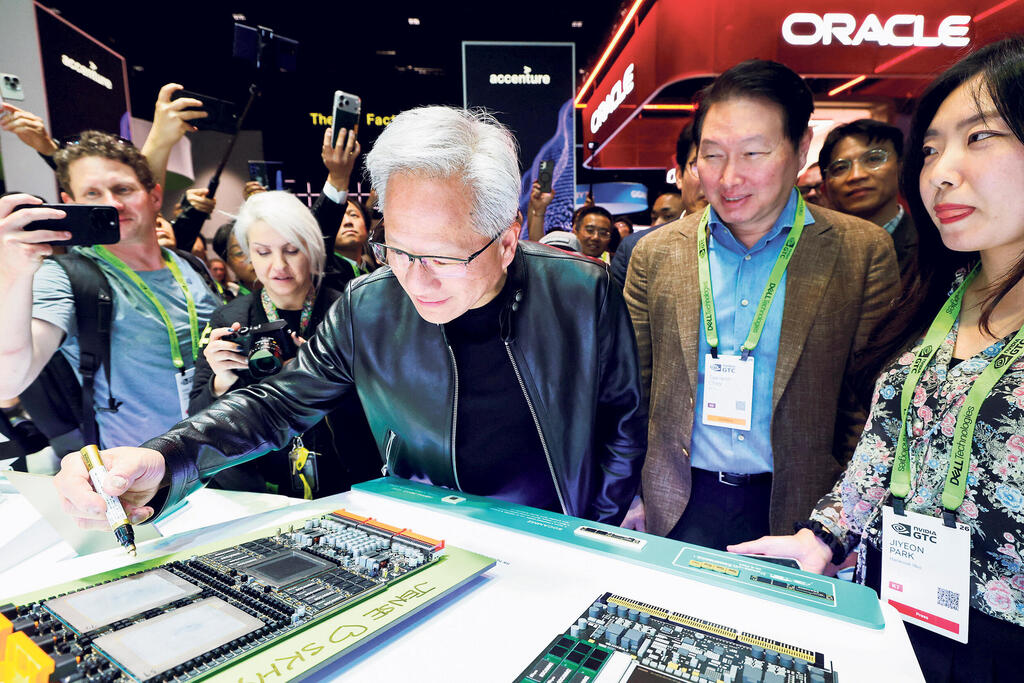
Nvidia CEO Jensen Huang last month at a conference in San Jose
(Reuters/ Fred Greaves)
Like any physical supply chain, their availability is shaped by familiar forces: geopolitical tensions, armed conflicts, concentrated production, and extreme weather events. Together, these factors are disrupting supply in ways that make building AI infrastructure more difficult and more expensive.
The intensifying technological rivalry between the United States and China has already led to sweeping restrictions on key raw materials used in advanced chip manufacturing. Beijing has imposed export controls in response to U.S. limits on chip exports, tightening access to critical inputs. Proposed U.S. legislation, the Multilateral Alignment of Technology Controls on Hardware (MATCH) Act, could escalate matters further by codifying and expanding restrictions on the sale of chipmaking equipment to China, including from allied countries such as Japan and the Netherlands. In response, China may deepen its own export restrictions, further straining global supply chains.
At the same time, regional conflicts are directly disrupting material flows. The closure of the Strait of Hormuz during the recent Iran conflict has affected not only oil shipments but also byproducts essential to chip manufacturing, including helium and plastics. The ongoing war between Russia and Ukraine continues to reverberate through the supply chain as well.
Climate events are adding another layer of disruption. A historic drought in Panama has reduced traffic through the Panama Canal, cutting daily ship capacity from 38 to 24 and limiting vessel size. This has significantly extended delivery times for hardware components traveling from Asia to the U.S. East Coast. In cases where production of a key material is geographically concentrated, localized climate events can trigger global shortages with long-term consequences.
2 View gallery

OpenAI CEO Sam Altman and Chinese President Xi Jinping.
(Andres Martinez Casares/AP, Kent Nishimura/Getty Images)
The picture that emerges is clear: the central challenges of the AI revolution are no longer purely technological. They increasingly revolve around managing supply chains, navigating geopolitical conflict, and mitigating economic shocks. There is no simple solution.
Helium: Qatar’s supply shock
Helium is essential to semiconductor manufacturing, used for cooling systems and maintaining ultra-clean environments during lithography and etching. Because it is a byproduct of natural gas extraction, its supply is tightly linked to the fossil fuel industry.
Qatar accounts for roughly one-third of global helium production. Earlier this year, Iranian strikes on key LNG facilities operated by QatarEnergy shut down helium production entirely, while the closure of the Strait of Hormuz has blocked exports. Rebuilding liquefaction infrastructure could take years.
South Korea’s chip industry, heavily dependent on Qatari helium, has been particularly affected. Companies such as Samsung Electronics and SK hynix have moved into emergency stockpiling mode, and prices for ultra-pure helium have doubled. With limited inventories under just-in-time supply models, production cuts are already underway, with broader market impacts expected in late 2026.
Plastics: A hidden vulnerability
Plastics, derived from naphtha, are critical for circuit boards, cables, and other hardware. Disruptions to oil flows through Hormuz have slowed naphtha supply, tightening the plastics market.
South Korea, which imports a significant portion of its naphtha through the strait, has designated it an “economic security item” and banned exports. Suppliers are warning of sharply rising prices and delivery delays stretching from weeks to months.
Energy: Rising costs for data centers
While not directly part of hardware supply chains, fossil fuels are critical to powering data centers. The surge in AI demand has already strained electricity systems, slowing the transition to renewable energy and pushing companies toward alternatives such as nuclear power.
In the short term, however, reliance on gas and diesel remains high. Disruptions in global energy markets are driving up operating costs for data centers, putting pressure on the economics of AI companies such as OpenAI.
Copper: A looming structural shortage
Copper is a foundational material for data center infrastructure. Traditional facilities require up to 15,000 tons, while AI-focused centers may need as much as 50,000 tons.
Demand is surging, while supply struggles to keep pace. According to the International Energy Agency, shortages could reach 30% by 2035 without major new investment. Declining ore quality and rising development costs are compounding the problem.
Tungsten: China’s tightening grip
Tungsten’s extreme heat resistance makes it indispensable for advanced chips. China controls nearly 80% of global supply and has imposed export restrictions, sharply tightening the market.
Prices have surged dramatically, and Western inventories are rapidly depleting. Efforts to develop alternative sources, from Vietnam to Canada, are underway but will take years to scale.
Gallium, Germanium, Graphite: Strategic chokepoints
These materials are essential for semiconductors, optics, and batteries, and China dominates their supply. Export restrictions imposed over the past two years have driven prices sharply higher and exposed the vulnerability of global tech supply chains.
Rare earths: Environmental trade-offs
Elements such as dysprosium and neodymium are critical for motors, cooling systems, and backup generators. Their production involves environmentally hazardous processes, which has led Western countries to outsource supply, primarily to China, which now dominates both mining and processing.
Antimony: A fragile supply chain
Used in semiconductors and fire-resistant materials, antimony is another metal under pressure. With China controlling most production and limited Western alternatives, prices have been highly volatile.
T-Glass and quartz: Bottlenecks in materials
Specialized materials such as T-Glass, produced almost exclusively by Japan’s Nittobo, and ultra-pure quartz from a small number of U.S. mines are creating additional bottlenecks. Supply disruptions in these niche materials can ripple through the entire semiconductor ecosystem.
Neon gas: War-driven shortages
Neon, essential for chipmaking lasers, has been disrupted by the war in Ukraine. Although supply has partially stabilized, inventories remain low and production capacity is still recovering.
HBM memory: Demand outstrips supply
High Bandwidth Memory (HBM) chips are critical for AI workloads, but their complex manufacturing process limits supply. Major producers, including Micron Technology, are struggling to keep up with demand, leading to sharp price increases and supply constraints.
Advanced packaging: A critical bottleneck
Technologies such as CoWoS, led by TSMC, are essential for integrating modern chips. However, limited capacity and dependence on specialized materials like ABF are creating significant delays.
GPUs and CPUs: Demand overwhelms supply
AI processors, particularly those developed by Nvidia, are at the heart of the revolution. But shortages in packaging and memory are constraining supply, driving prices higher.
Meanwhile, demand for CPUs is also rising, especially as AI applications become more complex. Manufacturers like Intel and AMD are prioritizing data center demand, leaving PC makers facing longer wait times and rising costs.
Silicon photonics: A talent bottleneck
Even as hardware evolves, a shortage of skilled workers is emerging as a key constraint. Silicon photonics, a promising technology for faster data transmission, requires expertise spanning both optics and semiconductor engineering. The talent pipeline is not keeping pace with demand.



