










“Intel’s Classiq deal proves deep-tech barriers have fallen,” says Entrée Capital’s Avi Eyal
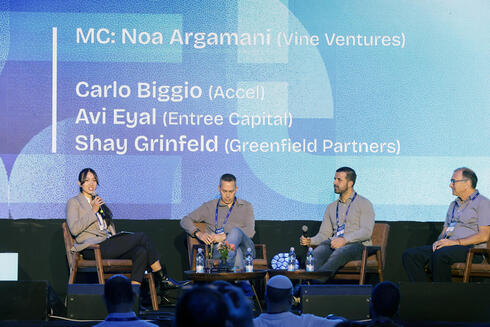
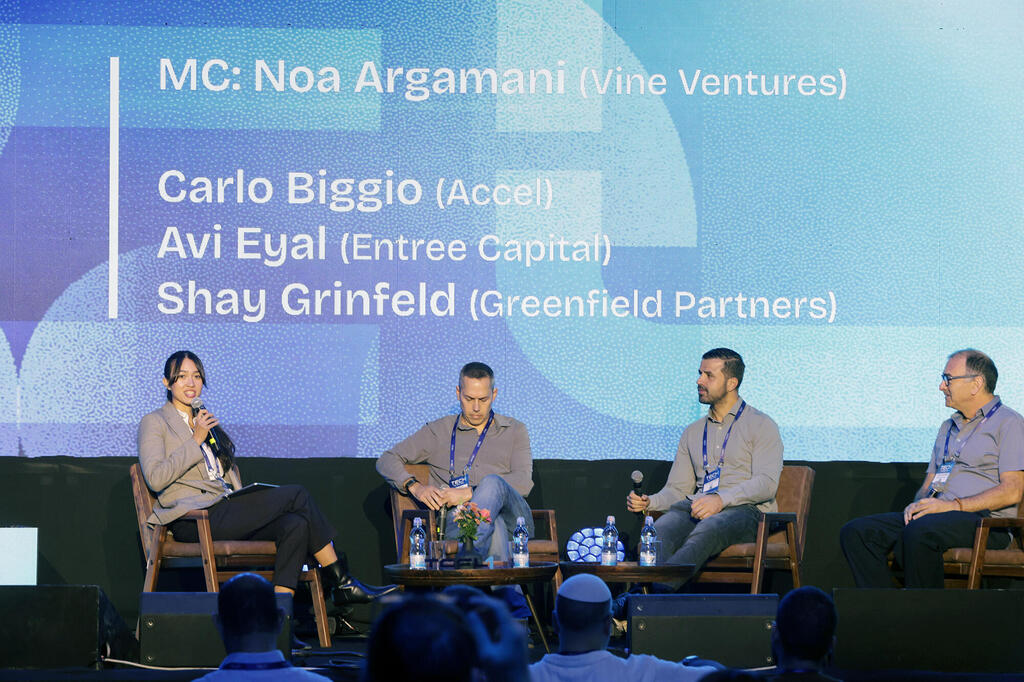
The investor, whose fund backed the Israeli quantum-computing startup early, says AI is expanding opportunities across semiconductors, energy and robotics, even as deep tech requires longer investment horizons. Eyal spoke on a panel moderated by Noa Argamani. Other participants on the panel included Carlo Biggio, a partner at Accel, and Shay Grinfeld, founder and Managing Partner at Greenfield Partners.
“Intel’s massive acquisition of Classiq proves that many of the barriers that once held back the deep-tech sector have fallen. Today, it is easier to develop deep-tech solutions, and there is an abundance of capital available in the field,” said Avi Eyal, managing partner at Entrée Capital, at the Tech1 conference hosted by Calcalist and Live Nation in Tel Aviv.
Entrée was among the earliest investors in Classiq, which develops an operating system for quantum computers. Intel acquired the company this week for $2.3 billion, in what was described as the largest quantum-related deal in history.
“We were fortunate to be involved with Classiq from the initial concept stage, through its founding six years ago, and up to this outcome: its acquisition by Intel,” Eyal said. “It’s wonderful to be associated with this, but the real question is why and how we decided to pursue it.
“As a fund, we have always focused on deep tech. In quantum computing, where specific use cases and applications remain unclear, we reasoned that if we could decouple software from hardware, we could build a highly successful business. The software would be ready by the time the hardware caught up.
“The deep-tech sector is growing, driven by applications in fields such as semiconductors and energy. Yet it is important to recognize that deep tech involves longer timelines and requires a greater level of commitment from investors.”
Eyal spoke on a panel moderated by Noa Argamani, a platform manager at Vine Ventures who was kidnapped from the Nova music festival on October 7, 2023, and later rescued in a military operation.
“For a long time, my name was associated with October 7, but today I am proud to be here in the context of innovation and investment,” Argamani said at the start of the discussion. “I am excited to help Israeli founders think globally from day one. Over the past few months, I’ve spent time with investors and founders, and one question kept coming up: with AI transforming so much, what is truly important, and what is just hype? It’s difficult to distinguish between what is merely exciting and what is genuinely significant and investable.”
Carlo Biggio, a partner at Accel, discussed how investment priorities have shifted in recent years.
“A few years ago, most of us wouldn’t have invested in fields with physical components, such as biotech or semiconductors, because scaling them is difficult,” he said. “But now, with AI, semiconductors have become a highly sought-after, fast-growing investment area.
“In biotech, particularly in drug discovery, models now enable processes to move faster and produce better outcomes. Energy is fundamental to AI, which is highly energy-intensive. And robotics, which was considered too resource-intensive and costly a decade ago, is now a high-demand sector with promising revenue potential. The categories in which we invest have expanded significantly.”
Shay Grinfeld, founder and managing partner at Greenfield Partners, said AI had also changed how investors view the potential of robotics and automation.
“A great deal has changed over the past three years. We used to invest primarily in software, but the advent of AI has shifted our focus. We’ve seen that many roles previously untouched by robotics can now be augmented or even replaced by robots. The market has become virtually limitless, representing an entirely new approach to investment.”
Grinfeld said Israel’s history of developing technology infrastructure could position local companies to benefit from the next wave of AI investment.
“Historically, Israel has excelled in infrastructure, from the early days of processors to networking, cloud computing and mobile infrastructure. We are now in another wave of AI infrastructure.
“The challenges we see in AI infrastructure and physical AI will not disappear; they will remain with us for a long time. There is a tremendous opportunity to invest in Israeli companies building infrastructure solutions. This encompasses not only hardware but also software infrastructure, including everything required to operate these systems safely. The concentration of talent in Israel creates many opportunities.”



