










Tech transformation: From managing a development team to implementing AI
Israeli high-tech companies are moving the best employees from development teams to new implementation roles. A new Microsoft report explains why this is happening: Only 16% of the world's workers are at the forefront of using technology, the rest are stuck - and what's really holding everything back are the organizations
A year ago, when Microsoft published its annual World of Work report, the promise was that every employee would become a 'manager of agents.' Today, a year later, it seems that the prediction has come true, but only in part. The agents have indeed arrived - a 15-fold growth in their number within a year, and in large corporations even 18-fold. But while Microsoft published a new report this week celebrating 'unprecedented opportunity for every employee,' it itself presented a retirement plan for 7% of its employees in the US two weeks ago. In the global high-tech industry, over 200,000 employees were laid off in 2025, with the reason attributed to AI for about 70,000 of those layoffs, and in Israel, for the first time in a decade, a decline in the number of people employed in high-tech was recorded.
This gap between the tech giants’ narrative of empowerment and the reality of layoffs on the ground is the elephant in the room in any discussion about AI in the workplace. Microsoft’s report, which is based on an analysis of trillions of productivity signals from Microsoft 365 and a survey of 20,000 workers using AI in 10 countries, offers the following narrative: AI is expanding human capabilities, empowering workers through agent management, and opening the door to a new kind of work. But that’s only half the story. The half that doesn’t address the roles that are becoming redundant, the workers who are no longer needed.
Sam Altman, CEO of OpenAI, by the way, recently warned of a phenomenon he called "AI Washing" - companies that attribute layoffs to automation that actually stem from other business decisions, because "AI" is a word that impresses investors. And a recent study by The Budget Lab at Yale University found that the prediction of mass layoffs due to artificial intelligence has not yet been realized in macro data.
What is happening on the ground today, in many high-tech companies, is that the adoption of AI actually increases the workforce and creates new roles. Software engineers who spent years writing code now find that most of the code is written by the agent, and that they themselves are becoming the agent managers and AI implementers in the organization. Tagging teams that have become Prompt Engineering teams. New directors whose job is to unify all AI efforts in the organization.
According to Microsoft's report, only 16% of AI users worldwide are in what the company calls the "frontier zone," the point where high individual proficiency in using AI meets an organization ready to implement it. The rest are somewhere in the middle, and worse, 9% are in a state of implosion - employees who have already developed advanced skills, but the organization around them simply does not allow them to use them.
The conclusion from the report is that the agent revolution is already here, employees are already running, but they can't move forward, because the organization around them is simply not there. According to the study, organizational culture, executive support, and management practices are responsible for more than 2 times the impact of using AI than the approach or skill level of a specific person. In other words, you can recruit the most talented employees in the world, but if the organizational structure does not change in accordance with technology, the value that employees bring will not matter.
The Transformation Paradox
Microsoft's report points to a phenomenon called the "transformation paradox": 65% of employees fear being left behind if they don't use AI, but 45% say it feels safer to focus on existing goals than to redesign work with AI. And only 13% feel rewarded for reinventing work methods even if business results are not achieved. Employees do want to race ahead with AI, but organizations and systems - the metrics, incentives, and work methods - continue to reward the familiar and the old. On the one hand, the organization asks employees to adopt AI to be relevant, but in many cases continues to measure them against goals designed during the industrial revolution.
Of the 16% who are considered by the report to be the most advanced users of AI, the ones leading the change, 80% say they are doing work today that they couldn't do a year ago. At the Israeli company Aidoc, for example, the ability to do things that were once impossible has been an almost imaginary leap. In the past, developing a new algorithm to identify a medical problem in a CT or MRI scan would have taken almost a year. "The development rate was two to three algorithms that cover two to three additional medical problems per year," says Idan Bassuk, Chief AI at the company. "It's a nice pace that has brought us over nine years to cover about 30 medical problems, but it's far from full coverage that requires hundreds of problems." Therefore, the company realized that existing AI tools, which can write code, would not be enough. They developed AI that writes algorithms. "The bottleneck wasn't writing the code, but writing those algorithms to identify medical problems. We realized that this was something no company would develop for us because it was very specific to us, so we developed it ourselves," he says.
Because of the use of AI, entire roles in the company have changed, says Basuk. Teams that used to sit around and label pixels in medical scans – like a spinal fracture or a tumor – have become teams that deal primarily with prompt engineering. “We’ve really trained them to work with LLMs, write prompts, measure performance and do all sorts of complex techniques to maximize their accuracy,” he says. The professional profile of algorithm engineers has also changed. “Instead of Applied Algorithm Developer, most of the people we bring in today are Foundation Model Researchers.”
And contrary to expectations and the market trend, the adoption of AI in the company actually led to an increase in staff. "If the development rate was two to three algorithms a year, even if we doubled the organization, it wouldn't bring us closer to the hundreds we're aiming for. So it wasn't necessarily worth it for us to expand the organization," he says. "But it's precisely thanks to this model that we've developed a number of algorithms that took us five years to develop before, and next year we'll develop a greater number of algorithms than we've developed in the last decade. Because this model opened up this opportunity, it ultimately led us to expand the organization across all of its teams, to really maximize what we can get out of this transformation."
The new roles
Positions such as “AI ambassadors,” or “AI DevEx,” are becoming increasingly common in high-tech companies, as organizations try to redesign the work environment to integrate the technology.
At Lightrun, for example, they created a dedicated group called AI Lab. “This group knows how to move in very fast cycles. We connected the engineers directly to the customers,” explains Ilan Peleg, the company’s founder and CEO. “We wanted to adapt to the pace of AI, so you can’t just rely on internal development processes that use AI, but you also need to identify problems and needs among the customer audience in real time.” The people in the group were all developers who worked in the company’s development teams and have now moved to a new work model. “AI is amazing and allows you to move quickly, but if you don’t close the loop and get quick feedback, you can produce code - but you won’t know if it’s the right code that solves the problem. This means that instead of a classic development process that goes through characterization in large groups, the AI Lab engineers themselves identify the problems with the customers, develop a solution with the help of AI, receive feedback, and everything happens very quickly.
But the change in the organization did not stop at the AI Lab group, says Peleg. "The internal organization has changed completely. We took the organization and created autonomous groups, each group having a project manager attached to the goals. Instead of a heavy hierarchy, we connect the development group directly to the customers." The goal, he says, is to be as AI Native as possible.
At Evinced, they created a team called AI DevEx, which is responsible for the AI development experience. "Their role is to work on infrastructure and tools that will make developers much more efficient using AI," explains Ben Bracha, CTO of the company, which develops software tools for implementing digital accessibility in web and mobile applications. "In the end, we took a few internal team leaders and other key people in the organization and told them that the goal is to see how the organization is progressing with these tools, to closely monitor and measure it by costs versus development pace."
He emphasizes that this is not a temporary role and that the implementation of AI has not led to a reduction in the company's workforce. "This implementation will not end. You need a long-term arm that will adapt the products and tools at the rate at which technology changes. We need people who are constantly reading, learning, and pushing the organization forward and are constantly at the forefront of technology. We learned to work better thanks to AI. We realized that more can be done with less effort."
"A statement of intent for the organization"
At cyber company Axonius, Michael Gershtein recently moved from a role as development team manager to the new role of engineering director and AI leader. He describes this transition as a change in perception in the organization. "The transition from a classic development management role to leading the AI field is truly a statement of intent for the organization. At a cyber company with eight hundred employees, we could not be satisfied with a situation in which the adoption of these tools is carried out in a decentralized manner, with each employee or team operating separately and adapting different work habits and tools. The goal was to create a unified strategy, managed and under a clear policy, that makes artificial intelligence an integral part of the company's DNA, not only in the product we develop for customers, but at the heart of our internal working methods."
And this change is happening in all departments in the organization, not just development. "No matter which department we focus on, engineering, HR or marketing, we find opportunities to accelerate processes with the help of AI, and it's fascinating to see the range of reactions. On one side are the early adopters who are enthusiastically jumping on the technology and looking for where it can free them from Sisyphean work, and on the other side are those who need more time to digest the change."
This is why, he says, his role is not just technical: "My role and that of the team is not just to implement advanced tools and systems, but to manage this cultural change. We are there to show that AI is not a threat to the job, but a force multiplier that allows our employees and professionals to focus on creativity and solving complex problems. At the end of the day, true innovation is measured by the ability of the people on the ground to adopt these tools."
Gershstein's message corresponds with one of the key findings in the Microsoft report: When managers demonstrate the use of AI themselves and create a safe space for experimentation, employees report a significant jump in the perceived value of AI and trust in it.
"Every employee must use the tools"
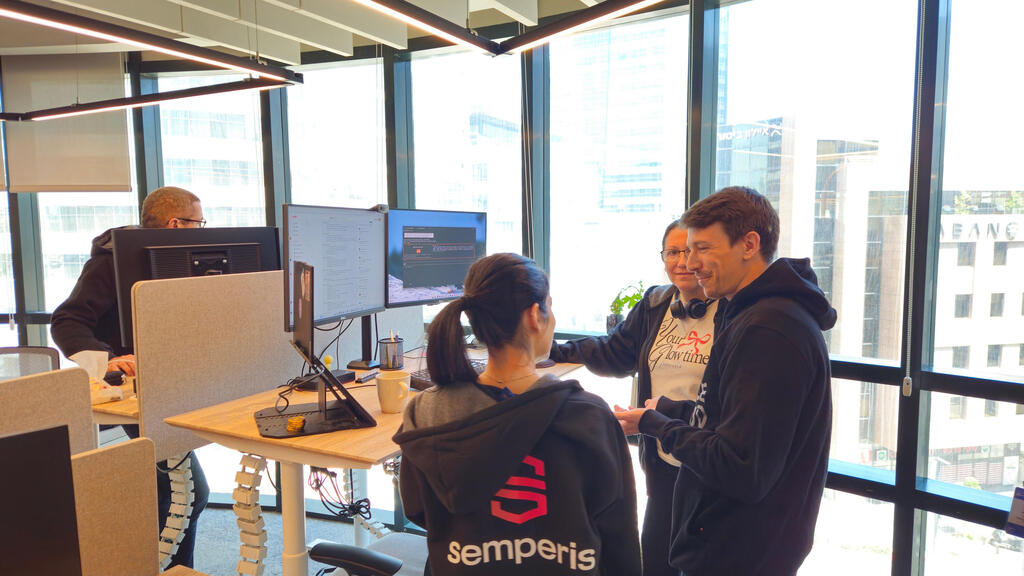
One of the interesting roles growing in organizations is "AI ambassadors," employees from within the team who lead implementation. At the cyber company Semperis, for example, they built an integrated model. "We require people to know the tools, to use them, and we train them to do so," says Matan Liberman, co-founder and director of operations in Israel. "We have a dedicated department for this, people whose focus is managing the implementation and improvement of AI tools within the organization. In large departments, we also have people from within the department itself whose responsibility it is to test additional tools and implement them."
From his perspective, there is no question at all about using AI tools. "Everyone looks at AI as something that comes to replace an employee. We look at it differently. Today, every employee must use the tools we have, and this gives us a very significant jump in productivity and ability to deliver." What makes their process unique is that it is regulated and comes 'from the top.' "The process is first of all to check the need and capabilities of the product. After that, we go to an information security review, an entire team that takes the product, checks where the information is located, authorization systems, whether the information can be deleted, whether it is on-premise, and many other things that we check. As soon as it passes, we first introduce it to the ambassadors who start playing and check the capabilities and value. From there, it goes to most of the people within the departments, who are the consumers of these products," he says.
But the critical step, he says, is the systematic measurement of the performance of AI tools in the organization. "We measure all the systems, how much time it saves, how much we use, and we see that it significantly increases productivity per employee." As an example, he tells of an AI tool developed in the organization, a kind of GPT chat that is connected to the organizational systems and works according to the permissions of each employee. "It gives us the ability to work with internal organizational information in all departments."
In 2023, Harvard Business School Professor Karim Lakhani coined one of the most quoted AI essays: "AI will not replace workers, but an employee who uses AI will replace an employee who does not use AI." Three years later, the updated statement seems to be: AI will not replace workers, it will replace organizations that do not know how to move forward with it.



