










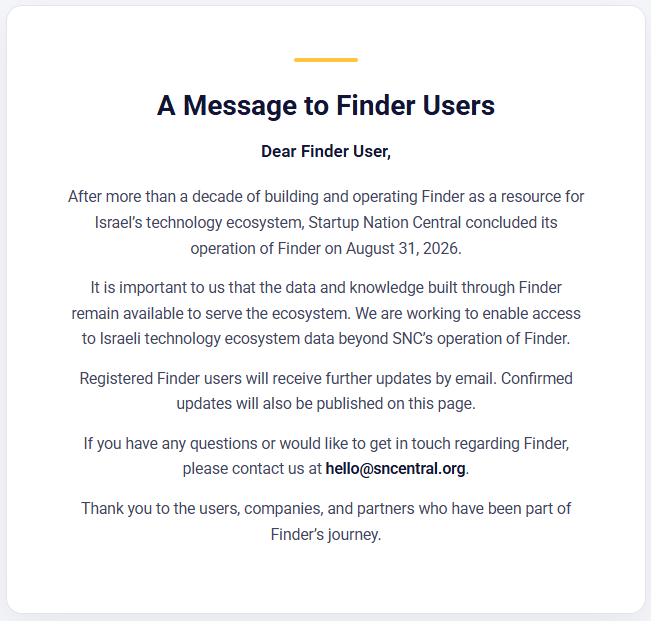
Startup Nation Central shuts down Finder, its flagship database of Israeli tech, and starts looking for a buyer
Interim CEO Aviva Steinberger says the platform was becoming overshadowed by AI search tools. A source close to SNC points to a cost problem too, and says the org quietly tested a paid version before pulling the plug.
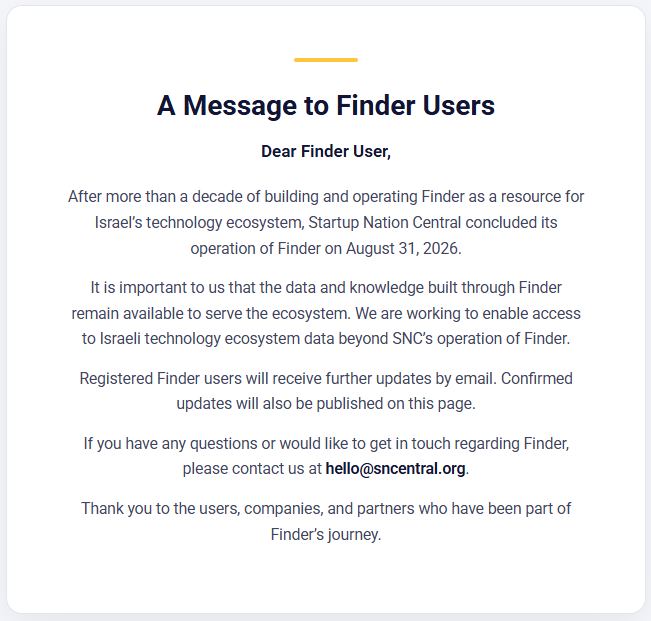
Startup Nation Central took its Finder platform offline on September 1, shutting down a database that for a decade served as the default reference point for anyone trying to map Israel's tech industry. Journalists, VCs, and the startups themselves relied on it. By SNC's own count, Finder drew 200,000 users globally and gave visibility to every company profiled on the platform at some point over its run. Interim CEO Aviva Steinberger told CTech the shutdown wasn't a sudden reaction to anything: SNC knew the September 1 date months in advance, the product of a strategic review that began last year.
Finder wasn't a simple directory. Over 10 years, fully funded by SNC's philanthropic arm, it grew into a full company-mapping tool, with profiles, sector insights, market mappings, and reports layered on top of the raw data. That scope is part of why it was expensive to run, and part of why Steinberger says a smaller, leaner version might still have a future somewhere else.
She explained that the way people search for information has changed in a way that makes the platform less effective than it was even five years ago. "If you or I were to be interested in getting information on anything, your first go-to would be the different AI models that exist," she said, describing how those habits have shown up in the way people look for information on the Israeli ecosystem too, not just in general search behavior.
That's the official story, and it's a real one. But it sits alongside a second, related shift happening inside SNC itself. Over the past year, the organization has been reworking its own model, moving resources toward convening people working on what Steinberger called "the things that are of the utmost national interest for Israel." Finder's future was one part that rework. "We were looking at what the role of SNC's philanthropy in supporting the tech ecosystem today is, versus when the organization was founded 14 years ago."
The timing lines up with a strategic restructuring at SNC, first reported by CTech in February. Running Finder at full scale wasn't cheap. Steinberger put the team at "over 22 people" with a significant budget as of December 2025. A source close to SNC puts the number closer to 25 before cuts began. From January through the shutdown, SNC scaled the team back and automated more of the platform's upkeep, trying to find a leaner version that could survive outside the organization. Either way, it was a heavy staffing commitment for a platform that never charged users anything.
In the months leading up to the shutdown, SNC quietly tested a paid subscription model for Finder, to see whether the platform could sustain itself commercially. The early demand was real: people were willing to pay for access.
SNC hasn't put out a formal RFP. Instead, Steinberger said, the organization has been targeted in its outreach, looking for an institutional partner with "the wherewithal and understanding of what it would mean to maintain this." She's clear that whatever comes next won't look identical to what shut down on September 1. "It's not the same Finder," she said, pointing to interest from both nonprofit and for-profit entities in the underlying data and historical archive, and noting that other players already offer pieces of what Finder used to cover. Whatever form it takes, she wants it to stay a public resource. "It is a national treasure," she said.
For now, the platform sits frozen. The data is preserved as a snapshot from September 1 and isn't being updated. Steinberger said the reaction since the shutdown has come mostly from Israel, where Finder had a particularly visible role in the ecosystem. Outside the country, she said, "very few global voices have been coming forward saying, ‘I'm missing what I needed,’ because there are other opportunities to get that information." She reads the primarily-local response as validation of both Finder's legacy and a case for moving on from it.
Steinberger insists the shift isn't a retreat from SNC's mission, just a different way of pursuing it. "This is very much not about SNC's mission no longer being serving the ecosystem, but rather serving it differently and adapting it to the changing realities that we're all in, both on the technical side and on the geopolitical side," she said. What replaces Finder, and who ends up running it, is still an open question, and one SNC says it's in no rush to force.



