










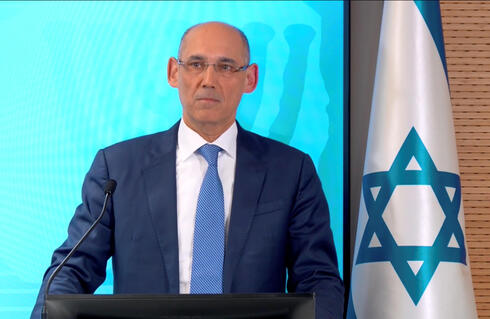
Bank of Israel governor warns higher taxes will be needed to fund Israel's future
Prof. Amir Yaron says Israel's economic recovery remains uneven, warns that growth alone will not solve the country's fiscal challenges, and argues that higher taxes are likely to be needed to finance rising defense spending.
Israel's economy is recovering faster than expected, but Bank of Israel Governor Prof. Amir Yaron warns that the headline numbers tell only part of the story. In an interview with Calcalist, Yaron says much of the recent growth has been driven by a handful of multinational companies, while the broader economy continues to struggle with labor shortages caused by the war. He also cautions that higher taxes will likely be needed to finance permanently higher defense spending, stresses that growth alone will not be enough to reduce the national debt, and warns that undermining the authority of the High Court would damage Israel's economy by weakening regulatory and judicial certainty.
Bank of Israel Governor Prof. Amir Yaron, you have raised your 2026 growth forecast, which is encouraging. At the same time, however, a significant share of that growth appears to be driven by exports from a handful of companies operating in Israel, such as Nvidia. Doesn't that obscure what is happening in the broader economy?
Prof. Yaron: "We addressed this explicitly in both the Monetary Committee's statement and my remarks. In practice, if we look at the rest of the economy, there is a supply constraint resulting from the extensive reserve duty. That constraint has two dimensions. First, there are simply fewer workers available because many have been called up for reserve service. Second, there may be an impact on the productivity of employees returning from reserve duty. These constraints have limited the activity of labor-intensive companies across the economy."
What does that mean for the broader economy and for a return to normal economic conditions?
Prof. Yaron: "We are in a period where the economy begins to recover, then a security incident occurs, and then, as time passes, the supply constraints gradually ease. We have now reached a peak of only 24,000 reservists absent from work due to reserve duty. Some reservists continue working while serving, so this figure refers specifically to those absent from their jobs."
"We are already beginning to see this reflected in the latest data. We will wait for the national accounts, but we hope this will help close the output gap, the difference between the current level of GDP and the level we estimate the economy would have reached had the war not occurred. That gap currently stands at roughly 4%, and we estimate it will be closed by the end of 2027."
But isn't there a risk of being overly encouraged by data that may be somewhat misleading?
Prof. Yaron: "I don't want to suggest that the data are misleading or inaccurate. Some of the income generated by these companies, for example, Nvidia and Mellanox, does remain in Israel. The key issue is avoiding excessive concentration or dependence on a small number of companies."
"I also want to emphasize that we are seeing growth in exports of goods produced in Israel more broadly. It is true that part of this increase comes from defense technology, but it demonstrates that growth is not being driven solely by those companies."
Earlier this week, the government announced that it does not recognize the High Court's ruling regarding the Second Authority Council. In the past, you have emphasized the importance of independent institutions. What are the economic implications of this?
Prof. Yaron: "I repeat: the High Court is the supreme judicial authority, and we must all comply with and act in accordance with its rulings. Failure to do so undermines the foundations of democracy."
"There are those who argue about whether the government's statements were intended literally or not. I will not enter that discussion. What is clear is that the more such conflicts occur, and the more there is non-compliance, the greater the uncertainty surrounding Israel's regulatory framework."
"We know that this harms the economy. I have previously spoken about the importance of independent institutions, and there is extensive empirical and theoretical research demonstrating their contribution to economic performance. Weakening those institutions harms us."
"As for quantifying the economic impact, we are not yet in a position to do so. But non-compliance undermines democracy and damages regulatory and judicial certainty."
The Treasury and the Defense Ministry are still at odds over tens of billions of shekels. As the government's economic adviser, how do you view this dispute?
Prof. Yaron: "There is a certain mixing of short-term and long-term issues. The immediate question concerns the 2026 defense budget, where there is currently a dispute over roughly NIS 40 billion. At the same time, longer-term strategic questions are being folded into that discussion."
"On a fundamental level, we understand that the economy needs security. But security also depends on a strong economy. An organization as large as the defense establishment certainly has room for efficiency improvements, and we should strive to make it as efficient as possible because it accounts for such a significant share of the state budget."
What do you expect will happen this year? The Treasury believes the additional defense allocation will not exceed NIS 15 billion, while the Defense Ministry believes it needs NIS 40 billion. That gap could affect both the deficit and inflation.
Prof. Yaron: "For 2026, much will depend on questions such as the true cost of Operation Roaring Lion and the number of reservists required in Lebanon."
"At the moment, our forecast includes NIS 15 billion of additional defense spending. But if you ask me, there is a fairly high probability that the final figure will exceed that amount."
"In October, there will be another review by the Treasury and the Defense Ministry regarding expenditure, in accordance with the existing budget agreement."
What concerns you most about the continuation of this debate?
Prof. Yaron: "The 2026 budget already looks different from those of 2024 and 2025. Those budgets underwent adjustments, and under certain assumptions we expected the debt-to-GDP ratio to stabilize or decline."
"This year, however, we are not in a scenario where debt-to-GDP is expected to fall, even before accounting for any additional defense spending. Naturally, this also creates greater uncertainty."
But the 2024 and 2025 budgets were reopened several times as well.
Prof. Yaron: "That's true. But even before Operation Roaring Lion, the 2026 budget process began with a target deficit of just over 3%, then increased to 3.9%, and continued rising."
"These repeated upward revisions to the deficit are undesirable. There was a time when policymakers debated spending increases of NIS 1 billion. Today, discussions revolve around tens of billions. That ongoing process is not positive."
Looking further ahead, Prime Minister Netanyahu has spoken about adding NIS 350 billion to defense spending over the coming decade. What is your view?
Prof. Yaron: "That's correct. The Prime Minister has issued that directive. We were not involved in discussions regarding the NIS 350 billion figure."
"We need to examine the evolving threat environment and carefully assess the country's actual defense requirements because these additions will impose a very significant burden over time."
"These are critical decisions for the Israeli economy. The key question is whether the NIS 183 billion requested by the defense establishment for 2026 is a one-time requirement or whether future governments will also face permanently higher defense budgets. If so, our ability to reduce debt and invest in growth engines will be constrained."
You have clearly said that government revenues will need to increase, which effectively means higher taxes. Why?
Prof. Yaron: "We want the national debt to decline because Israel needs fiscal buffers. We entered both the pandemic and the October 7 attacks with a debt-to-GDP ratio of around 60%, which gave us considerable flexibility."
"At the same time, we know with certainty that defense spending will remain higher than it would have been absent October 7, even though each government will have to determine the precise level."
"We also need to increase investment in key growth areas."
Some argue that economic growth alone will generate enough additional revenue.
Prof. Yaron: "Those who claim that growth alone will reduce the debt ratio while simultaneously increasing revenues are essentially arguing that Israel is already beyond the peak of the Laffer Curve."
"Our analysis does not support that conclusion. We are not there. Growth alone will not be sufficient."
But couldn't greater efficiency, spending cuts and integrating more people into the labor force generate higher revenues without raising taxes?
Prof. Yaron: "If policymakers want to reduce the debt, invest in growth engines and increase defense spending, then taxes will ultimately have to rise, even if government spending becomes more efficient, even if labor force participation increases, and even if coalition funds are reduced."
Which taxes should be raised?
Prof. Yaron: "We need a comprehensive review of the tax system rather than piecemeal measures."
"We already know that the tax burden on the highest-income deciles, nine and ten, is relatively high, while the burden on the middle-income groups is lower."
"We need a comprehensive review of the tax system as part of preparing the next state budget."



