











Was the Iran deal real? Inside the Polymarket decision traders are fighting
Users allege decentralized voting system allowed a small group of “whales” to determine a quarter-billion-dollar outcome.
Has a final agreement been signed that ended the war between Israel and the United States and Iran? In light of continued mutual attacks last week and Donald Trump’s statement that “the Islamic Republic will not exist,” the clear answer appears to be no. But according to the prediction market Polymarket, the answer is yes: a permanent agreement to end hostilities was signed on June 15.
The question is whether this claim reflects reality, or whether it is driven by subjective incentives within a betting system that is disconnected from it.
A group of users who lost significant sums on the market argue the latter. They are now challenging Polymarket, claiming the platform has structural flaws in its resolution and dispute mechanisms that allow outcomes to be decided in ways that contradict written rules and, they say, factual reality, enabling profits or losses worth tens of millions of dollars to be redistributed.
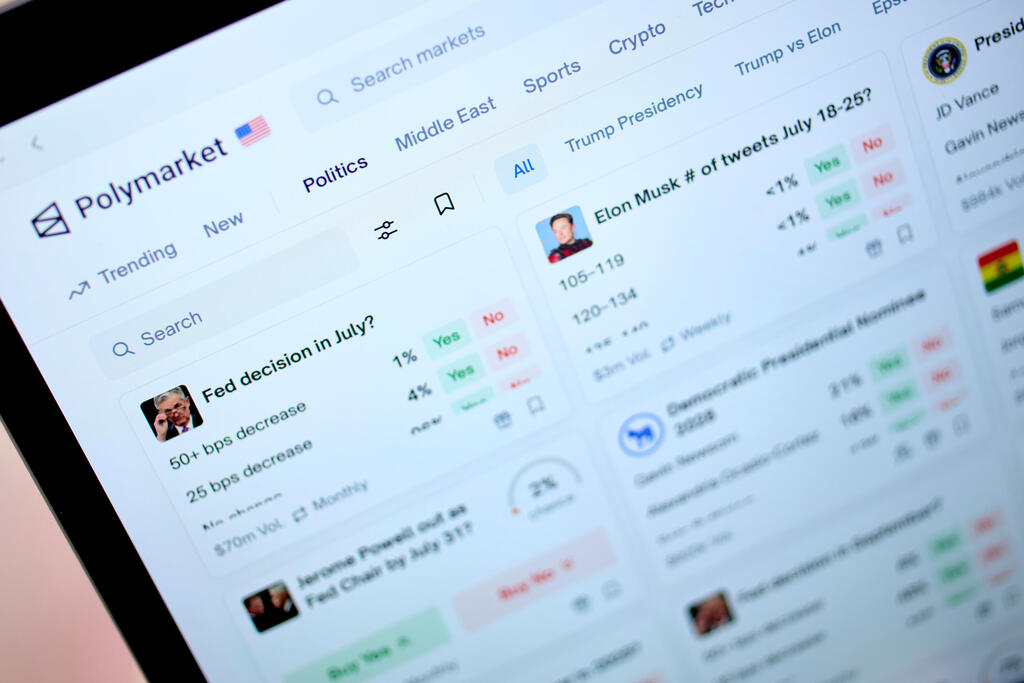
“Users should be aware that investing money on Polymarket entails a real risk that the market outcome will be determined in a way that does not necessarily align with the written rules or factual reality,” said B., who lost 100,000 shekels. “Polymarket ignored repeated requests from users, refused to take responsibility for the controversial decision, and did not provide a fair mechanism to examine the claims raised.”
“I was sure it wouldn’t end like this”
Each bet on Polymarket, referred to on the platform as a “market”, is a binary prediction on whether a defined event will occur. For example: Will Brazil beat Japan in a World Cup match? Yes or no. In sports or award ceremonies, outcomes are typically clear-cut.
But Polymarket also allows bets on geopolitical events, where definitions can be ambiguous. For example: Will traffic in the Strait of Hormuz return to normal by July 31, yes or no?
Although market rules define conditions for a “yes” outcome, interpretation can become disputed. That is the case in the market asking whether the United States and Iran would sign a permanent peace agreement by a specific deadline.
The market saw total trading volume of $478.91 million across multiple deadlines. For example, $24.17 million was staked on whether such an agreement would be signed by April 30.
On June 14, Iran and the United States signed a memorandum of understanding aimed at ending military operations. This is where the dispute begins, whether such an agreement qualifies as “permanent” under the market definition.
“I was following developments closely to see whether any agreement had been signed,” B. told Calcalist. “I knew something would be signed, but I also knew a permanent peace agreement could not happen before the nuclear issue was resolved. When reports appeared that a peace agreement had been signed, the market shifted sharply toward ‘yes’. At that point I could have exited with a loss of 80%, but I believed strongly that a permanent agreement was not possible.”
Related articles:
He added that he and others had already raised concerns before resolution that the June 15 market might be closed as “Yes, a permanent agreement has been signed,” but assumed Polymarket would not rule that way at the final stage.
Where the dispute begins
The core dispute is whether the memorandum of understanding between Iran and the United States meets Polymarket’s definition of a permanent peace agreement. According to the rules, a permanent agreement must include a mutual commitment to a lasting cessation of hostilities, while explicitly temporary agreements are excluded.
The agreement does state an “immediate and permanent end to military operations,” but also includes language indicating a transitional phase, including a commitment to negotiate a final agreement within 60 days. That dual wording has created disagreement over whether any of the related markets, worth roughly $260 million, should resolve as “yes.”
However, the June 15 market ($177.37 million) appears more clear-cut. Its rules state that resolution would occur only after an official signing or unequivocal public confirmation by both governments, excluding statements of intent or progress.
According to critics, no such formal signing occurred by the deadline. They argue that the agreement was only formally signed on June 17, when Trump appeared to sign alongside French President Emmanuel Macron.
“The agreement needs to be in writing,” said Omer Agniyahu, who lost about $2,300. “No signed document was published on that date. Iran also said it would sign only on the 17th. Before the deadline, they referred to a 60-day extension to negotiate a final ceasefire, not a permanent one. The conditions for resolution were not met.”
The dispute-resolution mechanism
When a resolution is challenged, Polymarket refers the case to UMA, a decentralized crypto-based arbitration system. Token holders vote on outcomes over a 48-72 hour period, with voting power determined by the number of tokens staked.
In practice, the outcome is decided by weighted token holdings rather than individual voters.
In this case, the vote ultimately resolved in favor of “yes,” confirming the market outcome as a permanent agreement.
Critics argue the system is vulnerable to concentration of power. According to Agniyahu’s analysis, a small number of large holders (“whales”) controlled a disproportionate share of voting power, with the largest controlling 16.7%, the top five controlling 41.7%, and the top seven controlling 50.3%ת all reportedly voting “yes.”
“This means a vote involving roughly a quarter of a billion dollars was effectively decided by seven participants,” he said.
Another concern raised is potential conflicts of interest: some wallets that voted in UMA also appear to have held positions in the Polymarket market itself.
“We contacted Polymarket repeatedly and received no response,” said B. “We intend to pursue legal avenues.”
Polymarket did not respond to a request for comment.
First published: 12:16, 06.07.26



