










The hidden copyright risk inside AI-generated content
Israel’s legal draft suggests users, not just companies, could face liability.
Have you posted an AI-generated meme video on TikTok? You could be exposed to tens of thousands of shekels in copyright damages.
A draft precedent-setting opinion being prepared by the Office of the Attorney General warns that publishing photos, videos, or other AI-generated content could constitute copyright infringement, particularly if the outputs are similar to protected works on which the underlying models were trained. Although the opinion is intended primarily for government agencies, its legal conclusions are relevant to all users of AI tools.
1 View gallery
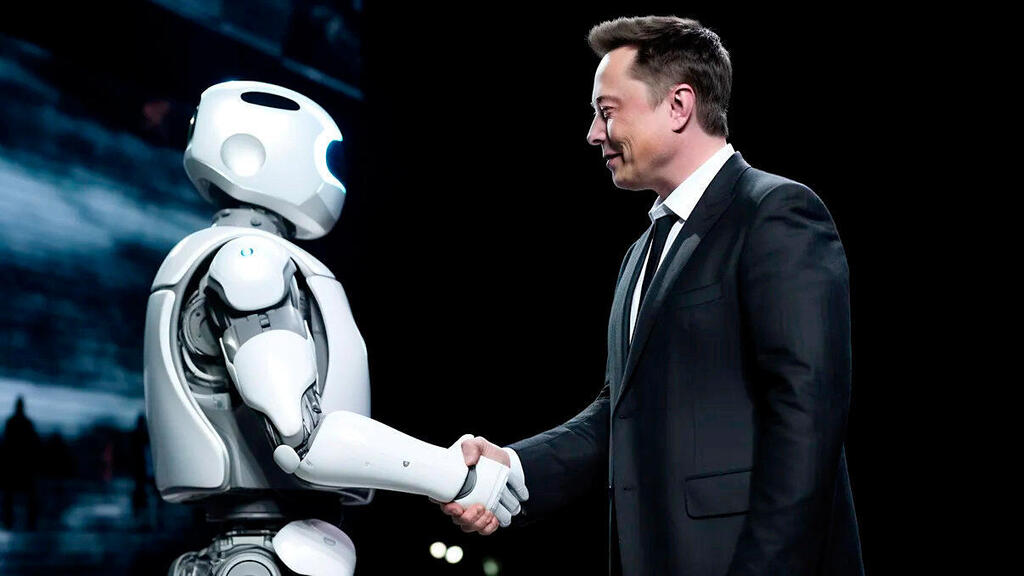
An image created with the help of AI – Elon Musk shaking hands with a robot.
(Midjourney prompted by The Decoder)
“AI tools are here to stay and their use is widespread, but it is important to ensure protection of copyrights and to make informed use,” said Attorney Carmit Yulis, Deputy Attorney General for Civil Law, at a conference held at Tel Aviv University last week. “The opinion is aimed at civil servants who want to use creative artificial intelligence, but we are learning that the market wants to hold on to a legal document that will serve as a ‘guide for the perplexed’ in this field.”
One of the most common uses of chatbots such as OpenAI’s ChatGPT or Google’s Gemini is generating images, videos, or music for a wide range of purposes, from social media posts and presentations to artistic or entertainment content.
In general, the large AI models are trained on vast datasets containing a wide variety of works, many of which are protected by copyright. This has already led to high-profile lawsuits filed by writers, artists, Hollywood studios, music companies, and media organizations against AI developers over alleged unauthorized use of copyrighted material in training datasets.
However, according to the Attorney General’s draft opinion, even ordinary users who publish AI-generated content may be exposed to copyright claims, even in cases where they created the content themselves using prompts.
“When it comes to products created on the basis of an independent prompt, there is a risk that they will resemble works protected by third-party copyright, particularly works on which the system was trained, which may amount to copyright infringement,” the opinion states. It was written by Ayelet Feldman, Howard Poliner, and Hodaya Gaheli-Schwartz from the Civil Department of the Attorney General’s Office.
“In other words, the new product may be considered a copy of a substantial part of a protected work, or a derivative work, that is, a work substantially based on another work.” Publishing such works without the consent of the original copyright holder constitutes a violation of copyright law and may expose the publisher to civil lawsuits and damages that could reach tens of thousands of shekels.
In this sense, the legal situation is not fundamentally different from the use of “traditional” copyrighted works, such as posting a photograph online without the photographer’s consent. However, AI-generated content introduces an additional practical complication: it may be difficult to assess the degree of similarity to original works or determine the rights status, making it challenging to conclude whether publication infringes copyright. As a result, users may not always be able to determine whether publishing AI-generated content is legally permissible.
An important exception to copyright protection is fair use, which allows the use of protected works under certain conditions without the owner’s consent. In such cases, the application of fair use to AI-generated content is not fundamentally different from traditional works.
For example, courts consider the nature of the use, whether it is commercial, whether it serves socially important purposes such as criticism, or whether it is transformative, meaning it creates a fundamentally different work.
“This test is not affected by the fact that the content is produced by AI,” the report states. “However, not every use of AI-generated output based on protected works qualifies as transformative use.”
Another key factor is the degree of similarity between the new work and the original work, whether it is a full copy, a copy of the “heart” of the work, or only a marginal similarity.
“Artificial intelligence creates new texts and images, while the original works serve as the basis for training the model,” the opinion explains. “However, it is not always known whether the AI-generated output includes protected parts of other works, or what their scope may be.”
To address this, the opinion suggests conducting preliminary checks to ensure the output does not infringe copyright and documenting the prompt used. Where possible, users are encouraged to ask systems about sources of inspiration and to compare outputs against existing works using internet searches or specialized tools.
Another relevant concept is “orphan works,” works whose rights holders are unknown or cannot be located after reasonable effort. In the context of AI-generated content, where training sources are often unclear, similar principles may apply.
As part of the duty of reasonable diligence, the opinion recommends attempting to identify potential rights holders where possible. If the AI system does not disclose its training sources, users are advised to make reasonable inquiries through the system itself and, in the case of images, conduct online searches or use dedicated tools.
The opinion outlines two main strategies for organizations seeking to reduce copyright risk.
The first is to use AI systems whose terms of use explicitly address intellectual property rights. This approach is particularly relevant for government agencies using AI tools through national procurement frameworks such as Israel’s Nimbus project.
For private organizations, the recommendation is to use systems and repositories that provide clear legal assurances, such as training only on public domain or licensed datasets, or that offer indemnification in the event of legal claims arising from use.



